

100% Pass Your P_SAPEA_2023 Exam Dumps at First Attempt with ExamDumpsVCE
Penetration testers simulate P_SAPEA_2023 exam PDF
NEW QUESTION # 28
Which runtime environments does SAP directly support an SAP BTP?
- A. Kubemetes/SAP Business Technology Platform (BTP), ABAP environment
- B. SAP BTP, Cloud Foundry environment/SAP Business Technology Platform (BTP), ABAP environment/SAP BTP, Kyma runtime
- C. OpenJDK for Java applications/Openshift for Kubernetes
Answer: B
Explanation:
SAP Business Technology Platform (BTP) is a suite of cloud-based platform-as-a-service (PaaS) offerings from SAP. BTP provides a variety of runtime environments for running applications, including:
SAP BTP, Cloud Foundry environment: This is a popular runtime environment for running Java, Node.js, and Python applications.
SAP Business Technology Platform (BTP), ABAP environment: This is a runtime environment for running ABAP applications.
SAP BTP, Kyma runtime: This is a runtime environment for running Kubernetes-based applications.
In addition to these runtime environments, BTP also provides a number of other services, such as:
Database services: BTP provides a variety of database services, including SAP HANA, MySQL, and PostgreSQL.
Messaging services: BTP provides a variety of messaging services, such as SAP Cloud Platform Integration and SAP Cloud Platform Event Mesh.
Storage services: BTP provides a variety of storage services, such as SAP Cloud Platform Object Storage and SAP Cloud Platform File Storage.
BTP is a comprehensive platform that provides a variety of services for running applications and managing data. The different runtime environments available in BTP allow you to choose the right environment for your specific needs.
SAP BTP supports multiple runtime environments for different purposes and skill sets. A runtime environment is any runtime that hosts applications and services. An SAP BTP environment provides integration into the SAP BTP account model, cockpit, and permissions management10. The following are the runtime environments that SAP directly supports on SAP BTP:
SAP BTP, Cloud Foundry environment: This environment allows you to create polyglot cloud applications in Cloud Foundry. It supports various programming languages, such as Java, Node.js, Python, Go, and PHP. It also provides a code-to-container packaging and deployment model, platform-managed application security patching and updates, automatic application routing, load balancing, health checks, and multilevel self-healing. It also supports the Cloud Application Programming Model (CAP), which is an opinionated framework for developing business applications.
SAP Business Technology Platform (BTP), ABAP environment: This environment allows you to create ABAP-based cloud applications within the Cloud Foundry environment. It supports the ABAP programming language and the ABAP RESTful Programming Model (RAP), which is a framework for developing RESTful services and user interfaces. It also provides an integrated development lifecycle and enables you to reuse existing on-premise ABAP assets.
SAP BTP, Kyma runtime: This environment provides a fully managed cloud-native Kubernetes application runtime based on the open-source project "Kyma". It supports various programming languages and models, such as Node.js, Python, Go, Java, CAP, and serverless functions. It also provides a built-in service mesh, eventing framework, API gateway, service catalog, and service binding capabilities. It enables you to develop highly scalable, microservice-based applications and user-centric process extensions.
Verified : 10: https://help.sap.com/docs/btp/architecture-and-development-guide-for-industry-cloud-solutions/runtimes-environments-and-programming-models | : https://help.sap.com/docs/btp/sap-business-technology-platform/environments
NEW QUESTION # 29
Green Elk & Company is the world's leading manufacturer of agricultural and forestry machinery. The former company slogan "Elk always runs has recently been changed to "Elk feeds the world" One of Green Elk's strategic goals is to increase its revenue in the emerging markets of China, India, and other parts of Asia by 80 % within three years. This requires a new business model that caters to significantly smaller farms with limited budgets. You are the Chief Enterprise Architect and the CIO asked you to conduct interviews with the key stakeholders of Green Elk to assess the business strategy. You are planning to interview the owner of the business unit of finished goods. Which of the following sets of questions would you ask?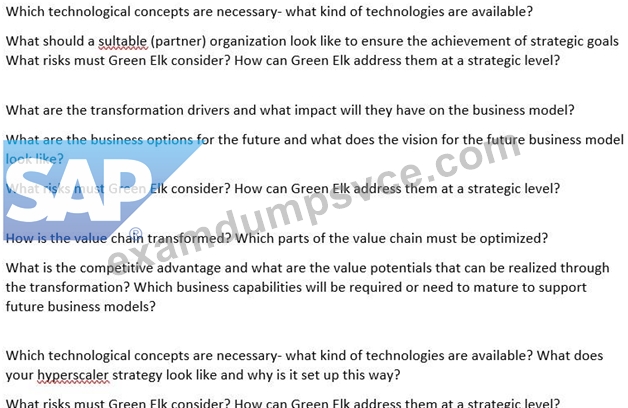
- A. Which technological concepts are necessary- what kind of technologies are available? What does your hyperscaler strategy look like and why is it set up this way? What risks must Green Elk consider? How can Green Elk address them at a strategic level?
- B. How is the value chain transformed? Which parts of the value chain must be optimized?What is the competitive advantage and what are the value potentials that can be realized through the transformation? Which business capabilities will be required or need to mature to support future business models?
- C. What are the transformation drivers and what impact will they have on the business model?What are the business options for the future and what does the vision for the future business model look like?What risks must Green Elk consider? How can Green Elk address them at a strategic level?
- D. Which technological concepts are necessary- what kind of technologies are available? What should a sultable (partner) organization look like to ensure the achievement of strategic goals What risks must Green Elk consider? How can Green Elk address them at a strategic level?
Answer: B
Explanation:
In the context of Green Elk & Company's strategic goal to expand in emerging markets, the most pertinent set of questions to ask the owner of the business unit of finished goods would focus on the transformation of the value chain and the competitive advantages that can be leveraged. Therefore, the best set of questions is represented by option C:
How is the value chain transformed? This question aims to understand the changes required in the current value chain to support the new business model targeting smaller farms with limited budgets. It's essential to identify which processes and interactions need to be adapted or redefined to meet the needs of the emerging markets.
Which parts of the value chain must be optimized? Optimization efforts should be directed towards the most impactful areas of the value chain that can drive efficiency, reduce costs, and improve service delivery in the context of the new markets.
What is the competitive advantage and what are the value potentials that can be realized through the transformation? Understanding the unique strengths of Green Elk & Company and how they can be harnessed to create value in the new business environment is crucial for the success of the expansion strategy.
Which business capabilities will be required or need to mature to support future business models? The company must assess its current capabilities and determine which ones need to be developed or enhanced to support the strategic goals effectively.
These questions are designed to elicit information that will help in crafting a business strategy that is aligned with the company's vision of feeding the world and achieving significant revenue growth in the targeted emerging markets.
Reference:
SAP. (n.d.). SAP Enterprise Architecture Framework. SAP Community.
The Open Group. (2018). TOGAF Version 9.2: Enterprise Architecture Framework.
Porter, M.E. (1985). Competitive Advantage: Creating and Sustaining Superior Performance. Free Press.
NEW QUESTION # 30
Which integration styles does SAP's Integration Advisory Methodology (ISA-M) cover in general?
- A. Cloud2Cloud/Cloud2OnPremise/Cloud2Cloud/User2On Premise/User2Cloud/Thing2On Premise/Thing2Cloud
- B. Process Integration/Data Integration/Analytics Integration/User Integration/Thing Integration.
- C. Ul Integration/Process Integration/Data Integration/Thing Integration.
Answer: B
Explanation:
The Integration Advisory Methodology (ISA-M) is a framework that helps organizations to design, build, and manage their integration landscape. ISA-M covers a wide range of integration styles, including:
Process Integration: This style of integration involves the integration of business processes across different systems and applications.
Data Integration: This style of integration involves the integration of data from different sources into a single data repository.
Analytics Integration: This style of integration involves the integration of data from different sources for the purpose of analytics.
User Integration: This style of integration involves the integration of user interfaces from different systems and applications.
Thing Integration: This style of integration involves the integration of things, such as sensors and actuators, with other systems and applications.
ISA-M also includes a number of other integration styles, such as event-driven integration, service-oriented integration, and enterprise application integration.
By covering a wide range of integration styles, ISA-M provides organizations with a flexible framework that can be used to meet their specific integration needs.
SAP's Integration Solution Advisory Methodology (ISA-M) is a framework that helps enterprise architects to define and execute an integration strategy for their organization. ISA-M covers five integration styles that represent different aspects of integration in a hybrid landscape. These integration styles are3:
Process Integration: This integration style enables end-to-end business processes across different applications and systems, such as SAP S/4HANA, SAP SuccessFactors, or third-party solutions. Process integration typically involves orchestrating or choreographing multiple services or APIs to achieve a business outcome.
Data Integration: This integration style enables data exchange and synchronization between different data sources and targets, such as SAP HANA, SAP Data Warehouse Cloud, or third-party databases. Data integration typically involves extracting, transforming, and loading (ETL) data to support analytical or operational scenarios.
Analytics Integration: This integration style enables data visualization and exploration across different data sources and targets, such as SAP Analytics Cloud, SAP BusinessObjects BI Platform, or third-party tools. Analytics integration typically involves creating dashboards, reports, or stories to provide insights and recommendations for decision making.
User Integration: This integration style enables user interaction and collaboration across different applications and systems, such as SAP Fiori Launchpad, SAP Jam, or third-party portals. User integration typically involves creating consistent and seamless user experiences that integrate multiple UI technologies and frameworks.
Thing Integration: This integration style enables device connectivity and management across different applications and systems, such as SAP IoT, SAP Edge Services, or third-party platforms. Thing integration typically involves connecting physical devices or sensors to the cloud or the edge and enabling data ingestion, processing, and action.
Verified Reference: 3: https://help.sap.com/docs/btp/architecture-and-development-guide-for-industry-cloud-solutions/runtimes-environments-and-programming-models
NEW QUESTION # 31
As an Enterprise Architect, you must ensure that future extensions to the Digital Core of the enterprise guarantee stable and reliable operations. The architecture guideline demands to follow the clean-core strategy. What does this demand ensure and entail?
- A. Extensions are kept strictly separate from the SAP application, Extensions are developed in accordance with the SAP Application Extension Methodology. Side-by-side extensibility options are always preferable to on-stack extensibility options.
- B. Extensions do not break an upgrade, and upgrades do not break an extension. Such extensions can access SAP business objects only through well defined, upgrade-stable interfaces.
- C. Extensions may access SAP tables directly and in a well-documented, clean way. Therefore, the code of extensions can be adapted quickly to accommodate future changes.
Answer: B
Explanation:
The clean-core strategy is fundamental to ensuring that the Digital Core remains stable and reliable during operations and future upgrades. By following this strategy, any extensions made are guaranteed not to affect the core system upgrades, and likewise, system upgrades will not disrupt the functionality of the extensions. This is achieved by using well-defined and stable interfaces for extensions to interact with SAP business objects, ensuring compatibility and stability across system updates.
= The SAP architecture guidelines which prescribe maintaining a clean core, detailing how to develop extensions that are compatible with SAP's upgrade strategy and protect the integrity of the core system.
NEW QUESTION # 32
Which of the following lists of SAP Enterprise Architecture artifacts support making informed Target Application Architecture decisions that are aligned with the strategic direction of a company?
- A. Solution Context/Solution Concept/Stakeholder Map/Baseline Business and Solution Architecture
- B. Stakeholder Map/Business Strategy Map/Solution Strategy/Architecture Roadmap
- C. Principles Standards, Guidelines/Solution Context/Baseline Business and Solution Architecture
Answer: B
Explanation:
To make informed decisions about the Target Application Architecture that are aligned with the strategic direction of a company, certain artifacts are necessary to ensure that there is a clear connection between the stakeholder needs, business strategy, and the architectural vision. Option A includes a Stakeholder Map, which identifies the key players and their interests; a Business Strategy Map, which outlines the strategic objectives; a Solution Strategy, which details the approach to achieve the objectives through solutions; and an Architecture Roadmap, which lays out the plan to move from the current to the future state. These artifacts together provide a comprehensive view that guides the Target Application Architecture towards aligning with the company's strategic direction.
Reference:
Enterprise Architecture frameworks and methodologies that outline the use of strategic artifacts in architecture development.
Guidelines on creating architecture roadmaps that align with business strategies.
NEW QUESTION # 33
As the Chief Enterprise Architect of Wanderlust GmbH, you know that there is very little process documentation available on online marketing processes within Wanderlust. You also know that SAP has a rich End-to-End (E2E) Business Processes content repository. To take advantage of that, you have engaged an SAP Enterprise Architect. The SAP Enterprise Architect is using SAP's Business Process Model (BPM) and the Business Capability Model (BCM) while mapping processes to capabilities, how are the two models connected? Note: There are 2 correct answers to this question.
- A. Through the E2E Business Process of BPM, which is enabled by the Business Domain of BCM.
- B. Through the Business Activity of BPM, which is enabled by the Business Capability of BCM.
- C. Through the Enterprise Domain, to which both the E2E Business Process of BPM and the Business Domain of BCM are assigned.
- D. Through the Business Process Module of BPM, which is directly linked to the Business Area of BCM.
Answer: A,B
Explanation:
The connection between SAP's Business Process Model (BPM) and the Business Capability Model (BCM) lies in how the end-to-end business processes are enabled by the business domains and capabilities outlined in the BCM. Each business activity in the BPM is supported by one or more business capabilities from the BCM. This linkage ensures that the company's capabilities are directly tied to the business activities and processes, providing a clear line of sight from high-level business strategy down to operational execution.
Reference = This connection is standard in enterprise architecture where processes are designed to be supported by capabilities, ensuring that capabilities provide the necessary functions to execute the processes effectively.
NEW QUESTION # 34
What kind of applications can you develop with SAP Business Application Studio?
- A. SAPUI5 (SAP Fiori) applications
- B. SAPUI5 (SAP Fiori) applications and ABAP applications
- C. ABAP applications
Answer: B
Explanation:
Explanation
SAP Business Application Studio is a cloud-based development environment that can be used to develop SAPUI5 (SAP Fiori) applications and ABAP applications. It provides a wide range of features and tools that can help developers to create high-quality applications quickly and easily.
SAPUI5 applications are web-based applications that are built using the SAPUI5 framework. They are typically used to provide users with a modern and user-friendly interface to SAP applications.
ABAP applications are traditional SAP applications that are written in the ABAP programming language.
They are typically used to implement business logic and to interact with SAP data.
SAP Business Application Studio also provides support for other types of applications, such as Node.js applications and Python applications. However, it is most commonly used to develop SAPUI5 and ABAP applications.
Here are some of the features and tools that are available in SAP Business Application Studio:
A code editor with syntax highlighting and code completion.
A debugger that allows developers to step through code and debug errors.
A test runner that allows developers to run unit tests and integration tests.
A deployment manager that allows developers to deploy applications to SAP Cloud Platform.
A library of pre-built components that can be used to speed up development.
SAP Business Application Studio is a powerful development environment that can be used to create a wide range of applications. It is a good choice for developers who want to create SAPUI5 and ABAP applications.
NEW QUESTION # 35
Which of the following roles are missing from Wanderlust's current Enterprise Architecture practice structure? Note: There are 2 correct answers to this question.
- A. Application Architect
- B. Data Architect
- C. Architecture Board
- D. Business Architect
Answer: A,D
Explanation:
From the current Enterprise Architecture practice structure presented for Wanderlust GmbH, it appears that there are dedicated roles for a Chief Enterprise Architect and a Technology Architect. However, the roles of Application Architect and Business Architect are not explicitly mentioned. An Application Architect is crucial for designing and maintaining the application landscape, ensuring that it aligns with business requirements, while a Business Architect is essential for aligning IT strategy with business strategy and understanding the impact of business changes on the architecture. Their absence indicates a gap in ensuring the alignment between business processes and IT systems, as well as in defining and maintaining the application strategy.
Reference = The roles and responsibilities within an Enterprise Architecture framework typically include both Application and Business Architects to ensure a comprehensive approach to aligning IT and business strategies.
NEW QUESTION # 36
Which of the following lists of SAP Enterprise Architecture artifacts support making informed Target Application Architecture decisions that are aligned with the strategic direction of a company?
- A. Solution Context/Solution Concept/Stakeholder Map/Baseline Business and Solution Architecture
- B. Stakeholder Map/Business Strategy Map/Solution Strategy/Architecture Roadmap
- C. Principles Standards, Guidelines/Solution Context/Baseline Business and Solution Architecture
Answer: B
Explanation:
To make informed decisions about the Target Application Architecture that are aligned with the strategic direction of a company, certain artifacts are necessary to ensure that there is a clear connection between the stakeholder needs, business strategy, and the architectural vision. Option A includes a Stakeholder Map, which identifies the key players and their interests; a Business Strategy Map, which outlines the strategic objectives; a Solution Strategy, which details the approach to achieve the objectives through solutions; and an Architecture Roadmap, which lays out the plan to move from the current to the future state. These artifacts together provide a comprehensive view that guides the Target Application Architecture towards aligning with the company's strategic direction.
:
Enterprise Architecture frameworks and methodologies that outline the use of strategic artifacts in architecture development.
Guidelines on creating architecture roadmaps that align with business strategies.
NEW QUESTION # 37
Which integration styles does SAP's Integration Advisory Methodology (ISA-M) cover in general?
- A. Ul Integration/Process Integration/Data Integration/Thing Integration.
- B. Cloud2Cloud/Cloud2OnPremise/Cloud2Cloud/User2On Premise/User2Cloud/Thing2On Premise/Thing2Cloud
- C. Process Integration/Data Integration/Analytics Integration/User Integration/Thing Integration.
Answer: A
Explanation:
The Integration Advisory Methodology (ISA-M) is a framework that helps organizations to design, build, and manage their integration landscape. ISA-M covers a wide range of integration styles, including:
Process Integration: This style of integration involves the integration of business processes across different systems and applications.
Data Integration: This style of integration involves the integration of data from different sources into a single data repository.
Analytics Integration: This style of integration involves the integration of data from different sources for the purpose of analytics.
User Integration: This style of integration involves the integration of user interfaces from different systems and applications.
Thing Integration: This style of integration involves the integration of things, such as sensors and actuators, with other systems and applications.
ISA-M also includes a number of other integration styles, such as event-driven integration, service-oriented integration, and enterprise application integration.
By covering a wide range of integration styles, ISA-M provides organizations with a flexible framework that can be used to meet their specific integration needs.
SAP's Integration Solution Advisory Methodology (ISA-M) is a framework that helps enterprise architects to define and execute an integration strategy for their organization. ISA-M covers five integration styles that represent different aspects of integration in a hybrid landscape. These integration styles are3:
Process Integration: This integration style enables end-to-end business processes across different applications and systems, such as SAP S/4HANA, SAP SuccessFactors, or third-party solutions. Process integration typically involves orchestrating or choreographing multiple services or APIs to achieve a business outcome.
Data Integration: This integration style enables data exchange and synchronization between different data sources and targets, such as SAP HANA, SAP Data Warehouse Cloud, or third-party databases. Data integration typically involves extracting, transforming, and loading (ETL) data to support analytical or operational scenarios.
Analytics Integration: This integration style enables data visualization and exploration across different data sources and targets, such as SAP Analytics Cloud, SAP BusinessObjects BI Platform, or third-party tools. Analytics integration typically involves creating dashboards, reports, or stories to provide insights and recommendations for decision making.
User Integration: This integration style enables user interaction and collaboration across different applications and systems, such as SAP Fiori Launchpad, SAP Jam, or third-party portals. User integration typically involves creating consistent and seamless user experiences that integrate multiple UI technologies and frameworks.
Thing Integration: This integration style enables device connectivity and management across different applications and systems, such as SAP IoT, SAP Edge Services, or third-party platforms. Thing integration typically involves connecting physical devices or sensors to the cloud or the edge and enabling data ingestion, processing, and action.
Verified Reference: 3: https://help.sap.com/docs/btp/architecture-and-development-guide-for-industry-cloud-solutions/runtimes-environments-and-programming-models
NEW QUESTION # 38
What are important factors of the SAP BTP. Cloud Foundry environment during runtime that you need to consider?
- A. Number of users and API calls
- B. Programming language and buildpacks
- C. CPU capacity and memory size of the application
Answer: C
Explanation:
Explanation
The CPU capacity and memory size of the application are important factors that affect the performance and scalability of the application in the SAP BTP. Cloud Foundry environment during runtime. These factors determine how many instances of the application can run in parallel and how much workload they can handle.
Verified References: :
https://help.sap.com/viewer/65de2977205c403bbc107264b8eccf4b/Cloud/en-US/350356d1dc314d3199dca15bd2
NEW QUESTION # 39
Green Elk & Company is the world's leading manufacturer of agricultural and forestry machinery. The former company slogan "Elk always runs" has recently been changed to "Elk feeds the world" One of Green Elk's strategic goals is to increase its revenue in the emerging markets of China, India and other parts of Asia by 80 % within three years. This requires a new business model that caters to significantly smaller farms with limited budgets The CIO asks you, the Chief Enterprise Architect, to present an architecture vision to address the aforementioned business challenge. According to the SAP Enterprise Architecture Framework, what is the best approach?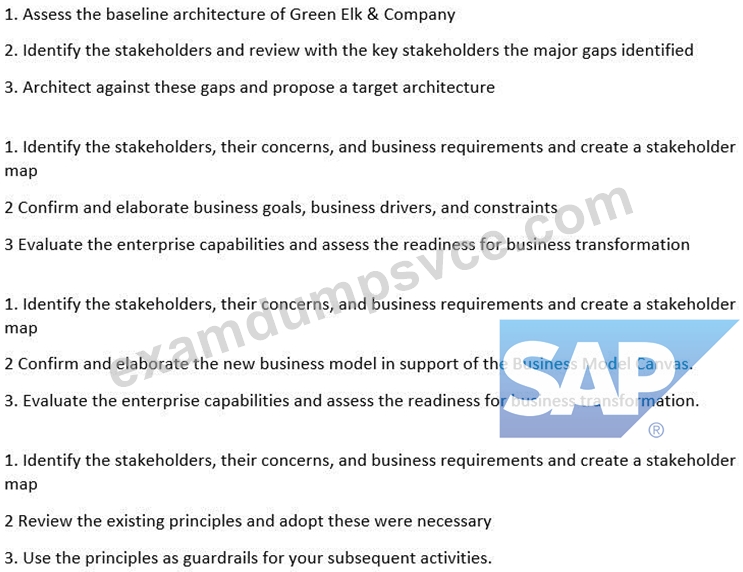
- A. 1. Identify the stakeholders, their concerns, and business requirements and create a stakeholder map/2 Confirm and elaborate business goals, business drivers, and constraints/3 Evaluate the enterprise capabilities and assess the readiness for business transformation
- B. 1. Identify the stakeholders, their concerns, and business requirements and create a stakeholder map/2 Confirm and elaborate the new business model in support of the Business Model Canvas./3. Evaluate the enterprise capabilities and assess the readiness for business transformation.
- C. 1. Assess the baseline architecture of Green Elk & Company/2. Identify the stakeholders and review with the key stakeholders the major gaps identified/3. Architect against these gaps and propose a target architecture.
- D. 1. Identify the stakeholders, their concerns, and business requirements and create a stakeholder map.2 Review the existing principles and adopt these were necessary3. Use the principles as guardrails for your subsequent activities.
Answer: A
Explanation:
According to the SAP Enterprise Architecture Framework, the best approach to addressing a business challenge through an architecture vision would be:
Identify the stakeholders, their concerns, and business requirements to create a comprehensive stakeholder map. This step is crucial to ensure that the architecture will address the needs of all parties involved.
Confirm and elaborate on business goals, business drivers, and constraints to clearly understand the objectives and limitations that the architecture must operate within.
Evaluate the enterprise capabilities and assess the readiness for business transformation to determine if the organization has the necessary resources, processes, and technology to support the new business model and achieve the strategic goals.
This method ensures that the architecture vision is aligned with the business strategy, that stakeholder needs are adequately addressed, and that the company is prepared for the changes that will come with the new business model.
= These steps are foundational to the SAP Enterprise Architecture Framework process and are detailed in SAP's EA documentation, particularly in the sections concerning the development of an architecture vision aligned with business strategy.
NEW QUESTION # 40
Tho Wanderlust CIO wants to focus loss on marketing strategy and planning, to instead prioritize marketing implement goals in mind to enhance number of leads generated:
* Run effective and highly visible campaigns (for example. on social media)
* Increase cross selling opportunities through online recommendation
AS the Chief Enterprise Architect Of Wanderlust. assisted by the SAP Enterprise Architects, you have been trying to re goals with the Business Process Modules, Segments and Activities in the Lead to Cash B2C Business Process Varia Business Architecture content repository (see graphic below).
What are relevant combinations Of business activities and goals based on the graphic below?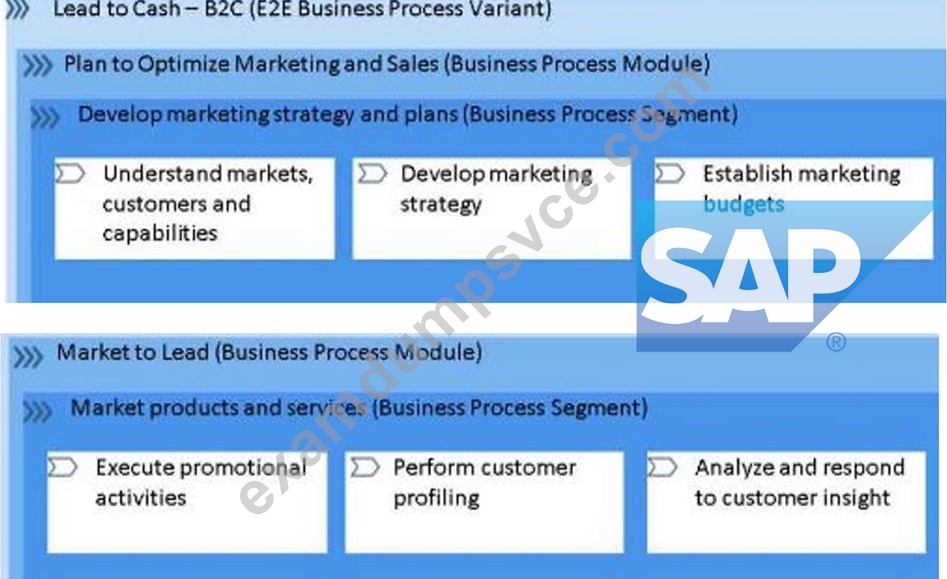
Note: There are 2 correct answers to this question.
See the Image
- A. Implement promotional activities-Run effective and high visibility campaigns.
- B. Design and mange a customer loyalty program- increase cross selling opportunities through online recommendations.
- C. Develop market strategy -Run effective and high visibility campaigns.
- D. Analyse and respond to customer insight- increase cross selling opportunities through online recommendations.
Answer: A,D
Explanation:
The business activities 'Analyze and respond to customer insight' and 'Implement promotional activities' directly relate to the CIO's goals of increasing cross-selling opportunities through online recommendations and running highly visible campaigns. Analyzing customer insights can provide data that enhances recommendation engines, leading to effective cross-selling. Implementing promotional activities, particularly in high-visibility platforms like social media, is key to driving campaign effectiveness.
= These relationships between business activities and goals would be informed by best practices in online marketing strategies, as documented within the Lead to Cash - B2C Business Process Variant.
NEW QUESTION # 41
Tho Wanderlust CIO wants to focus loss on marketing strategy and planning, to instead prioritize marketing implement goals in mind to enhance number of leads generated:
* Run effective and highly visible campaigns (for example. on social media)
* Increase cross selling opportunities through online recommendation
AS the Chief Enterprise Architect Of Wanderlust. assisted by the SAP Enterprise Architects, you have been trying to re goals with the Business Process Modules, Segments and Activities in the Lead to Cash B2C Business Process Varia Business Architecture content repository (see graphic below).
What are relevant combinations Of business activities and goals based on the graphic below?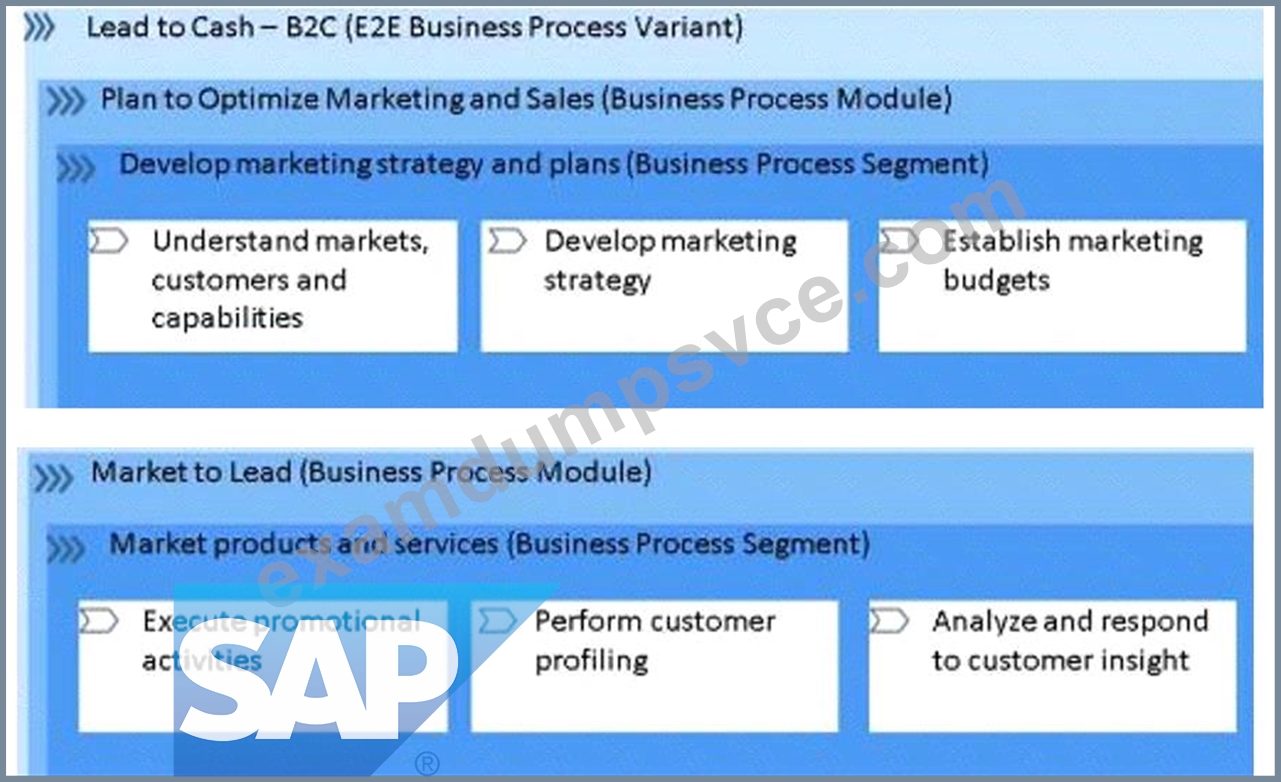
Note: There are 2 correct answers to this question.
See the Image
- A. Implement promotional activities-Run effective and high visibility campaigns.
- B. Design and mange a customer loyalty program- increase cross selling opportunities through online recommendations.
- C. Develop market strategy -Run effective and high visibility campaigns.
- D. Analyse and respond to customer insight- increase cross selling opportunities through online recommendations.
Answer: A,D
Explanation:
Explanation
Analyse and respond to customer insight is a business activity that is related to the Customer Insight segment of the Lead to Cash B2C Business Process Variant. This business activity can help Wanderlust to identify opportunities to increase cross selling through online recommendations.
Implement promotional activities is a business activity that is related to the Promotion segment of the Lead to Cash B2C Business Process Variant. This business activity can help Wanderlust to run effective and highly visible campaigns on social media.
The other two options, Develop market strategy and Design and mange a customer loyalty program, are not as relevant to the goals that Wanderlust is trying to achieve.
Develop market strategy is a business activity that is related to the Marketing Strategy segment of the Lead to Cash B2C Business Process Variant. This business activity is more focused on the overall marketing strategy of Wanderlust, rather than the specific goals of increasing cross selling or running effective campaigns.
Design and mange a customer loyalty program is a business activity that is related to the Customer Relationship Management segment of the Lead to Cash B2C Business Process Variant. This business activity is more focused on building long-term relationships with customers, rather than the specific goals of increasing cross selling or running effective campaigns.
Therefore, the best course of action is to focus on the Analyse and respond to customer insight and Implement promotional activities business activities in order to achieve Wanderlust's goals of increasing cross selling and running effective campaigns.
NEW QUESTION # 42
While discussing the Smart Battery initiative in greater detail with the appropriate stakeholder, as Chief Enterprise Architect of Wanderlust, you discover that several key areas such as value proposition, cost structure, revenue streams, partners, and channels have been worked upon in isolation and therefore do not tally with each other. Which artifact would you recommend to bring all the above key dimensions together in a single window, to have a unified, consistent, holistic view of the Smart Battery initiative?
- A. Business Model Canvas
- B. Architecture Principles
- C. Statement of Architecture Work
- D. Business Strategy Map
Answer: A
Explanation:
A Business Model Canvas is a strategic management and entrepreneurial tool that allows you to describe, design, challenge, invent, and pivot your business model1. A Business Model Canvas consists of nine building blocks that cover the four main areas of a business: customers, offer, infrastructure, and financial viability2. These building blocks are:
Value Proposition: The value that you deliver to your customers and the problem that you solve for them.
Customer Segments: The different groups of people or organizations that you aim to reach and serve.
Channels: The ways that you communicate with and deliver value to your customers.
Customer Relationships: The types of relationships that you establish and maintain with your customers.
Revenue Streams: The sources of income that you generate from your value proposition.
Key Resources: The most important assets that you need to create and deliver your value proposition.
Key Activities: The most important things that you do to create and deliver your value proposition.
Key Partnerships: The network of suppliers and partners that help you create and deliver your value proposition.
Cost Structure: The most significant costs that you incur to create and deliver your value proposition.
A Business Model Canvas is a useful artifact to bring all the key dimensions of the Smart Battery initiative together in a single window, to have a unified, consistent, holistic view of the initiative. By using a Business Model Canvas, you can:
Visualize the entire business model of the Smart Battery initiative on one page.
Identify the gaps, inconsistencies, or conflicts among the different elements of the business model.
Align the value proposition, cost structure, revenue streams, partners, and channels with the customer segments and their needs.
Test and validate your assumptions and hypotheses about the business model.
Iterate and improve your business model based on feedback and data.
Verified Reference: 1: https://www.strategyzer.com/canvas/business-model-canvas | 2: https://www.investopedia.com/terms/b/business-model-canvas.asp
NEW QUESTION # 43
Which of the following lists of SAP Enterprise Architecture artifacts support making informed Target Application Architecture decisions that are aligned with the strategic direction of a company?
- A. Stakeholder Map/Business Strategy Map/Solution Strategy/Architecture Roadmap
- B. Solution Context/Solution Concept/Stakeholder Map/Baseline Business and Solution Architecture
- C. Principles Standards, Guidelines/Solution Context/Baseline Business and Solution Architecture
Answer: B
Explanation:
Explanation
The answer is C. Solution Context/Solution Concept/Stakeholder Map/Baseline Business and Solution Architecture.
The following are the SAP Enterprise Architecture artifacts that support making informed Target Application Architecture decisions that are aligned with the strategic direction of a company:
Solution Context - This artifact provides an overview of the current business and IT landscape, including the business goals, objectives, and drivers.
Solution Concept - This artifact describes the proposed Target Application Architecture, including the high-level business capabilities, processes, and data.
Stakeholder Map - This artifact identifies the key stakeholders involved in the Target Application Architecture project, and their interests and concerns.
Baseline Business and Solution Architecture - This artifact provides a snapshot of the current Business and Solution Architecture, which can be used to compare to the Target Application Architecture and identify areas for improvement.
These artifacts can be used to make informed decisions about the Target Application Architecture by providing a clear understanding of the current landscape, the desired future state, and the needs of the key stakeholders.
NEW QUESTION # 44
As an Enterprise Architect, you must ensure that future extensions to the Digital Core of the enterprise guarantee stable and reliable operations. The architecture guideline demands to follow the clean-core strategy. What does this demand ensure and entail?
- A. Extensions are kept strictly separate from the SAP application, Extensions are developed in accordance with the SAP Application Extension Methodology. Side-by-side extensibility options are always preferable to on-stack extensibility options.
- B. Extensions do not break an upgrade, and upgrades do not break an extension. Such extensions can access SAP business objects only through well defined, upgrade-stable interfaces.
- C. Extensions may access SAP tables directly and in a well-documented, clean way. Therefore, the code of extensions can be adapted quickly to accommodate future changes.
Answer: B
Explanation:
https://community.sap.com/t5/technology-blogs-by-sap/integration-solution-advisory-methodology-isa-m-define-integration/ba-p/13397214
NEW QUESTION # 45
Wanderlust's numbers for order booking have been on a free-fall, ever since a recent economic downturn reduced showroom footfall to near zero. To counter the drop in in-person bookings, the CEO and CIO have been looking to revive their online channel, which was started six years ago. However, this channel was seldom used before the pandemic, which has led to a complete breakdown of Wanderlust's online marketing business ecosystem. Also of major concern, is their existing Non-SAP Marketing application, which lays unused due to poor integration with SAP CRM. As Chief Enterprise Architect, you have been approached by the CEO to document the online marketing business ecosystem first. Which of the following actions would you do to meet your CEO's request? Note: There are 2 correct answers to this question
- A. Identify the key organizational units, partners, and stakeholder groups that make up the online marketing ecosystem.
- B. Identify a suitable online marketing application that is better integrated with SAP CRM and ECC and can replace the existing one.
- C. Draw an organization map highlighting the inter relationships and hierarchies amongst the above organizational units, partners, and stakeholder groups.
- D. Identify the online marketing business capabilities and processes.
Answer: A,D
Explanation:
Identifying the online marketing business capabilities and processes will help to understand the current state of the ecosystem and identify the areas where improvement is needed. For example, if the ecosystem does not have the ability to track leads or manage customer relationships, then these will be areas that need to be addressed.
Identifying the key organizational units, partners, and stakeholder groups that make up the online marketing ecosystem will help to understand the relationships between the different entities in the ecosystem and identify the dependencies between them. For example, if the marketing team relies on the sales team to provide leads, then this dependency will need to be considered when designing the new ecosystem.
The other two options, Identifying a suitable online marketing application that is better integrated with SAP CRM and ECC and can replace the existing one and Drawing an organization map highlighting the inter relationships and hierarchies amongst the above organizational units, partners, and stakeholder groups, are not as critical at this stage. The application can be identified and the organization map can be drawn once the business capabilities and processes have been identified and the key organizational units, partners, and stakeholder groups have been identified.
Therefore, the best course of action is to identify the online marketing business capabilities and processes and identify the key organizational units, partners, and stakeholder groups that make up the online marketing ecosystem. This will help to understand the current state of the ecosystem and identify the areas where improvement is needed.
NEW QUESTION # 46
What are important factors of the SAP BTP. Cloud Foundry environment during runtime that you need to consider?
- A. Programming language and buildpacks
- B. Number of users and API calls
- C. CPU capacity and memory size of the application
Answer: A
Explanation:
In the SAP BTP Cloud Foundry environment, several factors are critical during runtime to ensure optimal application performance and scalability. The correct answer, A, highlights two fundamental aspects:
Programming language: This determines the specific buildpack to be used, as Cloud Foundry supports multiple programming languages through different buildpacks which provide framework and runtime support for applications.
Buildpacks: These are key components in the Cloud Foundry architecture that provide runtime and framework support necessary to build and deploy applications in various programming languages effectively.
These elements are crucial as they directly impact how applications are built, deployed, and run within the Cloud Foundry environment, influencing performance, compatibility, and scalability.
:
SAP BTP Cloud Foundry documentation.
Buildpacks and programming language support in SAP BTP.
NEW QUESTION # 47
Green Elk & Company is the world's leading manufacturer of agricultural and forestry machinery. The former company slogan "Elk always runs has recently been changed to "Elk feeds the world" One of Green Elk's strategic goals is to increase its revenue in the emerging markets of China, India, and other parts of Asia by 80 % within three years. This requires a new business model that caters to significantly smaller farms with limited budgets. You are the Chief Enterprise Architect and the CIO asked you to conduct interviews with the key stakeholders of Green Elk to assess the business strategy. You are planning to interview the owner of the business unit of finished goods. Which of the following sets of questions would you ask?
- A. Which technological concepts are necessary- what kind of technologies are available? What does your hyperscaler strategy look like and why is it set up this way? What risks must Green Elk consider? How can Green Elk address them at a strategic level?
- B. How is the value chain transformed? Which parts of the value chain must be optimized?What is the competitive advantage and what are the value potentials that can be realized through the transformation? Which business capabilities will be required or need to mature to support future business models?
- C. Which technological concepts are necessary- what kind of technologies are available? What should a sultable (partner) organization look like to ensure the achievement of strategic goals What risks must Green Elk consider? How can Green Elk address them at a strategic level?
- D. What are the transformation drivers and what impact will they have on the business model?What are the business options for the future and what does the vision for the future business model look like?What risks must Green Elk consider? How can Green Elk address them at a strategic level?
Answer: D
Explanation:
When assessing the business strategy as the Chief Enterprise Architect, the following set of questions would be pertinent to ask the owner of the business unit of finished goods:
What are the transformation drivers, and what impact will they have on the business model? Understanding the forces driving change is critical to aligning the business strategy and the enterprise architecture.
What are the business options for the future, and what does the vision for the future business model look like? This will provide insights into potential pathways for growth and innovation.
What risks must Green Elk consider, and how can Green Elk address them at a strategic level? Risk assessment and mitigation are essential components of strategic planning, particularly in the context of ambitious growth targets.
This set of questions is designed to uncover the strategic direction of the business unit and to ensure that the enterprise architecture will support the achievement of strategic goals.
Reference = The methodology for conducting such stakeholder interviews is encompassed within the SAP Enterprise Architecture Framework and the business strategy assessment process, which includes stakeholder engagement and alignment with business objectives.
NEW QUESTION # 48
Demand and Supply Planning (SAP IBP) implementation has been identified as a quick win, based on feedback from a large cross section of Wanderlust stakeholders. As the Chief Enterprise Architect, you have now been asked to scope and contextualize the architecture project. Architecture principles have already been adopted. Which of the following activities should you to initiate to conclude the Statement of Architecture Work for the intended SAP IBP implementation initiative? Note: There are 3 correct answers to this question.
- A. Conduct a technical Proof of Concept to understand features and functionalities of SAP IBP.
- B. Conduct a Fit Gap Assessment to identify requirements that cannot be met
- C. Conduct a high-level Capability Assessment to identify areas of improvement (business and IT).
- D. Outline the aspirational Solution Concept to address the stakeholders' needs and business requirements.
- E. Define the Solution Context for the architecture work.
Answer: B,D,E
Explanation:
The Statement of Architecture Work should encompass a Fit Gap Assessment to understand what requirements are currently not met by existing capabilities, the definition of the Solution Context to set the boundaries and scope of the architecture project, and the outline of the aspirational Solution Concept that encapsulates the stakeholders' needs and business requirements. These steps are vital in the preparatory phase to ensure that the architecture work is well-defined and targeted to deliver the anticipated outcomes.
Reference = These activities are part of standard enterprise architecture practices and are necessary to develop a comprehensive and actionable Statement of Architecture Work that guides the SAP IBP implementation initiative.
NEW QUESTION # 49
......
SAP P_SAPEA_2023 Exam Syllabus Topics:
| Topic | Details |
|---|---|
| Topic 1 |
|
| Topic 2 |
|
| Topic 3 |
|
| Topic 4 |
|
All P_SAPEA_2023 Dumps and Training Courses: https://braindump2go.examdumpsvce.com/P_SAPEA_2023-valid-exam-dumps.html
