

800-150 Practice Test Questions Updated 103 Questions
Cisco 800-150 Dumps - Secret To Pass in First Attempt
Cisco 800-150 Exam Syllabus Topics:
| Topic | Details |
|---|---|
| Topic 1 |
|
| Topic 2 |
|
| Topic 3 |
|
| Topic 4 |
|
NEW QUESTION # 54
Drag and drop the Cisco UCS components from the left onto the corresponding functionalities on the right.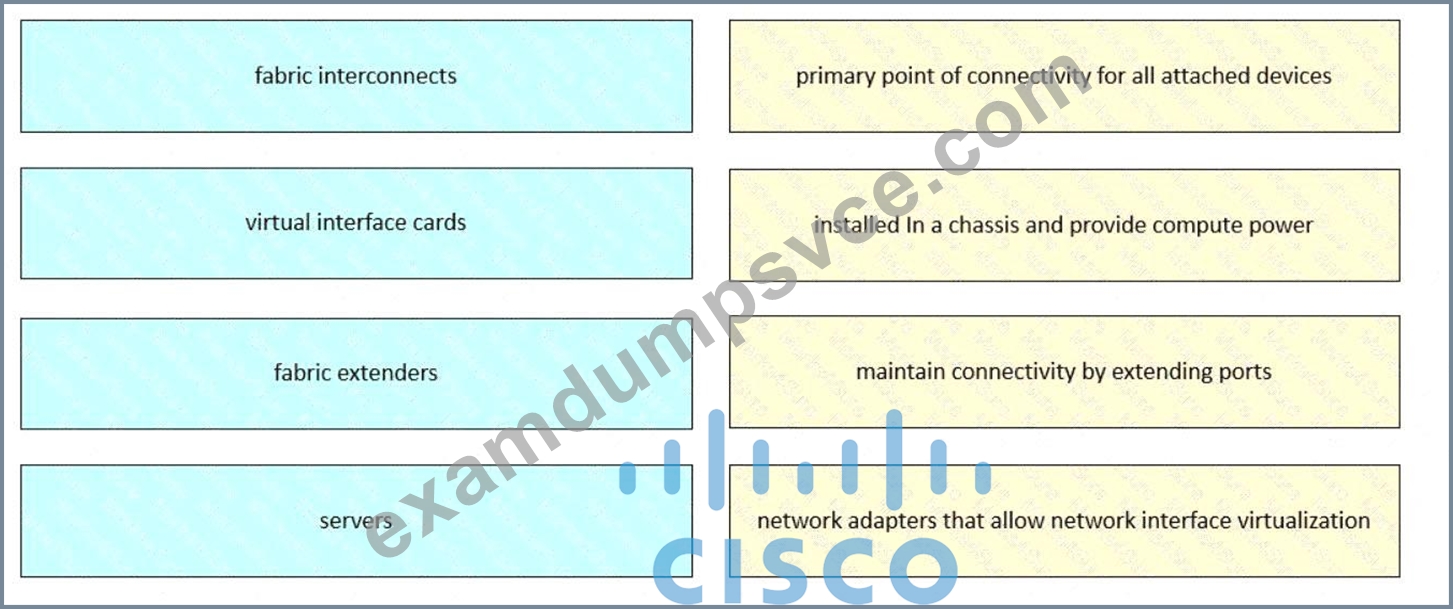
Answer:
Explanation: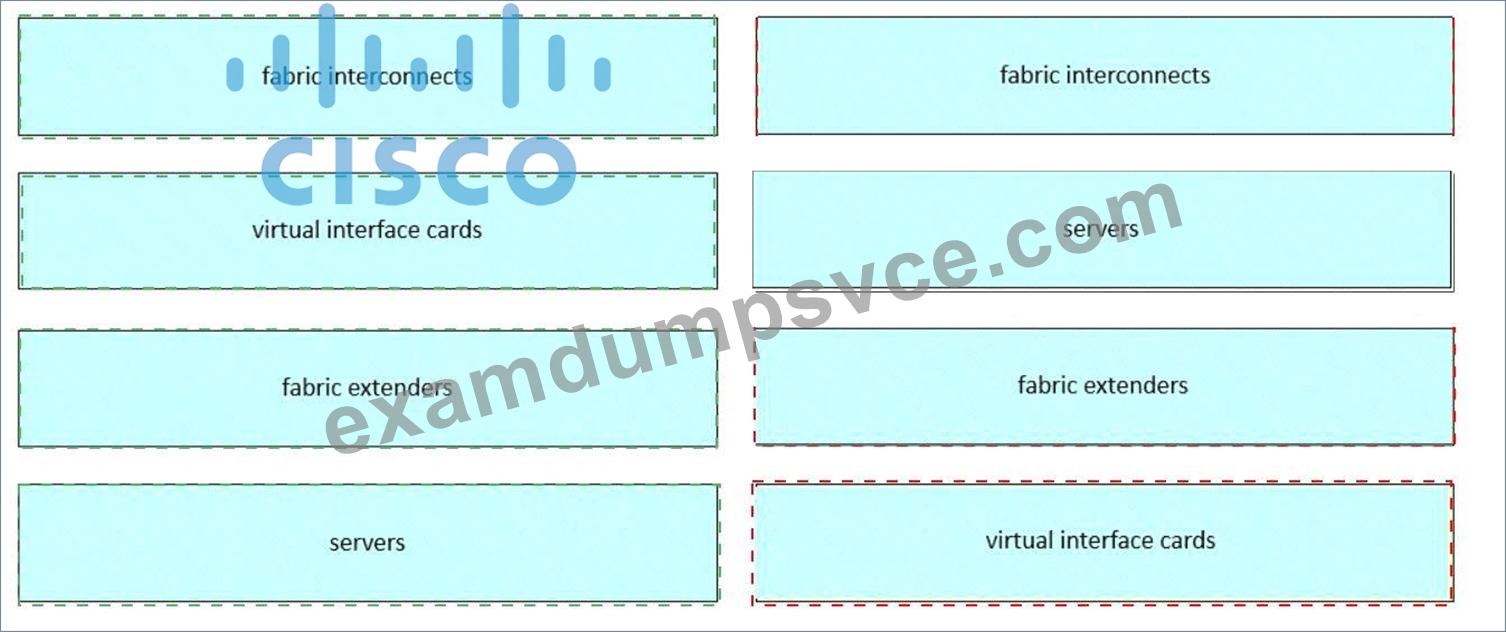
Explanation: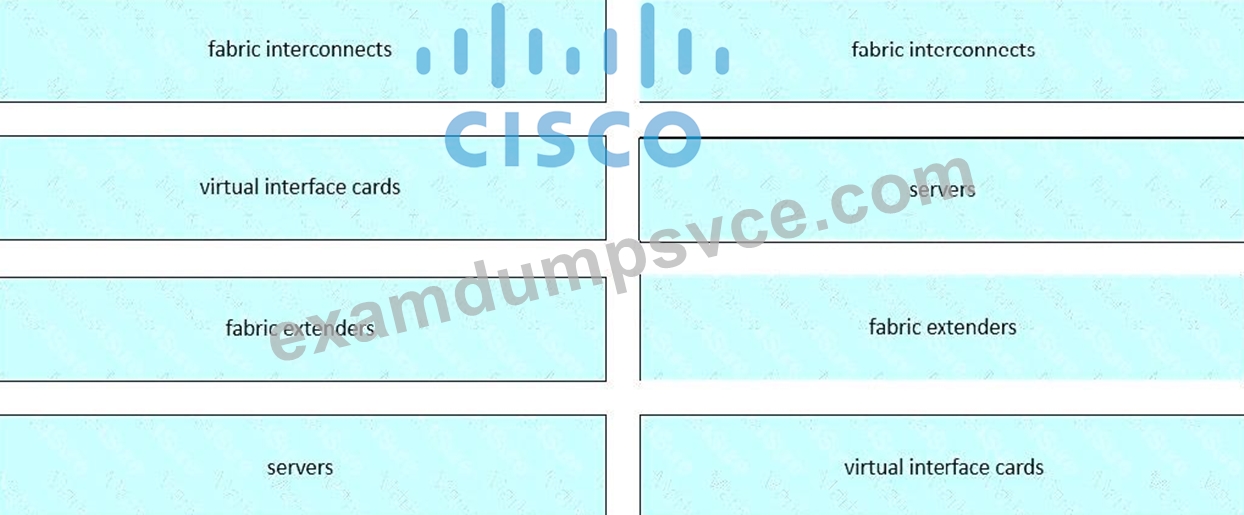
According toFLDTEC documentation and Cisco UCS architecture guides, each of these elements plays a distinct and essential role:
Fabric Interconnects (FI)- Act as the central switching and management point for the UCS domain, connecting servers to LAN and SAN.
Virtual Interface Cards (VICs)- Installed in servers, these adapters supportvirtualization of multiple NICs and HBAs, enabling dynamic profile assignment.
Fabric Extenders (FEXs)- Extend the I/O fabric from the FI to the chassis, reducing complexity and consolidating management.
Servers- Provide the actual compute resources and run workloads. These can bebladeorrack servershoused in the UCS chassis.
This structure is critical to theCisco Unified Fabric approach, which simplifies data center management through integration and automation.
NEW QUESTION # 55
Which Cisco switch series is designed to handle the combined responsibilities of core and distribution layers in a converged architecture?
- A. Catalyst 9000 Series
- B. Catalyst 1300 Series
- C. Meraki MS400 Series
- D. Catalyst 6500 E-Series
Answer: A
Explanation:
TheCisco Catalyst 9000 Seriesis engineered to address the evolving needs of modern enterprise networks by integrating the functionalities of both the core and distribution layers into a unified, converged architecture.
This series offers advanced capabilities such as high-speed data forwarding, enhanced security features, and support for automation and programmability, making it suitable for scalable and efficient network designs.
The Catalyst 9000 Series includes models like the Catalyst 9500 and 9600, which are optimized for core and distribution roles, providing high throughput and reliability. These switches support advanced features like Software-Defined Access (SD-Access) and are designed to meet the demands of cloud-scale and security- focused environments.
In contrast, theMeraki MS400 Series(Option A) is tailored for cloud-managed aggregation and lacks the comprehensive feature set required for core functionalities. TheCatalyst 6500 E-Series(Option B), while historically significant, is considered a legacy platform and may not support the latest advancements in network convergence. TheCatalyst 1300 Series(Option C) is designed for small to medium-sized businesses and is not intended for core or distribution layer deployments.
Reference:Supporting Cisco Devices for Field Technicians (FLDTEC) - Cisco Equipment and Related Hardware
NEW QUESTION # 56
Drag and drop the characteristics from the left onto the corresponding categories of MDS switch on the right.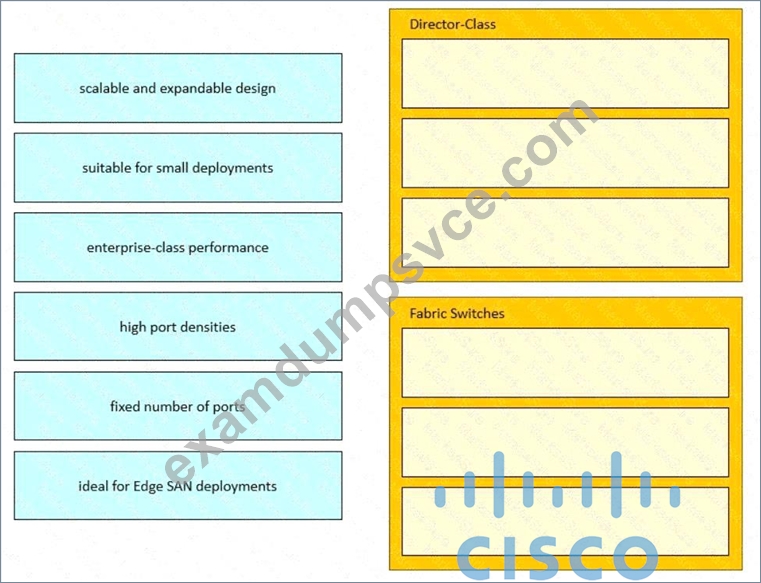
Answer:
Explanation: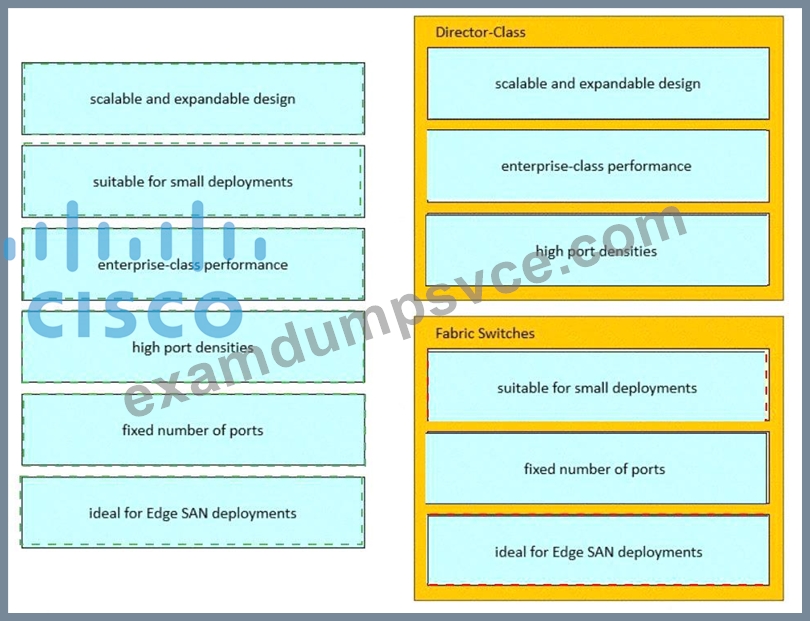
Explanation: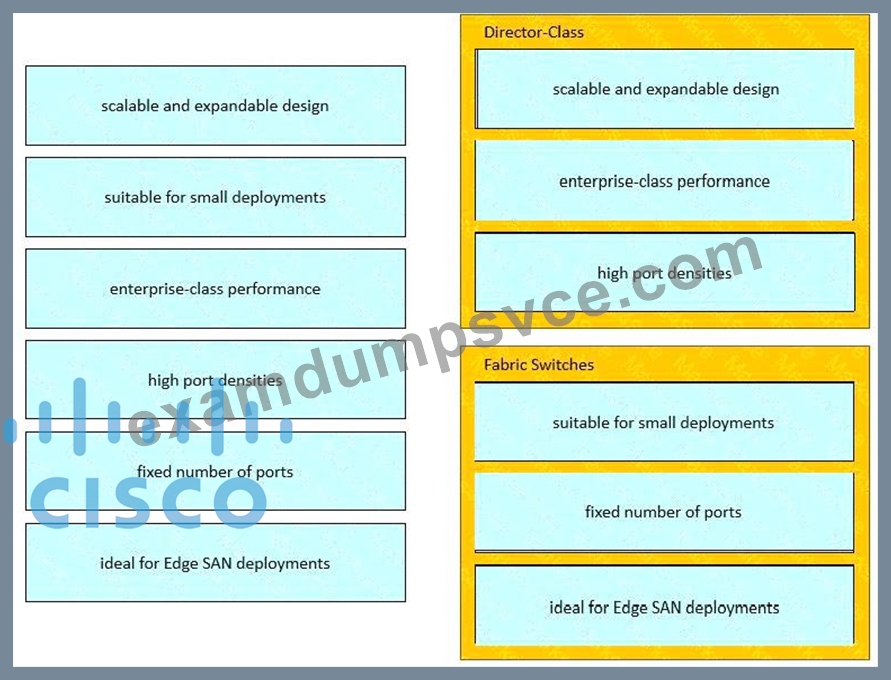
Cisco MDS switches are segmented into two key categories: Director-Class and Fabric Switches, each tailored for different SANenvironments:
Director-Class Switches (e.g., Cisco MDS 9700 Series):
Modular and highly scalable
Support hot-swappable components (line cards, supervisors, fabric modules) High port density and performance for core SANs in enterprise data centers Fabric Switches (e.g., Cisco MDS 9148T):
Compact, fixed-form factor
Best suited for smaller SANs or edge locations
Cost-effective and simple to deploy
This distinction is important when selecting hardware for data center core vs access layers in SAN architectures.
NEW QUESTION # 57
Which command is used to specify the source for the Cisco IOS software image to load during the boot process?
- A. boot system
- B. boot ios
- C. boot source
- D. boot image
Answer: A
Explanation:
Theboot systemcommand is used in globalconfiguration mode to specify the source and filename of the Cisco IOS software image that should be loaded during the device's boot process. This command ensures that the device loads a specific IOS image, whether it's stored locally in flash or fetched from a TFTP server.
Syntax example:
boot system flash:c1900-universalk9-mz.SPA.157-3.M3.bin
* boot image,boot ios, andboot sourceare invalid or non-existent in standard Cisco IOS.
Reference:Supporting Cisco Devices for Field Technicians (FLDTEC) -Cisco IOS Software Basics
NEW QUESTION # 58
Which common CLI command isused to install Cisco NX-OS Software?
- A. boot system
- B. install all
- C. copy tftp: running-config
- D. install kickstart
Answer: B
Explanation:
Theinstall allcommand is the standard method used to install or upgrade Cisco NX-OS software on Nexus switches. This command streamlines the installation process by automating tasks such as verifying the software image, checking for compatibility, and managing the installation of optional packages or SMUs (Software Maintenance Upgrades). It ensures a comprehensive and efficient upgrade process, minimizing the potential for errors.Cisco In contrast:
* copy tftp: running-configis used to copy configuration files, not software images.
* install kickstartis an outdated command from earlier NX-OS versions.
* boot systemsets the boot variable but does not handle the full installation process.
Reference:Supporting Cisco Devices for Field Technicians (FLDTEC) - Cisco IOS Software Basics
NEW QUESTION # 59
Which two components are accessed by removing the chassis cover on Cisco Catalyst 8000 Series Edge platforms? (Choose two.)
- A. Network Interface Modules
- B. DIMMs
- C. SSDs
- D. Fan trays
- E. Transceivers
Answer: B,C
Explanation:
On Cisco Catalyst 8000 Series Edge platforms, removing the chassis cover provides access to internal components such asDIMMs (Dual In-line Memory Modules)andSSDs (Solid-State Drives). These components are located internally and require the removal of the chassis cover for maintenance or replacement.
* DIMMsare used for system memory and are essential for the router's operation.
* SSDsprovide storage for system software and configurations.
Other components likeNetwork Interface Modules (NIMs)andtransceiversare typically accessible externally and do not require chassis cover removal.
Reference:Supporting Cisco Devices for Field Technicians (FLDTEC) - Cisco Equipment and Related Hardware
NEW QUESTION # 60
Which cable type should be used when installing replacement hardware and connecting two devices of the same type, like two DTEs or two DCEs?
- A. RJ-45 Ethernet straight-through patch cable
- B. USB Type A to Type B cable
- C. RJ-45 Ethernet crossover patch cable
- D. Rolled RJ-45 to RJ-45 console cable
Answer: C
Explanation:
When connectingtwo devices of the same type(e.g., two routers, two switches, or two DTEs), acrossover cableis required. This cable swaps the transmit and receive pairs to allow direct communication between devices without the need for an intermediate device like a switch.
* Straight-through cablesare used to connect different types of devices (e.g., PC to switch).
* Rolled cablesare used for console access.
* USB Type A to Bcables are typically used for peripheral device connections, not networking.
Reference:Supporting Cisco Devices for Field Technicians (FLDTEC) - Cisco Equipment and Related Hardware
NEW QUESTION # 61
Which pod-based deployment model provides the most flexibility and scalability in a modern data center topology?
- A. Fabric Extender model
- B. Spine-and-Leaf
- C. Top of Rack (ToR)
- D. End of Row (EoR)
Answer: B
Explanation:
TheSpine-and-Leafarchitecture is the preferredpod-based deployment modelin modern data centers because of itshigh scalability and flexibility. In this topology:
* Leaf switchesconnect to servers and act as the access layer.
* Spine switchesfunction as the core layer, interconnecting all leaf switches.
This non-blocking, highly redundant model supportspredictable latency, easy horizontal scaling, and load balancing, making it ideal for cloud-scale and virtualized environments.
* Top of Rack (ToR)andEnd of Row (EoR)are physical cabling layouts that do not inherently provide the same level of architectural scalability.
* Fabric Extender modelsextend switch ports but depend on upstream switches for intelligence, limiting flexibility.
Reference:Supporting Cisco Devices for Field Technicians (FLDTEC) - Cisco Equipment and Related Hardware
NEW QUESTION # 62
Refer to the exhibit. Drag and drop the names of the field-replaceable units from the left onto the corresponding letters on the image of the Cisco Catalyst 9400 modular switch.
Answer:
Explanation:
Explanation:
A # Power supply modules
B # Fan tray assembly
C # Line card slots 1 and 2
D # Supervisor modules
E # Line card slots 5, 6, and 7
The power supply units (A) are at the top, the fan tray (B) is a vertical module on the left, line cards (C and E) span multiple slots horizontally, and supervisor modules (D) are typically placed centrally for control functions.
In theFLDTEC courseunderCisco Modular Hardware Overview, the Cisco Catalyst 9400 series is broken down into clearly defined FRU zones:
* Power Supply Modules (A):Located at thetop of the chassis, these provide redundant, hot-swappable power to the switch.
* Fan Tray Assembly (B):Mounted vertically on the left, this ensures proper cooling and airflow throughout the chassis.
* Line Card Slots 1 and 2 (C):Located in the upper section for network expansion.
* Supervisor Modules (D):Positioned centrally, they handle control plane operations, management, and switching logic.
* Line Card Slots 5, 6, and 7 (E):Lower slots for high-density port expansion.
Correct FRU identification ensures successful maintenance, upgrades, and hardware replacement during field operations.
NEW QUESTION # 63
Which key sequence is used to enter the boot prompt mode when the Cisco NX-OS Software begins the software boot process?
- A. Ctrl-1
- B. Ctrl-X
- C. Ctrl-C
- D. Ctrl-Z
Answer: C
Explanation:
During the boot process of Cisco devices runningNX-OS, pressingCtrl-Cat the right time will interrupt the boot sequence and bring the system to theboot loader or ROMmon mode(commonly referred to as the boot prompt).
This allows a technician to perform low-level operations such as recovering passwords, specifying an alternate boot image, or performing diagnostics.
Other options (Ctrl-X, Ctrl-Z, Ctrl-1) are not used for interrupting the boot process in Cisco NX-OS platforms.
Reference:Supporting Cisco Devices for Field Technicians (FLDTEC) - Cisco IOS Software Basics
NEW QUESTION # 64
Which mode must the console terminal of the device be in before a prewritten configuration is pasted to transfer the configuration from an old device to a new one?
- A. Interface configuration mode
- B. User EXEC mode
- C. Privileged EXEC mode
- D. Global configuration mode
Answer: D
Explanation:
To apply a prewritten configuration to a new Cisco device, the console terminal must be inGlobal Configuration Mode. This mode allows administrators to enter configuration commands that affect the device's overall operation. To access Global Configuration Mode, one must first enter Privileged EXEC Mode by typingenable, and then enterconfigure terminal. Once in Global Configuration Mode, theprewritten configuration can be pasted, and the device will accept the commands accordingly.
Reference:Supporting Cisco Devices for Field Technicians (FLDTEC) - Device Configuration and Verification
NEW QUESTION # 65
Which Layer 2 technology extends to access layer devices, allowing individual switch ports to be assigned for network and traffic management in an enterprise network?
- A. VLANs
- B. BGP
- C. OSPF
- D. MPLS
Answer: A
Explanation:
In an enterprise network,Virtual Local Area Networks (VLANs)are the key Layer 2 technology used to logically segment a network into multiple broadcast domains. VLANs allow network administrators to assign individual switch ports to specific VLANs, enabling effective network segmentation and traffic management.
This configuration extends to access layer devices, such as switches where end-user devices connect. By isolating traffic into VLANs, administrators can improve network performance, enhance security by separating sensitive departments (such as finance and HR), and simplify network management.
Unlike routing protocols such as BGP and OSPF, which operate at Layer 3, or MPLS, which is a Layer 2.5 forwarding technology used primarily in service provider networks, VLANs are explicitly designed for Layer
2 segmentation within LAN environments.
Reference:Supporting Cisco Devices for Field Technicians (FLDTEC) - Cisco Equipment and Related Hardware
NEW QUESTION # 66
Which management option is best suited for standalone Cisco Secure Firewall deployments?
- A. Cisco Security Manager
- B. Cisco Secure Firewall Device Manager
- C. Cisco Defense Orchestrator
- D. Cisco Secure Firewall Management Center
Answer: B
Explanation:
For standalone Cisco Secure Firewall deployments, theCisco Secure Firewall Device Manager (FDM)is the most appropriate management option. FDM is a browser-based, on-box management tool that allows administrators to configure and manage a single firewall device without the need for external management infrastructure. It provides an intuitive interface for basic configurations, policy management, and monitoring.
In contrast:
* Cisco Secure Firewall Management Center (FMC)is designed for centralized management of multiple firewall devices.
* Cisco Defense Orchestrator (CDO)is a cloud-based solution for managing security policies across various devices.
* Cisco Security Manageris an older platform primarily used for managing ASA devices.
Reference:Supporting Cisco Devices for Field Technicians (FLDTEC) - Cisco Equipment and Related Hardware
NEW QUESTION # 67
Which step must be performed immediately after powering off the device when replacing a Cisco chassis?
- A. Back up the device configuration.
- B. Label and remove all I/O cables.
- C. Remove the chassis ground.
- D. Remove the chassis.
Answer: B
Explanation:
After powering off a Cisco device in preparation for chassis replacement, theimmediate next stepis tolabel and remove all I/O cables. This step is crucial to ensure that all connections can be accurately restored after the new chassis is installed.
Proper labeling prevents confusion and potential misconfigurations during reassembly. Only after all cables are safely disconnected should you proceed to remove the chassis ground and then the chassis itself.
Reference:Supporting Cisco Devices for Field Technicians (FLDTEC) - Maintenance and RMA Procedures
NEW QUESTION # 68
What is a feature of Cisco Meraki switches that simplifies the replacement process?
- A. Cloud-based management
- B. Built-in configuration wizard
- C. Offline configuration backup
- D. Automatic hardware detection
Answer: A
Explanation:
Cloud-based managementis a core feature of Cisco Merakiswitches and significantly simplifies the device replacement process. When a failed switch is replaced:
* The new hardware can be claimed in the Meraki dashboard.
* The previously assigned configuration is automatically applied to the replacement device.
* This eliminates the need for local reconfiguration and ensures continuity with minimal manual effort.
This centralized approach ensures that configurations are stored securely and consistently applied across devices.
Reference:Supporting Cisco Devices for Field Technicians (FLDTEC) - Cisco Equipment and Related Hardware
NEW QUESTION # 69
Which two cloud computing services are vendor-managed in an Infrastructure as a Service (IaaS) delivery model? (Choose two.)
- A. Operating System
- B. Networking
- C. Storage
- D. Data
- E. Applications
Answer: B,C
Explanation:
In theInfrastructure as a Service (IaaS)model, the cloud provider is responsible for managing and maintaining the underlying infrastructure components, including:
* Networking: The cloud provider handles all aspects of network configuration, hardware, and virtual networking.
* Storage: The cloud provider supplies and manages the physical and virtual storage infrastructure required to support the consumer's data needs.
The customer is responsible for managing:
* Operating Systems
* Applications
* Data
This model offers flexibility while shifting infrastructure maintenance responsibilities to the service provider.
Reference:Supporting Cisco Devices for Field Technicians (FLDTEC) - Cisco Licensing and Smart Licensing
NEW QUESTION # 70 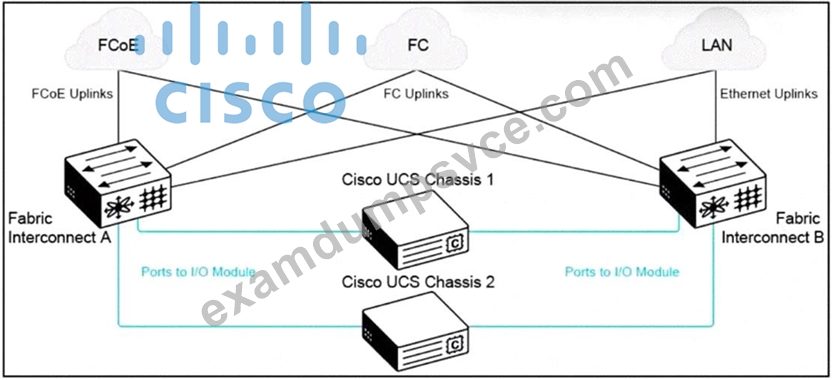
Refer to the exhibit. What is the redundancy implementation in this Cisco UCS architecture?
- A. The system uses a single point of connectivity, relying on internal redundancy within each UCS chassis.
- B. Redundancy is limited to the uplink connections, with no failover capabilities between the fabric interconnects.
- C. Redundancy is achieved through dual fabric interconnects, providing separate paths for FCoE, FC, and LAN traffic.
- D. Redundancy is implemented at the chassis level only, with chassis 1 acting as a backup for chassis 2.
Answer: C
Explanation:
In the providedCisco UCS architecture diagram, the infrastructure consists of:
* Two Fabric Interconnects (A and B), each connecting to:
* Ethernet (LAN)
* Fibre Channel (FC)
* FCoE (Fibre Channel over Ethernet)
* Both Fabric Interconnects are independently connected to bothCisco UCS Chassis 1 and 2through I/O Modules (IOMs).
This is theclassic active-active UCSdesign, providingfull path redundancyfor all traffic types:
* LAN uplinksare handled separately by Fabric Interconnect B.
* SAN trafficis distributed throughFC uplinksandFCoE uplinksvia Fabric Interconnects A and B.
* Each server in the chassis canfail over its traffic to the alternate fabric if one interconnect fails.
This architecture guaranteesno single point of failure, which is essential inmission-critical environments like data centers and enterprise server farms.
NEW QUESTION # 71
What happens to the switch operation when a supervisor module in a Cisco Nexus switch is replaced by two supervisor modules?
- A. The switch continues to operate without any interruption.
- B. The switch shuts down completely.
- C. All modules in the switch are reset due to a stateless switchover.
- D. Only the affected line cards reset.
Answer: C
Explanation:
In Cisco Nexus switches, when transitioning from a single supervisor module to a dual supervisor configuration, the behavior depends on the redundancy mode configured.
* Stateful Switchover (SSO):In configurations supporting SSO, the active and standby supervisors synchronize their state and configuration, allowing for seamless failover without resetting other modules.
* Stateless Switchover (Warm Standby):In certain modes, such as the ACI-mode on Cisco Nexus 9508 switches, the standby supervisor does not maintain synchronized state information with the active supervisor. In this scenario, if a switchover occurs (e.g., due to the replacement of the active supervisor), all modules in the switch are reset because the switchover is stateless.
Therefore, when a supervisor module is replaced in a configuration that does not support stateful switchover, all modules in the switch are reset due to the stateless nature of the switchover.
Reference:Supporting Cisco Devices for Field Technicians (FLDTEC) - Maintenance and RMA Procedures
NEW QUESTION # 72
What is the primary advantage of installing and deploying Cisco UCS E-Series servers in branch office routers?
- A. To increase the packet forwarding capacity of the router
- B. To serve as a backup storage system for the main data center
- C. To enhance the wireless capabilities of the router
- D. To provide local compute power for edge applications
Answer: D
Explanation:
Cisco UCS E-Series serversare integrated, blade-style compute modules that can be installed insideCisco ISR(Integrated Services Routers). Their primary advantage is toprovide local compute resources in branch officeswithout needing a full data center environment.
This enables:
* Hosting of virtual machines or applications locally
* Reduced latency for edge computing
* Lowered dependency on central data center resources
These servers are ideal for runningbranch-office workloads, virtualization, or edge analytics, allowing enterprises to deploy scalable compute capabilities closer to the data source.
Reference:Supporting Cisco Devices for Field Technicians (FLDTEC) - Cisco Equipment and Related Hardware
NEW QUESTION # 73
......
Cisco 800-150 Exam Dumps [2026] Practice Valid Exam Dumps Question: https://braindump2go.examdumpsvce.com/800-150-valid-exam-dumps.html
