

Guaranteed Accomplishment with Newest Aug-2026 FREE Juniper JN0-351
Use Valid New Free JN0-351 Exam Dumps & Answers
Juniper JN0-351 Exam Syllabus Topics:
| Topic | Details |
|---|---|
| Topic 1 |
|
| Topic 2 |
|
| Topic 3 |
|
| Topic 4 |
|
NEW QUESTION # 80
Which two statements about MACsec are true? (Choose two.)
- A. MACsec is an IEEE standard.
- B. MACsec functions on point-to-point connections.
- C. MACsec functions on point-to-multipoint connections.
- D. MACsec does not provide data integrity.
Answer: A,C
NEW QUESTION # 81
You are deploying a trunk port with multiple VLANs. In this scenario, which statement is true about the native VLAN?
- A. The native VLAN is the highest tagged VLAN ID on the port.
- B. The native VLAN must be the default VLAN on the port.
- C. The native VLAN is automatically configured through DHCP.
- D. The native VLAN is an untagged VLAN ID on the port.
Answer: D
NEW QUESTION # 82
Which two statements about BGP facilitate the prevention of routing loops between two autonomous systems? (Choose two.)
- A. EBGP routers will prepend their AS number when advertising routes to their neighbors
- B. EBGP routers will drop routes that contain their own AS number in the AS_PATH
- C. EBGP routers will only accept routes that contain their own AS number in the AS_PATH.
- D. EBGP routers will append their AS number when advertising routes to their neighbors.
Answer: A,B
NEW QUESTION # 83
Which statement is correct about graceful Routing Engine switchover (GRES)?
- A. GRES has a helper mode and a restarting mode.
- B. When combined with NSR, routing is preserved and the new master RE does not restart rpd.
- C. The PFE restarts and the kernel and interface information is lost.
- D. With no other high availability features enabled, routing is preserved and the new master RE does not restart rpd.
Answer: B
Explanation:
The Graceful Routing Engine Switchover (GRES) feature in Junos OS enables a router with redundant Routing Engines to continue forwarding packets, even if one Routing Engine fails.
GRES preserves interface and kernel information, ensuring that traffic is not interrupted.
However, GRES does not preserve the control plane.
To preserve routing during a switchover, GRES must be combined with either Graceful Restart protocol extensions or Nonstop Active Routing (NSR). When GRES is combined with NSR, nearly
75 percent of line rate worth of traffic per Packet Forwarding Engine remains uninterrupted during GRES. Any updates to the primary Routing Engine are replicated to the backup Routing Engine as soon as they occur.
Therefore, when GRES is combined with NSR, routing is preserved and the new master RE does not restart rpd.
NEW QUESTION # 84
Which two statements are correct about IS-IS? (Choose two.)
- A. IS-IS has two metric types and Junos sends both by default.
- B. IS-IS only allows you to configure two areas.
- C. IS-IS uses IPv6 as its transport protocol in the Junos OS implementation.
- D. IS-IS sends a maximum metric value of 63 by default.
Answer: A,D
NEW QUESTION # 85
Which two BGP attributes must be supported by all BGP implementations and must be included in every update? (Choose two.)
- A. community
- B. next hop
- C. MED
- D. AS path
Answer: B,D
Explanation:
BGP attributes are properties that BGP uses for route advertisement, path selection, and loop prevention 1
. There are four categories of BGP attributes 1 2 3 :
* Well-known mandatory: Must be recognized by all BGP routers, present in all BGP updates, and passed on to other BGP routers 1 2 3 .
* Well-known discretionary: Supported by all BGP implementations, and are optionally included in BGP updates 1 .
* Optional transitive: May not be supported by all implementations of BGP 1 .
* Optional non-transitive: May not be supported by all implementations of BGP 1 .
The well-known mandatory attributes must be supported by all BGP implementations and must be included in every update 1 2 3 . These include the AS path and next hop attributes 2 3 . Therefore, options A and C are correct.
NEW QUESTION # 86
Click the Exhibit button.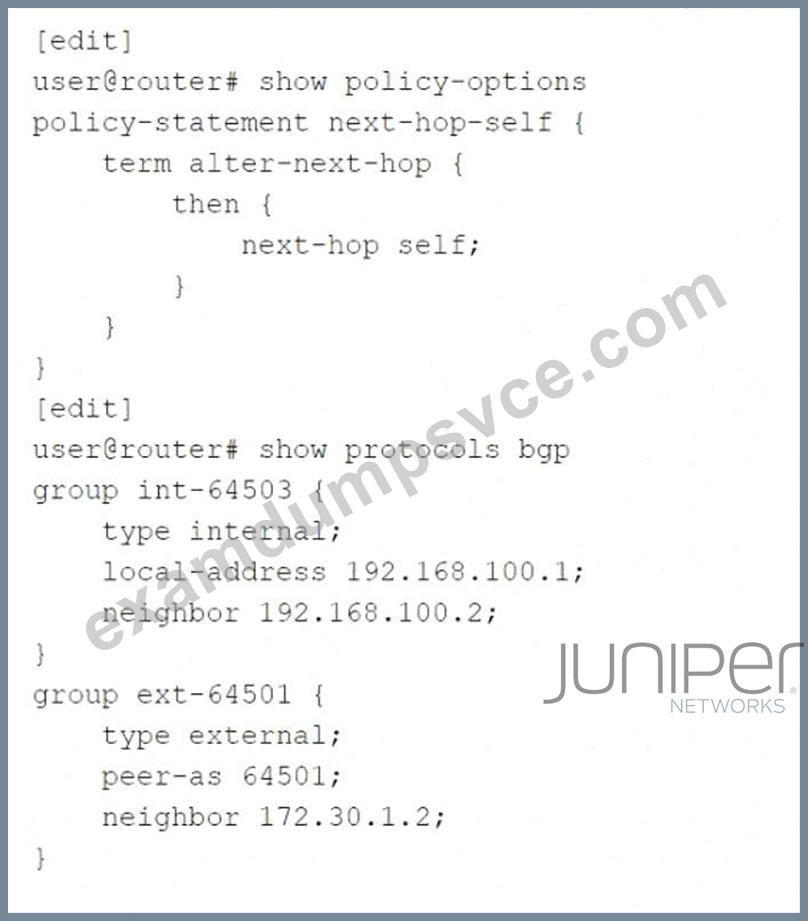
R1 has a BGP session with a router that has a peer autonomous system number of 64501. It is exchanging routes, and is advertising those routes to IBGP peers. The downstream IBGP peers, however, cannot pass traffic to the advertised networks.
Referring to the exhibit, which configuration change must occur to solve this problem?
- A. The BGP group int-64503 must include the import next-hop-self policy.
- B. The BGP group ext-64501 must include the export next-hop-self policy.
- C. The BGP group ext-64501 must include the import next-hop-self policy.
- D. The BGP group int-64503 must include the export next-hop-self policy.
Answer: D
NEW QUESTION # 87
You are using tunnels in your network. It is important that the routes be specific enough to ensure that the tunnels are established. You need to prevent a route that is new to the network from being used.
In this scenario, which type of route should be used?
- A. static
- B. multicast
- C. aggregate
- D. anycast
Answer: A
NEW QUESTION # 88
Which statement is correct about the configuration shown in the exhibit?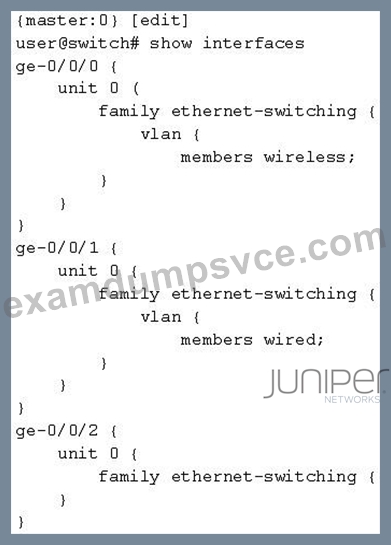
- A. The ge-0/0/0 and ge-0/0/1 interfaces are operating in trunk mode.
- B. All three interfaces are operating in access mode.
- C. The ge-0/0/2 interface is operating as a Layer 3 interface.
- D. The configuration will not complete the commit check process and will error out.
Answer: B
NEW QUESTION # 89
You are concerned about spoofed MAC addresses on your LAN. Which two Layer 2 security features should you enable to minimize this concern? (Choose two.)
- A. static ARP
- B. dynamic ARP inspection
- C. DHCP snooping
- D. IP source guard
Answer: B,C
Explanation:
A is correct because dynamic ARP inspection (DAI) is a Layer 2 security feature that prevents ARP spoofing attacks. ARP spoofing is a technique that allows an attacker to send fake ARP messages to associate a spoofed MAC address with a legitimate IP address. This can result in traffic redirection, man-in-the-middle attacks, or denial-of-service attacks. DAI validates ARP packets by checking the source MAC address and IP address against a trusted database, which is usually built by DHCP snooping. DAI discards any ARP packets that do not match the database or have invalid formats. C is correct because DHCP snooping is a Layer 2 security feature that prevents DHCP spoofing attacks. DHCP spoofing is a technique that allows an attacker to act as a rogue DHCP server and offer fake IP addresses and other network parameters to unsuspecting clients. This can result in traffic redirection, man-in-the-middle attacks, or denial-of-service attacks. DHCP snooping filters DHCP messages by classifying switch ports as trusted or untrusted. Trusted ports are allowed to send and receive any DHCP messages, while untrusted ports are allowed to send only DHCP requests and receive only valid DHCP replies from trusted ports. DHCP snooping also builds a database of MAC addresses, IP addresses, lease times, and binding types for each client.
NEW QUESTION # 90
Which statement is correct about Junos OS class of service (CoS) forwarding classes?
- A. Forwarding classes replace the need for classifiers.
- B. Forwarding classes are only used for ingress filtering.
- C. A forwarding class determines the output queue to which a packet is assigned for scheduling.
- D. Each interface can only support a single forwarding class.
Answer: C
Explanation:
In Junos OS class of service, a forwarding class is used to group packets for output queuing and scheduling treatment on egress interfaces. Packets are typically assigned to a forwarding class based on a classifier that examines fields such as DSCP or IEEE 802.1p CoS bits, and each forwarding class is then mapped to a specific output queue with defined scheduling behavior.
NEW QUESTION # 91
After receiving a BGP route, which two conditions are verified by the receiving router to ensure that the received route is valid? (Choose two)
- A. The local preference is greater than 0.
- B. The AS-path length is greater than 0.
- C. The next hop is reachable.
- D. The loops do not exist.
Answer: C,D
Explanation:
B is correct because the loops do not exist is one of the conditions that are verified by the receiving router to ensure that the received BGP route is valid. A loop in BGP means that a route has been advertised by the same AS more than once, which can cause routing instability and inefficiency1. To prevent loops, BGP uses the AS-path attribute, which lists the AS numbers that a route has traversed from the origin to the destination2. The receiving router checks the AS-path attribute of the received route and discards it if it finds its own AS number in the list2. This way, BGP avoids accepting routes that contain loops.
C is correct because the next hop is reachable is one of the conditions that are verified by the receiving router to ensure that the received BGP route is valid. The next hop is the IP address of the next router that is used to forward packets to the destination network3. The receiving router checks the next hop attribute of the received route and verifies that it has a valid route to reach it3. If the next hop is not reachable, the received route is not usable and is rejected by the receiving router3. This way, BGP ensures that only feasible routes are accepted.
NEW QUESTION # 92
In RSTP, which three port roles are associated with the discarding state? (Choose three.)
- A. alternate
- B. root
- C. disabled
- D. designated
- E. backup
Answer: A,C,E
Explanation:
In Rapid Spanning Tree Protocol (RSTP), there are several port roles that determine the behavior of the port in the spanning tree. The roles include root, designated, alternate, backup, and disabled.
The discarding state is associated with the backup, alternate, and disabled roles. In a stable topology with consistent port roles throughout the network, RSTP ensures that every root port and designated port immediately transition to the forwarding state while all alternate and backup ports are always in the discarding state. Disabled ports are also in the discarding state.
NEW QUESTION # 93
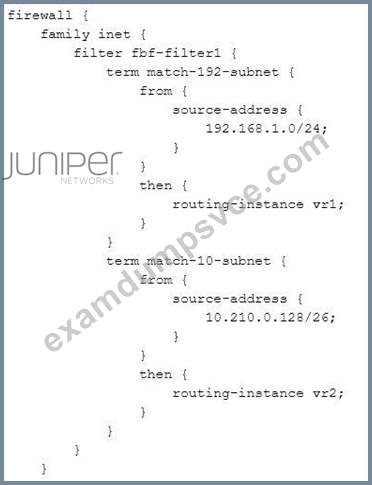
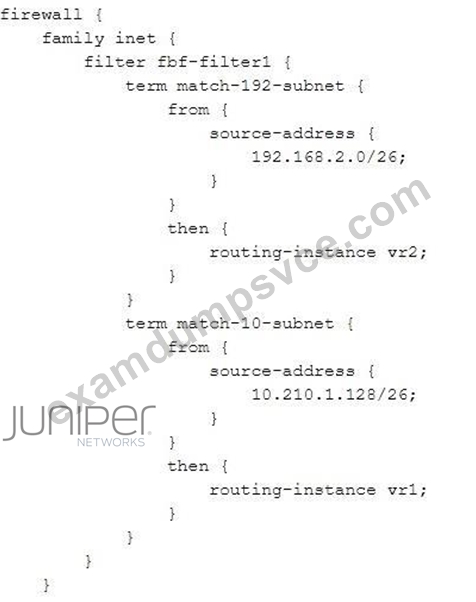
You must implement filter-based forwarding. You need to direct traffic from the 192.168.1.0/24 through vr1 and traffic from 10.210.0.128/26 through vr2.
Which configuration is correct in this scenario?
- A.
- B.
- C.
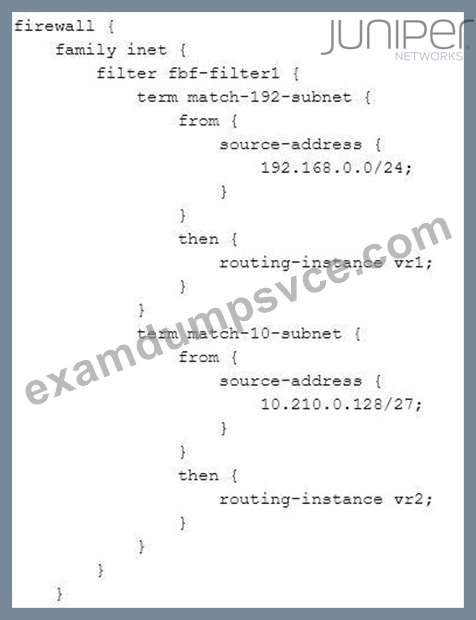
- D.
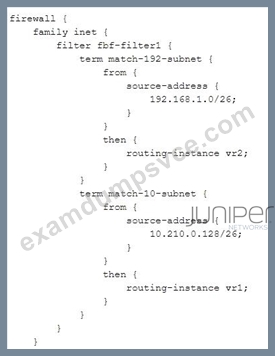
Answer: A
NEW QUESTION # 94
Which two BGP attributes must be supported by all BGP implementations and must be included in every update? (Choose two.)
- A. community
- B. next hop
- C. MED
- D. AS path
Answer: B,D
Explanation:
BGP attributes are properties that BGP uses for route advertisement, path selection, and loop prevention. There are four categories of BGP attributes:
Well-known mandatory: Must be recognized by all BGP routers, present in all BGP updates, and passed on to other BGP routers.
Well-known discretionary: Supported by all BGP implementations, and are optionally included in BGP updates.
Optional transitive: May not be supported by all implementations of BGP.
Optional non-transitive: May not be supported by all implementations of BGP. The well-known mandatory attributes must be supported by all BGP implementations and must be included in every update. These include the AS path and next hop attributes.
NEW QUESTION # 95
You implemented the MAC address limit feature with the shutdown action on all interfaces on your switch.
In this scenario, which statement is correct when a violation occurs?
- A. By default, the violation will automatically be cleared after 300 seconds and the interface will resume sending and receiving traffic for all learned devices.
- B. By default, devices that are learned before the violation occurs are still allowed to send and receive traffic through the specific interface.
- C. By default, you must manually clear the violation for the interface to send and receive traffic again.
- D. By default, the interface will continue to send and receive traffic for all connected devices after a violation has occurred.
Answer: C
Explanation:
When the MAC address limit feature with the shutdown action is implemented on a switch, if a violation occurs, the interface is disabled and a system log entry is generated. If the switch has been configured with the port-error-disable statement, the disabled interface recovers automatically upon expiration of the specified disable timeout. However, if the switch has not been configured for auto-recovery from port error disabled conditions, you must manually clear the violation by running the clear ethernet-switching port-error command for the interface to send and receive traffic again. This explanation is based on the Enterprise Routing and Switching Specialist (JNCIS-ENT) documents and learning resources available at Juniper Networks.
NEW QUESTION # 96
......
JN0-351 Braindumps PDF, Juniper JN0-351 Exam Cram: https://braindump2go.examdumpsvce.com/JN0-351-valid-exam-dumps.html
