

[Mar-2026] CompTIA XK0-006 Official Cert Guide PDF
Exam XK0-006: CompTIA Linux+ Certification Exam - ExamDumpsVCE
CompTIA XK0-006 Exam Syllabus Topics:
| Topic | Details |
|---|---|
| Topic 1 |
|
| Topic 2 |
|
| Topic 3 |
|
| Topic 4 |
|
NEW QUESTION # 69
A Linux administrator needs to securely erase the contents of a hard disk. Which of the following commands is the best for this task?
- A. sudo dd if=/dev/null of=/dev/sda1
- B. sudo shred /dev/sda1
- C. sudo parted rm /dev/sda1
- D. sudo rm -rf /dev/sda1
Answer: B
Explanation:
Secure data destruction is an important security requirement addressed in Linux+ V8 objectives. When data must be permanently erased, standard file deletion commands are insufficient because they do not overwrite the data on disk.
The shred command is specifically designed to securely erase files or block devices by overwriting them multiple times with random data. Using sudo shred /dev/sda1 overwrites the entire partition, making data recovery extremely difficult or impossible. This aligns directly with Linux+ V8 best practices for secure data sanitization.
The other options are incorrect. rm -rf removes directory entries but does not overwrite disk data. parted rm deletes partition entries but leaves the underlying data intact. dd if=/dev/null writes zero bytes and does not overwrite existing data blocks.
Linux+ V8 documentation identifies shred as the most appropriate tool for secure erasure when compliance or confidentiality is required. Therefore, the correct answer is B.
NEW QUESTION # 70
A systems administrator is helping to secure a new web application. During the tests, the administrator obtains the following output to validate the application: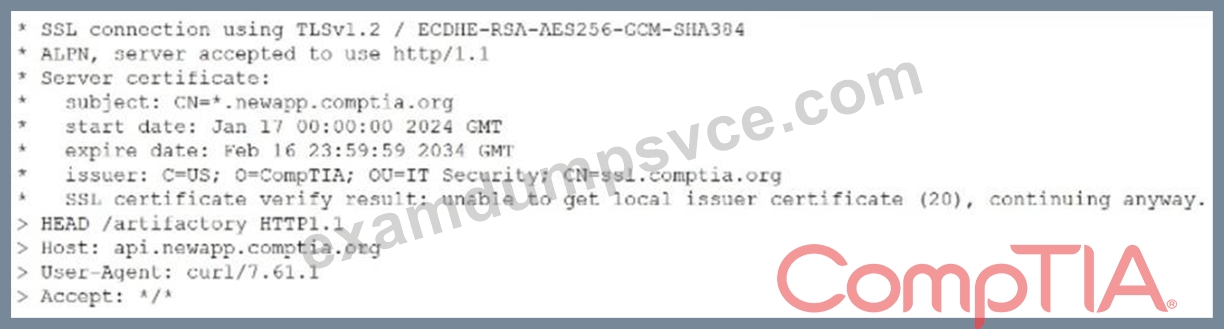
Which of the following explains the validation results?
- A. The certificate was only issued for one month, is already expired, and needs to be replaced
- B. The certificate uses an outdated algorithm and should be replaced with a more secure one.
- C. The certificate is a wildcard certificate that is highly insecure and should never be used.
- D. The certificate was not signed by trusted authority, which was forcefully ignored during the tests.
Answer: D
Explanation:
The validation output indicates that the certificate chain could not be verified because the local system does not trust the issuing certificate authority, and the connection proceeded anyway by ignoring the verification failure during testing.
NEW QUESTION # 71
Which of the following best describes a benefit of using a Python virtual environment?
- A. To make packages installed within the virtual environment available systemwide
- B. To help maintain a consistent environment across all projects
- C. To help decrease disk space usage
- D. To prevent conflicts between projects that require different versions of the same package
Answer: D
Explanation:
A Python virtual environment isolates project dependencies, allowing different projects to use different versions of the same package without interfering with each other.
NEW QUESTION # 72
SIMULATION 2
A junior system administrator removed an LVM volume by mistake.
INSTRUCTIONS
Part 1
Review the output and select the appropriate command to begin the recovery process.
Part2
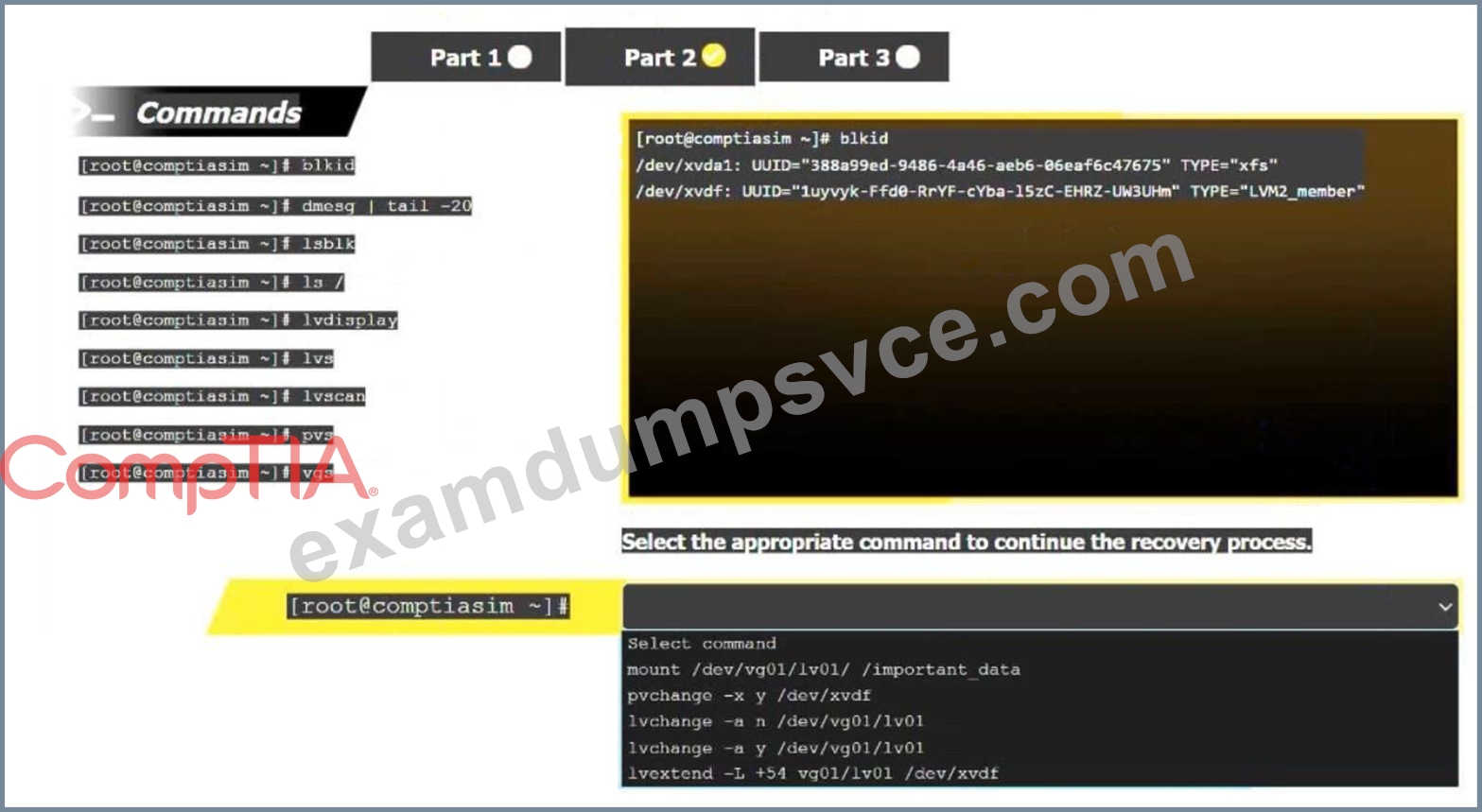
Review the output and select the appropriate command to continue the recovery process.
Part 3
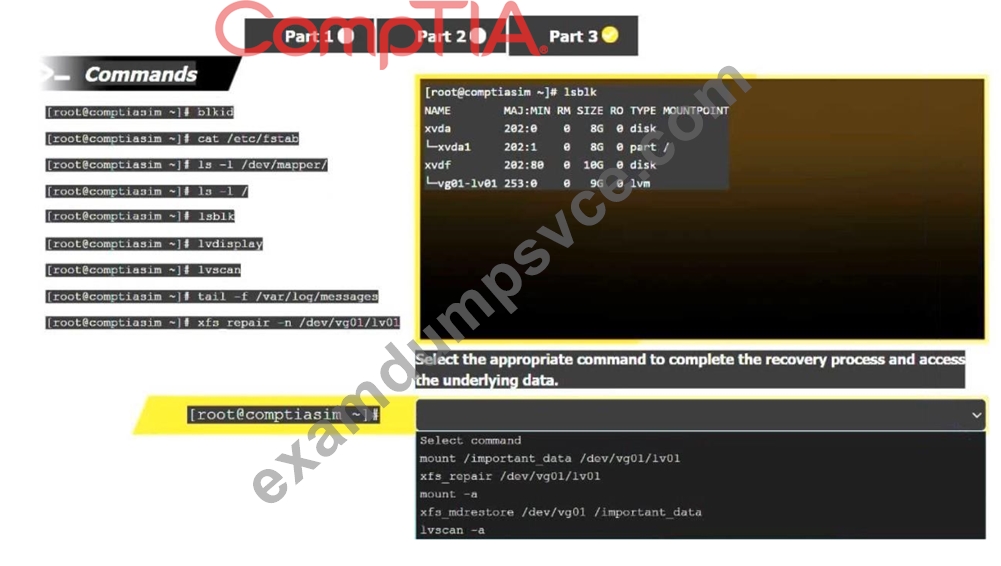
Review the output and select the appropriate command to complete the recovery process and access the underlying data.
If at any time you would like to bring back the initial state of the simulation, please click the Reset All button.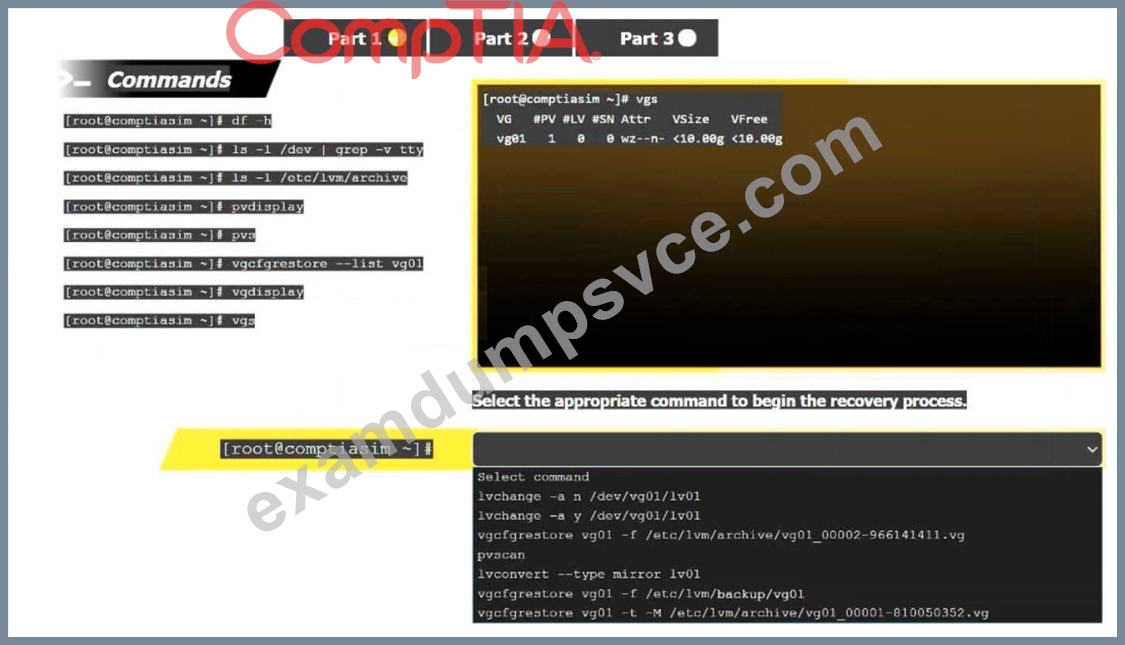
Answer:
Explanation: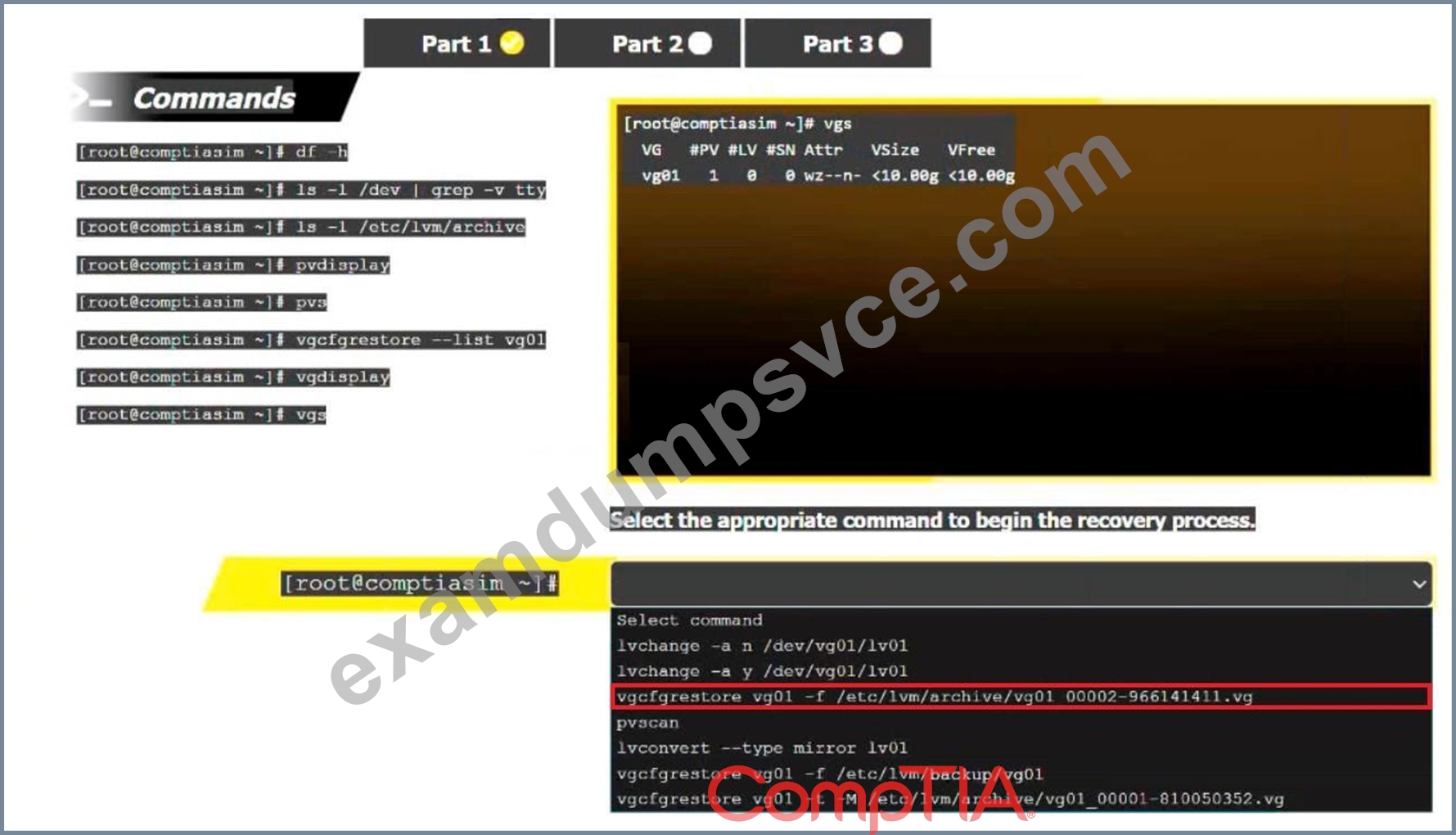
Restoring the Volume Group (VG) configuration from the LVM archive begins the recovery process after the VG metadata was lost.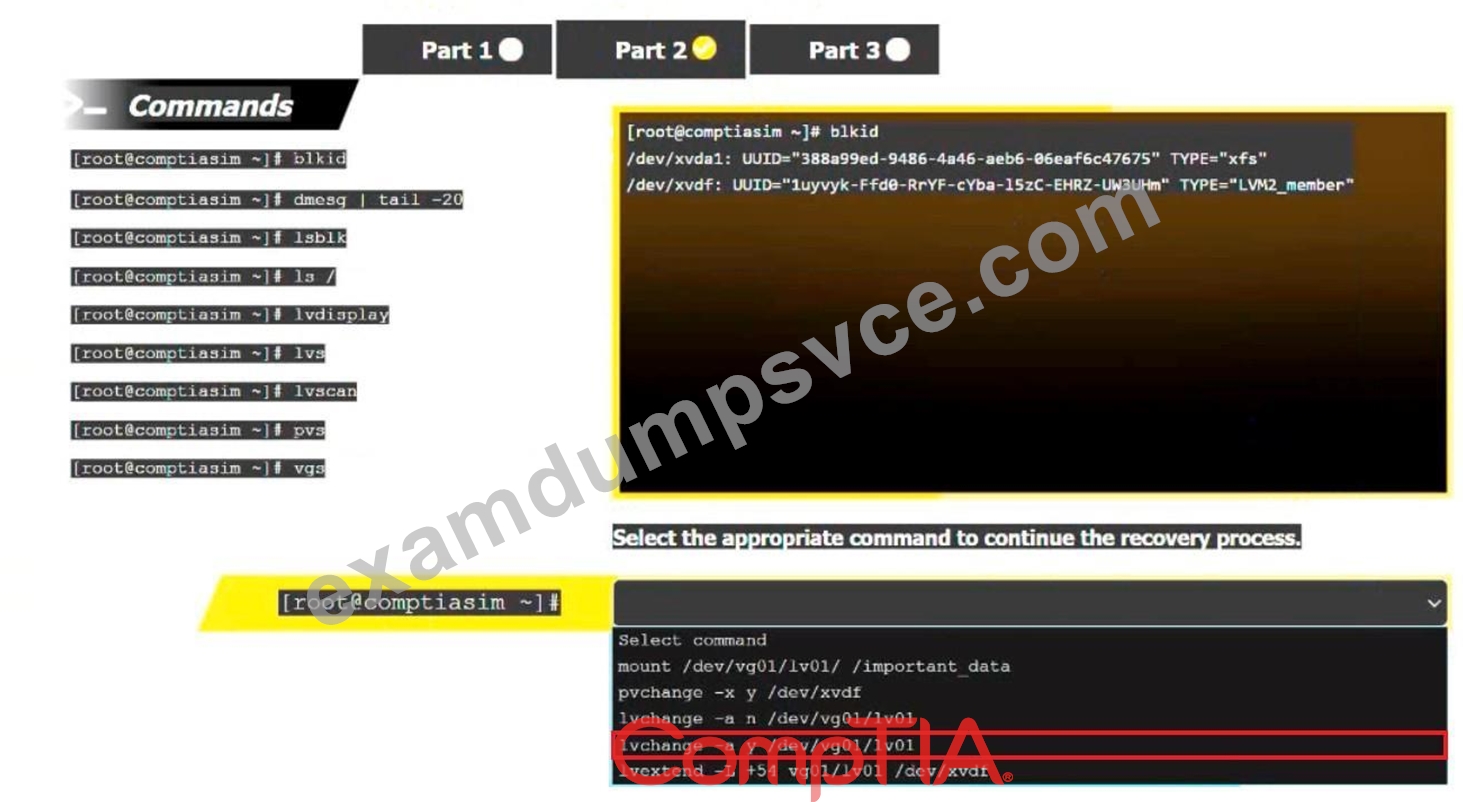
After restoring the VG metadata, the logical volume must be reactivated (-ay) so it becomes accessible to the system.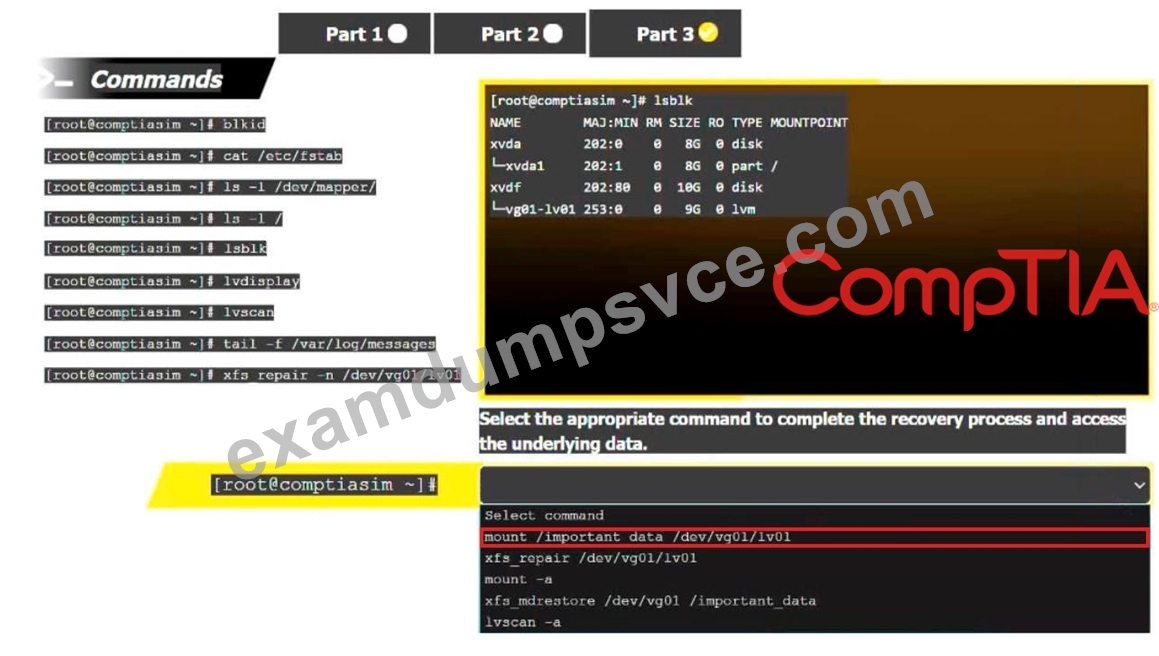
Once the LV is active, mounting it to the /important_data directory makes the filesystem accessible, completing the recovery process.
NEW QUESTION # 73
A DevOps engineer made some changes to files on a local repository. The engineer realizes that the changes broke the application and the changes need to be reverted back. Which of the following commands is the best way to accomplish this task?
- A. git stash
- B. git rebase
- C. git pull
- D. git reset
Answer: D
Explanation:
The git reset command reverts changes in the local repository to a previous commit, effectively discarding the problematic modifications and restoring the application to a working state.
NEW QUESTION # 74
Which of the following is the term used to describe reviewing processes and file operations on a Linux system?
- A. Logging
- B. Auditing
- C. Journaling
- D. Tuning
Answer: B
Explanation:
Auditing refers to the systematic review and tracking of processes and file operations on a Linux system to ensure accountability, security, and compliance.
NEW QUESTION # 75
Users cannot access an application that is running inside containers. The administrator wants to validate whether the containers are running. Which of the following commands should the administrator use?
- A. docker start
- B. docker ps
- C. docker run
- D. docker images
Answer: B
Explanation:
The docker ps command lists all running containers, allowing the administrator to verify whether the application's containers are active.
NEW QUESTION # 76
A user on a Linux VM is running /work/test.shBash script and receives the following error:
bash: /work/test.sh: Permission denied
After further investigation, the user receives the following outputs:
Which of the following commands should a systems administrator run to fix the issue?
- A. chmod g+x /work/test.sh
- B. mount -o remount,exec /work
- C. mount -o remount,suid /work
- D. chmod o+x /work/test.sh
Answer: B
Explanation:
The script /work/test.sh already has execute permissions (-rwxr--r--), but the filesystem is mounted with the noexec option, which prevents execution of binaries and scripts. Remounting the filesystem with the exec option allows execution of the script.
NEW QUESTION # 77
A systems administrator receives reports from users who are having issues while trying to modify newly created files in a shared directory. The administrator sees the following outputs: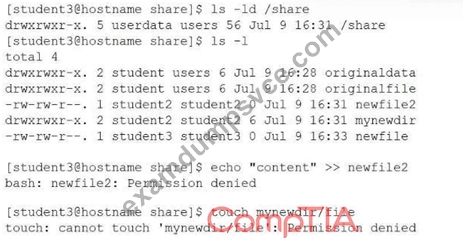
Which of the following provides the best resolution to this issue?
- A. Manually changing the group of the newly created files
- B. Adding a setuid bit to the user in the shared folder
- C. Changing all directory contents to be writable and readable for everyone
- D. Adding a setgid bit to the group in the shared folder
Answer: D
Explanation:
This scenario involves shared directory collaboration, which is a common system management task covered in the CompTIA Linux+ V8 objectives. The key issue is that users can create files in the shared directory, but other users in the same group cannot modify those files. This behavior is directly related to group ownership inheritance.
By default, when a user creates a file or directory, it is owned by the user and assigned the user's primary group, not necessarily the group of the parent directory. As shown in the output, files inside /share are owned by different groups (student, student2, student3), which prevents other group members from modifying them, even though the parent directory is group-writable.
The correct solution is to set the setgid (set group ID) bit on the shared directory, making option D correct.
When the setgid bit is applied to a directory, all newly created files and subdirectories inherit the group ownership of the parent directory, rather than the creator's primary group. This ensures consistent group ownership and allows all members of the shared group to collaborate effectively.
The other options are incorrect or poor practice. Option A (setuid) is intended for executables, not directories.
Option B requires constant manual intervention and does not scale. Option C weakens security by granting write access to all users, violating the principle of least privilege.
Linux+ V8 documentation explicitly recommends using the setgid bit on shared directories to manage collaborative access securely and efficiently.
NEW QUESTION # 78
A Linux software developer wants to use AI to optimize source code used in a commercial product. Which of the following steps should the developer take first?
- A. Install a private LLM to use on the internal network for source code optimization.
- B. Verify that the company has a policy governing the use of AI in software development.
- C. Research which available AI chatbots are best at optimizing source code.
- D. Use open-source LLMs that undergo regular security reviews by the community.
Answer: B
Explanation:
Linux+ V8 emphasizes security, compliance, and governance when introducing new automation technologies, including AI. Before using AI tools to optimize commercial source code, the developer must ensure that such usage complies with organizational policies.
Option B is correct because verifying company policy is the first and most critical step. AI tools may introduce risks such as intellectual property leakage, licensing conflicts, or regulatory violations. Many organizations restrict how source code can be shared with external systems, including AI services.
The other options are premature. Selecting tools or deploying models should only occur after policy approval.
Linux+ V8 highlights governance-first approaches when adopting automation technologies.
Therefore, the correct answer is B.
NEW QUESTION # 79
A systems administrator is developing a script to copy a file if it exists and return an error if it does not. Given the following incomplete script: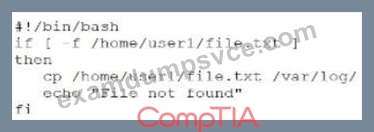
Which of the following statements is missing from the script?
- A. else
- B. while
A\B.
done - C. for
Answer: A
Explanation:
An else statement is required to handle the condition when the file does not exist so the script can return the error message instead of attempting the copy operation.
NEW QUESTION # 80
Users cannot access a server after it has been restarted. At the server console, the administrator runs the following commands;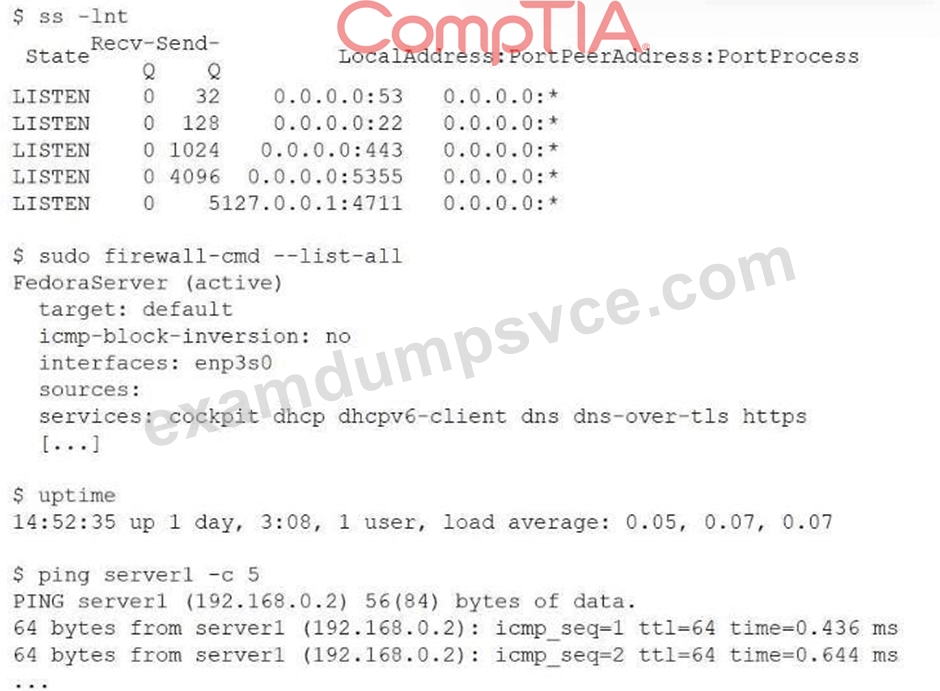
Which of the following is the cause of the issue?
- A. The DNS entry does not have a valid IP address.
- B. The SSH service has not been allowed on the firewall.
- C. The server load average is too high.
- D. The wrong protocol is being used to connect to the web server.
Answer: B
Explanation:
This issue is a classic example of post-reboot connectivity troubleshooting, which falls under the Troubleshooting domain of CompTIA Linux+ V8. The administrator has correctly gathered evidence using multiple diagnostic tools, allowing the root cause to be identified through correlation.
The ss -lnt output confirms that the SSH daemon is running and listening on TCP port 22. This eliminates the possibility that the SSH service failed to start after reboot. Additionally, the uptime output shows a very low load average, indicating that system performance is not a limiting factor. The successful ping test confirms that the server is reachable at the network layer and that DNS resolution and basic connectivity are functioning correctly.
The critical clue comes from the firewall configuration. The output of firewall-cmd --list-all shows that only specific services are allowed through the firewall, such as https, dns, and cockpit. The SSH service is notably absent. On systems using firewalld, services must be explicitly allowed, even if the daemon itself is running and listening on the correct port.
As a result, incoming SSH connection attempts are being blocked by the firewall, preventing users from accessing the server remotely after reboot. This aligns precisely with option B.
The other options are incorrect. DNS is functioning, as shown by successful ping responses. System load is low and not contributing to the issue. There is no indication that users are attempting to access the web server using an incorrect protocol.
Linux+ V8 documentation emphasizes that administrators must verify both service status and firewall rules when diagnosing access issues. In this case, allowing SSH with a command such as firewall-cmd --add- service=ssh --permanent followed by a reload would resolve the problem.
NEW QUESTION # 81
Which of the following describes the method of consolidating system events to a single location?
- A. Webhooks
- B. Health checks
- C. Threshold monitoring
- D. Log aggregation
Answer: D
Explanation:
Comprehensive and Detailed 250 to 350 words of Explanation From Linux+ V8 documents:
Consolidating system events from multiple sources into a single, centralized location is a key concept in Linux system administration and is explicitly covered under logging and monitoring topics in the CompTIA Linux+ V8 objectives. This method is known as log aggregation, making option A the correct answer.
Log aggregation refers to the practice of collecting logs generated by operating systems, services, applications, and network devices and storing them in a centralized repository. In Linux environments, logs may originate from systemd-journald, syslog, application-specific log files, containers, and cloud-based workloads. Aggregating these logs allows administrators to analyze events more efficiently, correlate issues across systems, and improve troubleshooting, auditing, and security monitoring.
Linux+ V8 documentation emphasizes centralized logging as a best practice in environments with multiple servers. Without log aggregation, administrators would need to log in to each system individually to inspect logs, which is inefficient and error-prone. Centralized solutions such as syslog servers, ELK/EFK stacks, and SIEM platforms enable real-time analysis, long-term retention, and alerting based on log data.
The other options do not describe log consolidation. Health checks are used to verify whether services or systems are operational but do not collect or store event data. Webhooks are HTTP-based callbacks used for event-driven automation and notifications, not for storing logs. Threshold monitoring involves generating alerts when metrics exceed defined limits, such as CPU or memory usage, but it does not centralize system event records.
Linux+ V8 stresses that effective log aggregation improves incident response, supports compliance requirements, and enhances system visibility. It is especially important for detecting security incidents, diagnosing failures, and performing root-cause analysis across distributed systems.
NEW QUESTION # 82
An average of one out of three users in a company cannot reach the company website. A Linux administrator determines that one of the three website servers is down. The administrator inspects the DNS configuration for the website and notices the following entry: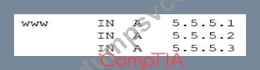
Which of the following accurately explains the issue?
- A. One of the DNS records has not been signed with a DNSSEC-supported key, and this is causing some web browsers to reject the DNS response.
- B. The DNS configuration is missing corresponding AAAA records and PTR records, and this is causing clients to fail the hostname translation.
- C. DNS returns all three records in a different order each time, and the browser typically uses the first address in the DNS response.
- D. The administrator has incorrectly configured the DNS server to be an iterative resolver instead of an authoritative resolver.
Answer: C
Explanation:
With multiple A records, DNS performs simple round-robin ordering and returns the records in a different sequence on each query. Most clients try the first address returned-so when the downed server's IP appears first (about one in three times), those users cannot connect.
NEW QUESTION # 83
Which of the following is a reason multiple password changes on the same day are not allowed?
- A. To stop users from circulating through the password history to return to the originally used password
- B. To enforce using multifactor authentication with stronger encryption algorithms instead of passwords
- C. To avoid brute-forced password attacks by making them too long to perform
- D. To increase password complexity and the system's security
Answer: A
Explanation:
Restricting multiple password changes in one day prevents users from cycling through password changes just to reuse an old password, thereby enforcing stronger security practices.
NEW QUESTION # 84
A Linux server is not starting up because files in the /boot/partition are corrupt. After the initial GRUB screen, the following message is displayed:
Probing EDD (edd=off to disable)... ok
uncompression error
--system halted
Which of the following steps should the Linux administrator take to recover the system without destroying the existing installation? (Choose two.)
- A. Reinstall the kernel packages.
- B. Start up the system using rescue boot media.
- C. Increase the amount of swap memory.
- D. Start up in single-user mode.
- E. Reinstall the OS.
- F. Replace the hard drive.
Answer: A,B
Explanation:
Using rescue boot media lets you boot the machine, mount the existing partitions, and access the corrupted /boot files without reinstalling the OS.
Reinstalling the kernel packages restores the missing or corrupt files in /boot (e.g., vmlinuz and initramfs), allowing GRUB to load and uncompress the kernel properly.
NEW QUESTION # 85
Which of the following commands would a Linux administrator use to determine the temperature of a motherboard?
- A. lspci
- B. dmidecode
- C. lm_sensors
- D. ipmtool
Answer: C
Explanation:
This utility reads hardware sensor data exposed by the system, including motherboard and CPU temperature values, allowing administrators to monitor system thermal conditions.
NEW QUESTION # 86
A new drive was recently added to a Linux system. Using the environment and tokens provided, complete the following tasks:
* Create an appropriate device label.
* Format and create an ext4 file system on the new partition.
The current working directory is /.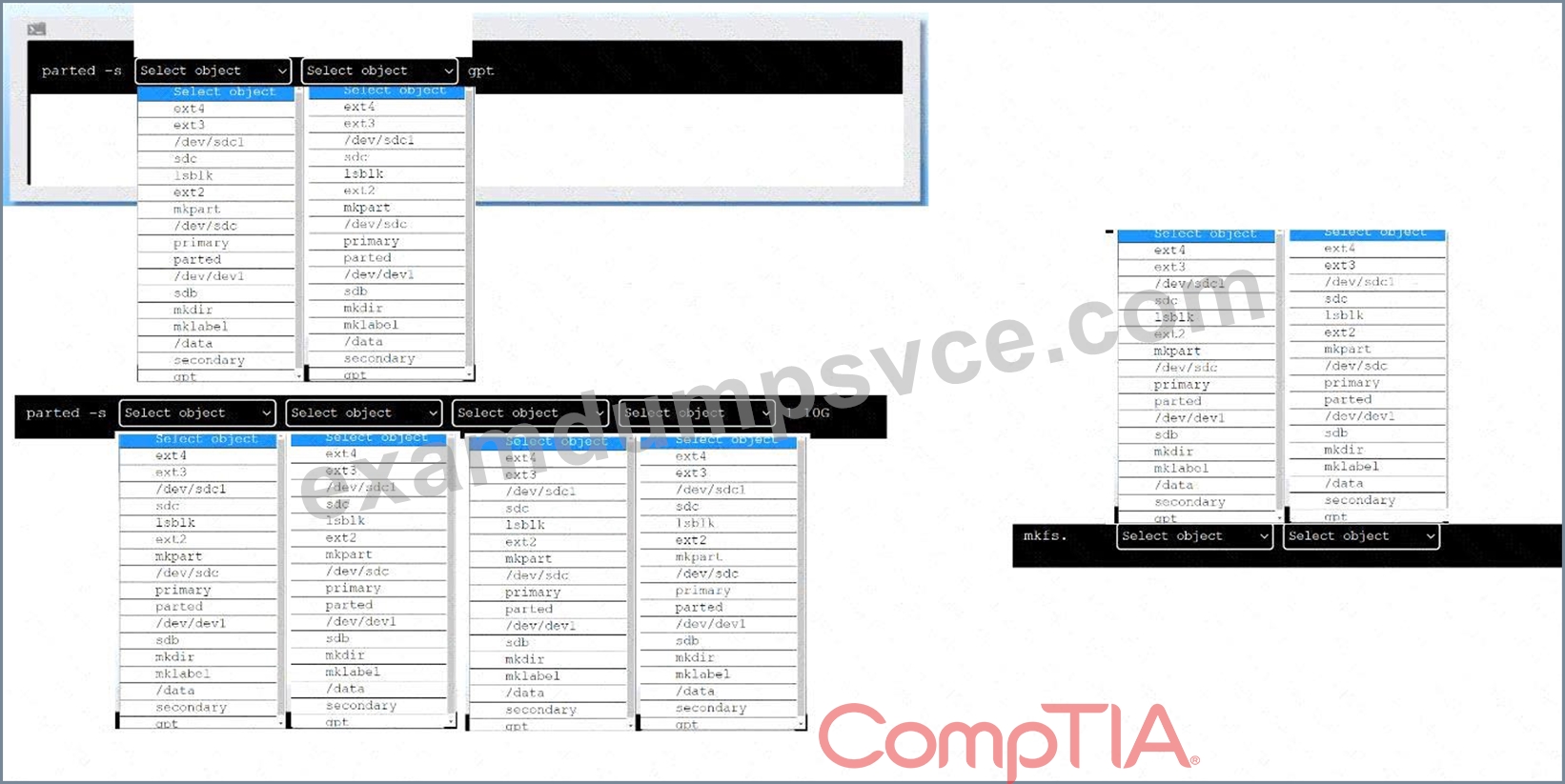
Answer:
Explanation: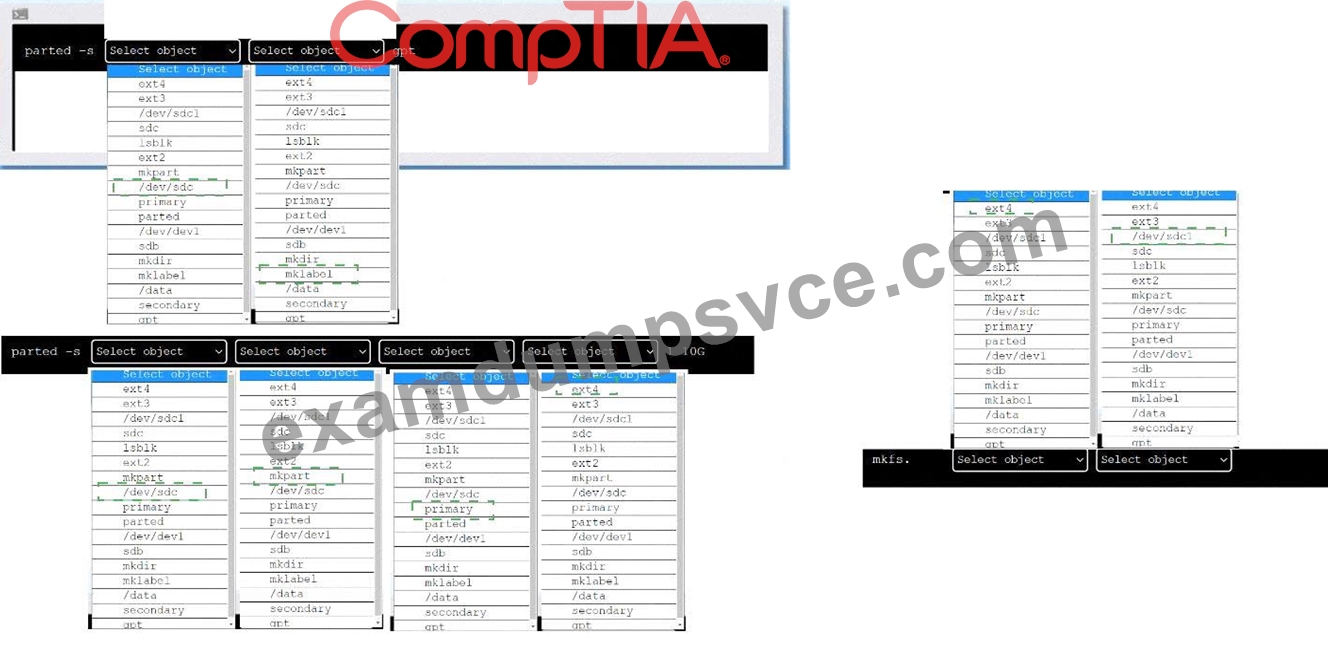
Explanation: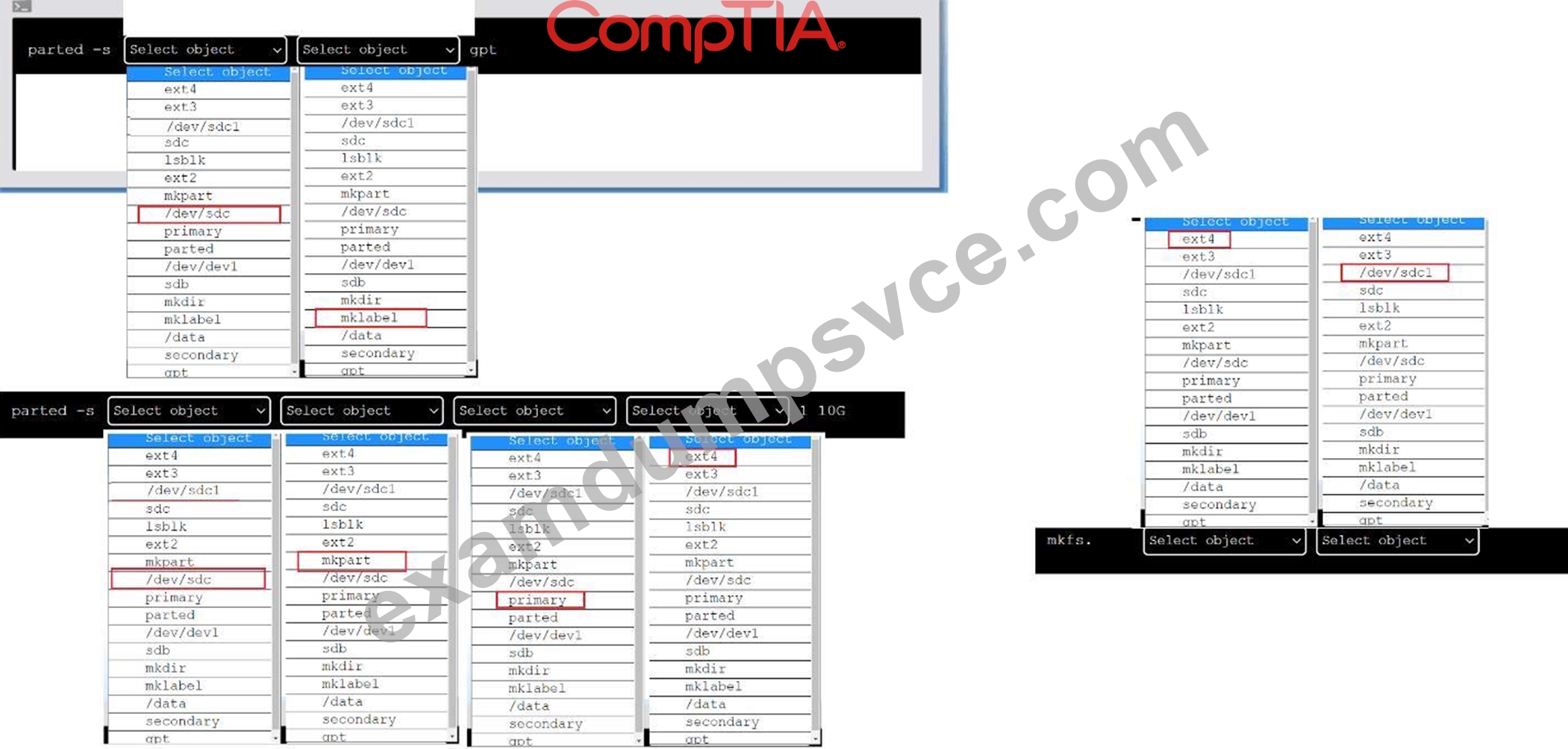
To create an appropriate device label, format and create an ext4 file system on the new partition, you can use the following commands:
* To create a GPT (GUID Partition Table) label on the new drive /dev/sdc, you can use the parted command with the -s option (for script mode), the device name (/dev/sdc), the mklabel command, and the label type (gpt). The command is:
parted -s /dev/sdc mklabel gpt
* To create a primary partition of 10 GB on the new drive /dev/sdc, you can use the parted command with the -s option, the device name (/dev/sdc), the mkpart command, the partition type (primary), the file system type (ext4), and the start and end points of the partition (1 and 10G). The command is:
parted -s /dev/sdc mkpart primary ext4 1 10G
* To format and create an ext4 file system on the new partition /dev/sdc1, you can use the mkfs command with the file system type (ext4) and the device name (/dev/sdc1). The command is:
mkfs.ext4 /dev/sdc1
You can verify that the new partition and file system have been created by using the lsblk command, which will list all block devices and their properties.
NEW QUESTION # 87
A Linux administrator prepares a backup script named testBack.sh. The backup script must be executed at 3:00 p.m. every Sunday. Which of the following crontabconfigurations will satisfy this requirement?
- A. 0 * * * 15 testBack.sh
- B. */15 * * * 0 testBack.sh
- C. 0 15 * * 0 testBack.sh
- D. * 15 * * 0 testBack.sh
Answer: C
Explanation:
This cron entry schedules the script to run at minute zero of hour fifteen every Sunday, which corresponds to 3:00 p.m. each week.
NEW QUESTION # 88
SIMULATION 3
You are a systems administrator and have created an uncompressed backup of the application directory. Several hours later, you must restore the application from backup.
INSTRUCTIONS
Within each tab, click on an object to form the appropriate command used to create the backup and restore the application.
Command objects may only be used once, but the spacebar ˽ object may be used multiple times.
Not all objects will be used. Click the arrow to remove any unwanted objects from your command.
If at any time you would like to bring back the initial state of the simulation, please click the Reset All button.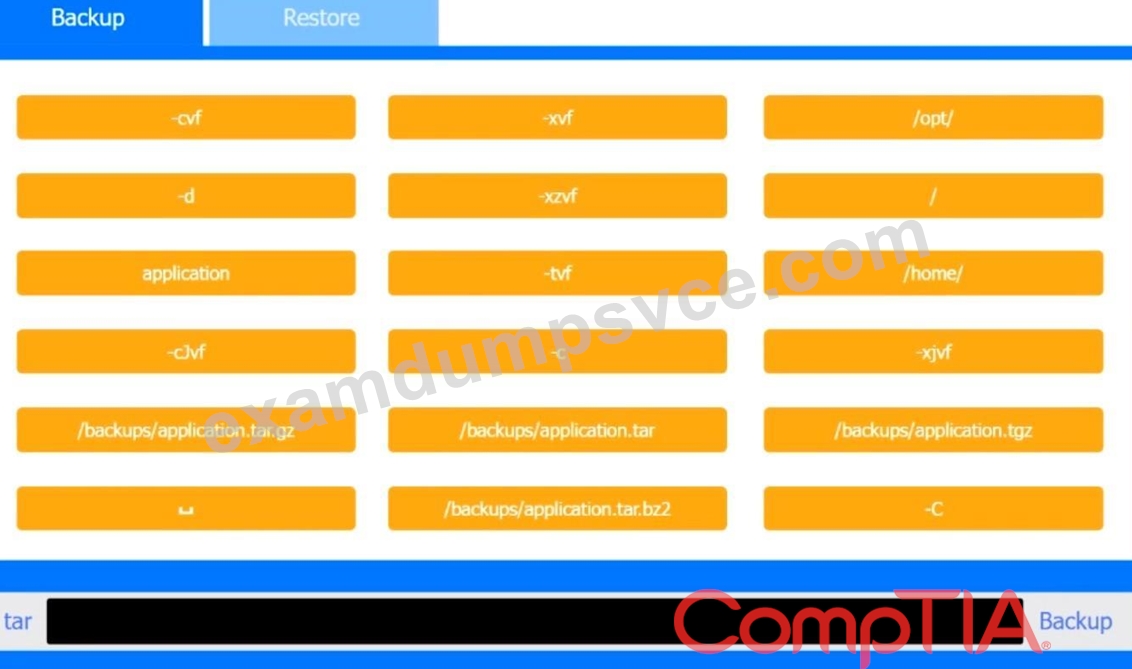
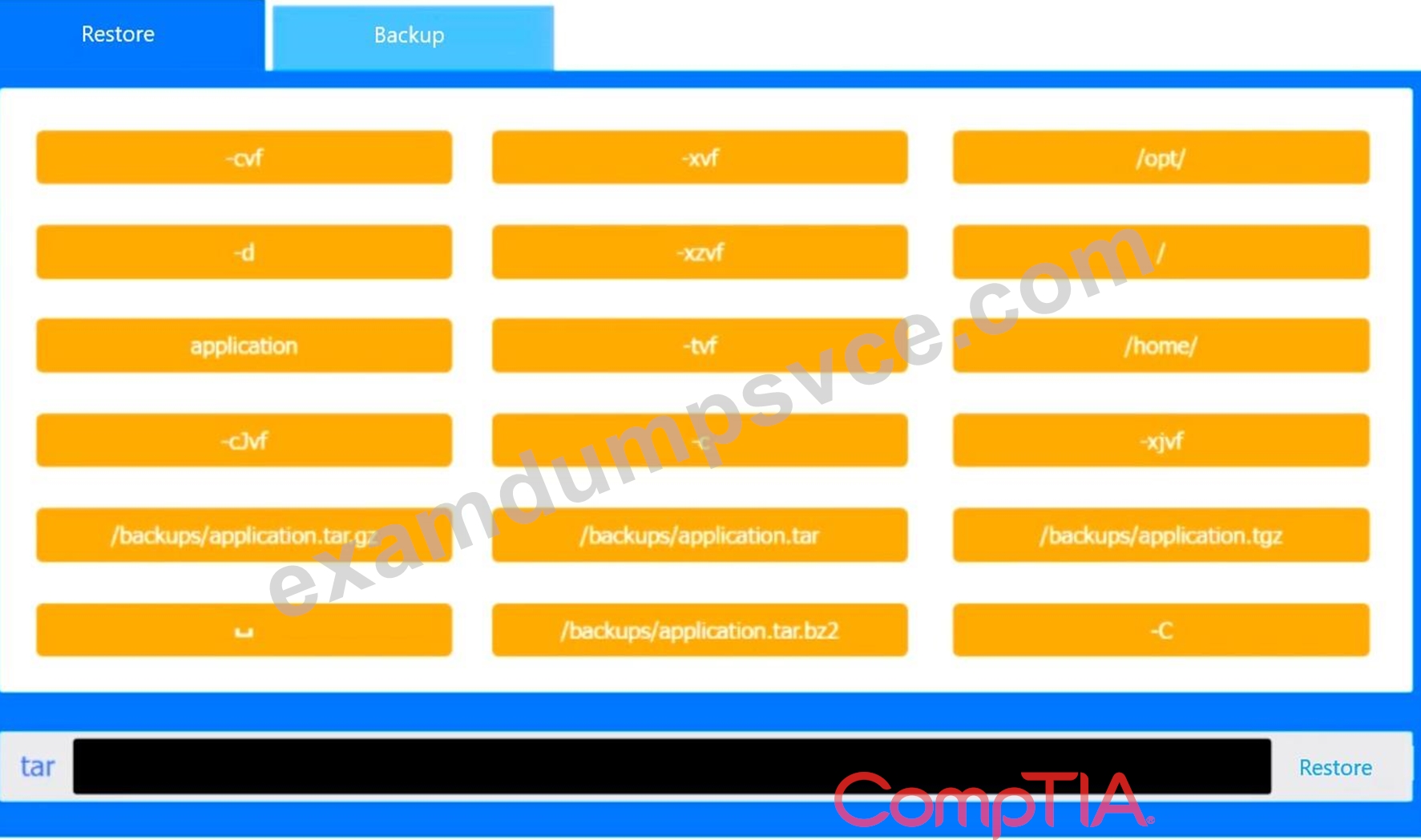
Answer:
Explanation: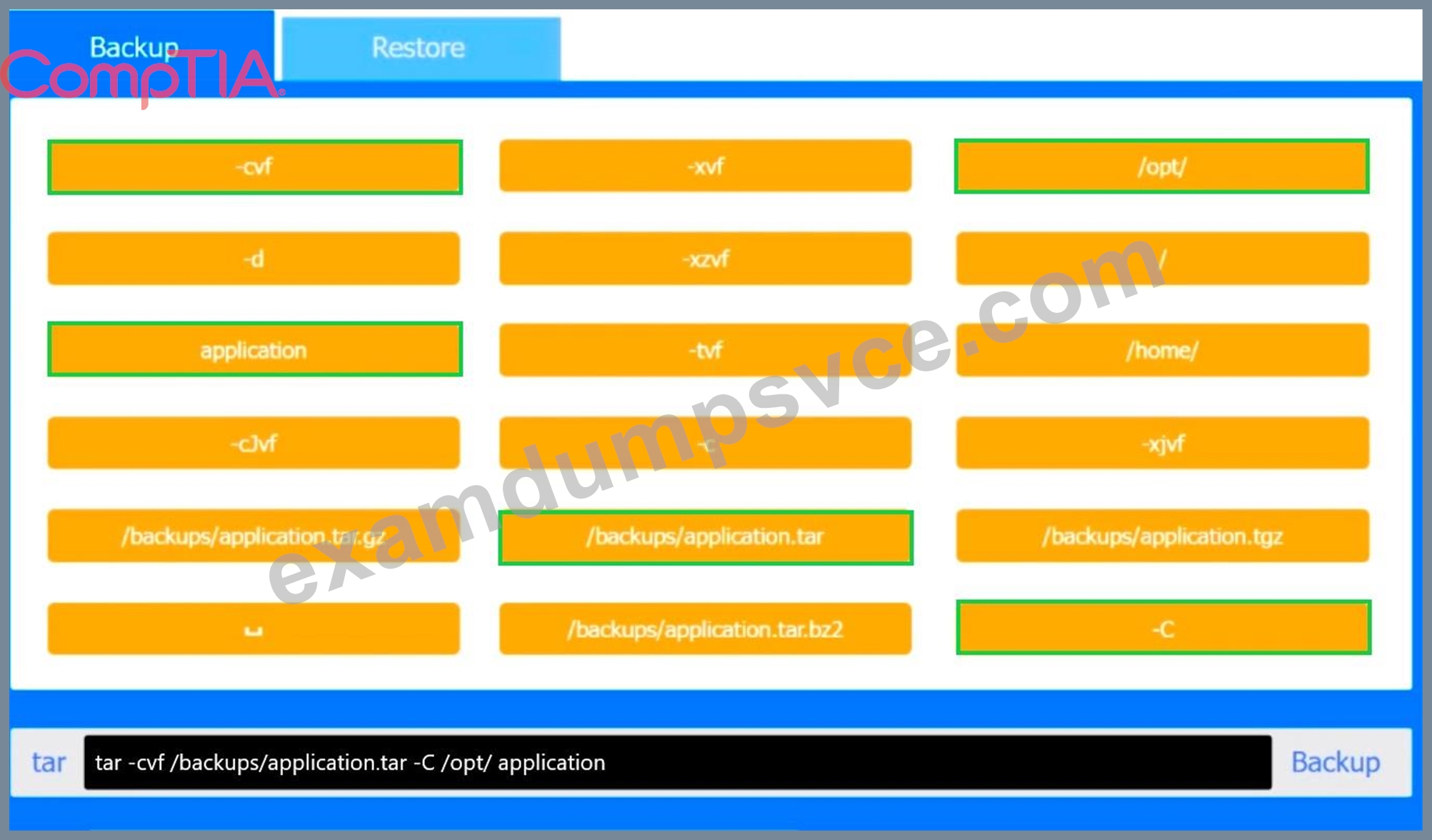
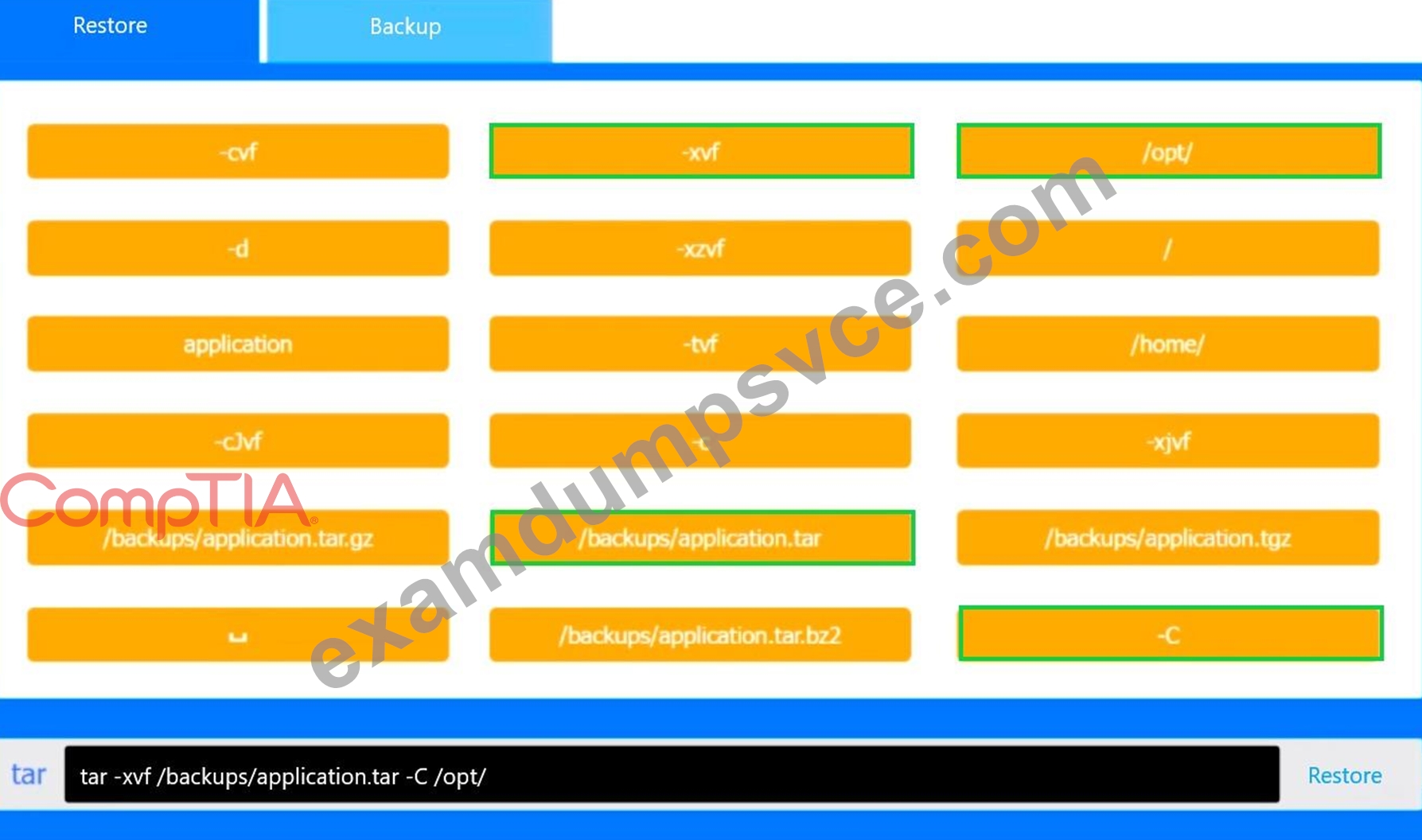
-cvf creates (-c) a verbose (-v) archive file (-f) named /backups/application.tar.
-C /opt/ application changes to /opt/ so only the relative application directory is saved, avoiding absolute paths.
-xvf extracts (-x) the same archive, and -C /opt/ restores the contents back into the original location.
NEW QUESTION # 89
An administrator attempts to install updates on a Linux system but receives error messages regarding a specific repository. Which of the following commands should the administrator use to verify that the repository is installed and enabled?
- A. yum repo-pkgs
- B. yum repolist all
- C. yum list installed repos
- D. yum reposync available
Answer: B
Explanation:
Package management troubleshooting is an important skill in Linux+ V8, especially on RPM-based distributions that use yum or dnf. When update errors reference a repository, the administrator must verify whether the repository exists and whether it is enabled.
The command yum repolist all displays all configured repositories, including those that are enabled, disabled, or temporarily unavailable. This makes it the most effective command for diagnosing repository-related issues. It allows administrators to quickly confirm the repository's status and take corrective action, such as enabling it or fixing configuration errors.
The other options are incorrect. yum repo-pkgs manages packages within a repository but does not list repository status. yum list installed repos is not a valid yum command. yum reposync is used to mirror repositories locally and is not intended for verification.
Linux+ V8 documentation highlights yum repolist all as the standard command for repository inspection and troubleshooting.
Therefore, the correct answer is D. yum repolist all.
NEW QUESTION # 90
A Linux systems administrator is creating a new file, /var/tmp/myfile. This file needs to point to /usr/local/myfile. Both files reside on different filesystems. Which of the following commands should the administrator use to accomplish this task?
- A. ln -s /usr/local/myfile /var/tmp/myfile
- B. link /usr/local/myfile /var/tmp/myfile
- C. touch /usr/local/myfile | file /var/tmp/myfile
- D. cat /usr/local/myfile > /var/tmp/myfile
Answer: A
Explanation:
A symbolic link can reference a target located on a different filesystem, making it the correct method for creating a pointer from /var/tmp/myfile to /usr/local/myfile when the files reside on separate filesystems.
NEW QUESTION # 91
......
Free XK0-006 Exam Dumps to Improve Exam Score: https://braindump2go.examdumpsvce.com/XK0-006-valid-exam-dumps.html
