

Online SD-WAN-Engineer Test Brain Dump Question and Test Engine
Real Palo Alto Networks SD-WAN-Engineer Exam Dumps with Correct 88 Questions and Answers
NEW QUESTION # 13
When configuring SASE connectivity with easy onboarding at a branch, which two options must be selected?
(Choose two.)
- A. IPSec Termination Node
- B. Prisma Access Primary Location
- C. IPSec Crypto Profile
- D. Prisma Access IKE Profile
Answer: A,B
Explanation:
Prisma SD-WAN simplifies the integration with Prisma Access through a feature known as "CloudBlades," specifically the Prisma Access for Networks CloudBlade. The "easy onboarding" workflow is designed to automate the complex task of establishing secure tunnels between Branch ION devices and the SASE security processing nodes (SPNs).
When an administrator initiates this process, the system abstracts the manual configuration of IKE and IPSec parameters. Instead of manually defining an IPSec Crypto Profile or an IKE Profile (which are automatically handled by the CloudBlade orchestration), the user must specify where the traffic is going and which physical resources will handle the connection. The Prisma Access Primary Location (Option B) is a mandatory selection because it determines the geographical region and specific compute instance within the Prisma Access cloud that will serve as the primary security gateway for that branch.
Furthermore, the IPSec Termination Node (Option D) must be selected to define the specific endpoint within the Prisma Access infrastructure where the ION device's tunnels will terminate. This selection ensures that the Controller can properly orchestrate the site-to-site VPN tunnels, ensuring that the branch traffic is correctly routed to the SASE fabric for security inspection. By selecting these two options, the CloudBlade can automatically negotiate the rest of the tunnel parameters, significantly reducing the potential for human error and accelerating the deployment of a Secure Access Service Edge (SASE) architecture across multiple branch locations.
NEW QUESTION # 14
An administrator needs to generate a monthly report showing the "Top Applications" by bandwidth usage across all branch sites to justify a bandwidth upgrade.
Which specific component of the Prisma SD-WAN interface is designed to create, schedule, and email these PDF summaries?
- A. Reports
- B. Flow Browser
- C. Media Analytics
- D. Activity Charts
Answer: A
Explanation:
Comprehensive and Detailed Explanation
Prisma SD-WAN separates real-time visibility from historical summarization.
* Reports (C): The Reports section is the dedicated engine for generating historical summaries.
Administrators can create custom report templates (e.g., "Monthly Executive Summary") that include specific widgets like "Top Applications by Volume," "Site Availability," or "Circuit Utilization." Crucially, this feature allows for Scheduling, where the system automatically generates the PDF report at a set interval (e.g., first day of the month) and emails it to a distribution list.
* Activity Charts (A) / Media Analytics (B): These provide interactive, visual graphs for ad-hoc analysis but are not designed for generating downloadable, scheduled PDF summaries for management.
* Flow Browser (D): This is for deep-dive troubleshooting of individual sessions, not for high-level aggregate reporting.
NEW QUESTION # 15
In the Prisma SD-WAN portal, the Application Health dashboard assigns a color-coded "Health Score" (Green, Yellow, Red) to applications.
Which three metrics are combined to calculate this composite AppX (Application Experience) score? (Choose three.)
- A. Network Transfer Time (NTT)
- B. Transaction Failure Rate
- C. Jitter
- D. Bandwidth Utilization
- E. Server Response Time (SRT)
Answer: A,B,E
Explanation:
Comprehensive and Detailed Explanation
The AppX (Application Experience) score is a proprietary metric used by Prisma SD-WAN to provide a holistic view of user experience, rather than just network statistics. It is calculated based on three key components:
* Transaction Failure Rate (A): The percentage of application transactions that failed (e.g., TCP resets, HTTP 500 errors). This indicates availability.
* Network Transfer Time (B): The time taken for packets to traverse the network (WAN/LAN latency).
This indicates network health.
* Server Response Time (C): The time taken by the application server to respond to a request. This indicates backend performance.
Why not D or E?
* Bandwidth Utilization (D) is a capacity metric, not a direct measure of quality. A link can be 90% full but still deliver packets quickly (good AppX), or 10% full but dropping packets (bad AppX).
* Jitter (E) is a network-layer metric primarily relevant for UDP Real-Time media. While important, the high-level "AppX" score for general TCP apps focuses on the "Time-to-Glass" metrics (NTT/SRT) and success rates.
NEW QUESTION # 16
In a data center (DC) with two ION devices, all of the remote branch Prisma SD-WAN VPNs are active only on DC ION-1.
Why are no VPNs active on DC ION-2?
- A. The DC and branches are in a different domain.
- B. The BGP core peer is down.
- C. The ION device is behind a NAT.
- D. The static route to core as a next hop is missing.
Answer: B
Explanation:
Comprehensive and Detailed Explanation
In a Prisma SD-WAN Data Center deployment, the operational state of the Secure Fabric VPNs (overlay tunnels) is directly tied to the health of the BGP Core Peer configuration.4 Core Peer Dependency: DC ION devices typically peer with the data center core switch (Core Router) via BGP to learn the subnets (prefixes) for the applications hosted in the DC. The Prisma SD-WAN controller monitors this BGP peering status.5 Controller Logic: If the BGP Core Peer on a DC ION goes down (or is not established), the controller automatically marks the VPN tunnels terminating at that specific ION as "Inactive".6 This is a fail-safe mechanism designed to prevent remote branches from sending traffic to a DC ION that has lost conne7ctivity to the internal data center network (and thus the applications).
Scenario Analysis: In this scenario, DC ION-1 has active VPNs, meaning its BGP Core Peer is UP and it is successfully advertising reachability. DC ION-2 has no active VPNs, which strongly indicates that its BGP Core Peer is down.8 Because the controller sees the peer is down, it suppresses the tunnel establishment or marks existing tunnels as inactive to ensure traffic is only directed to the healthy node (ION-1).
NEW QUESTION # 17
Full discovery and classification of IoT devices by the IoT Security service is failing. Which Prisma SD- WAN ION device configuration will cause this behavior?
- A. The Prisma SD-WAN ION devices lack properly configured or enabled Service Health Probes specifically targeting the IoT device subnets. Without these active probes, the system cannot gather critical real-time reachability and performance metrics essential for dynamic device profiling and classification.
- B. The Syslog export configuration on the ION devices to the Strata Logging Service has filters that are too restrictive, potentially excluding logs vital for IoT Security's device identification and classification engine. This prevents comprehensive event data, including device discovery messages, from reaching the portal.
- C. The ION devices are missing DHCP Configuration. If ION devices are not explicitly configured as either a DHCP relay agent or a DHCP server, DHCP traffic logs will not be sent to the Strata Logging Service, resulting in incomplete device profiles for IoT Security.
- D. The ION devices are not configured to explicitly enable and export IPFIX flow records, especially those containing Layer 2 and Layer 7 context, to the Strata Logging Service for IoT Security. While ARP data is sent by default, comprehensive device classification relies on these detailed flow records, which are not being captured.
Answer: C
Explanation:
Palo Alto Networks IoT Security relies on rich metadata and traffic logs to identify, classify, and secure devices across the network. A critical component of this discovery process is the ingestion of DHCP (Dynamic Host Configuration Protocol) traffic. DHCP packets contain vital information about a device, such as the MAC address, vendor-specific identifiers (Option 60), and hostnames, which are used by the machine learning engine to create a precise device profile.
In a Prisma SD-WAN environment, if the ION devices are not involved in the DHCP process, the necessary logs cannot be forwarded to the Strata Logging Service (SLS) for analysis by the IoT Security cloud. To ensure successful discovery, the ION device at the branch must be explicitly configured as either the DHCP Server for the local segment or as a DHCP Relay Agent. When the ION handles DHCP traffic, it automatically extracts and sends the relevant metadata to the cloud.
If the ION is bypassed-for example, if a local Layer 3 switch is handling DHCP internally without relaying it to the ION-the IoT Security service will lack the context needed to move beyond basic IP-level visibility.
Without these DHCP-derived "fingerprints," the system cannot perform the full classification required to apply granular security policies or identify potential vulnerabilities. Therefore, verifying that the ION device is correctly integrated into the DHCP lifecycle is the primary troubleshooting step for incomplete IoT device discovery in the Prisma SD-WAN portal.
NEW QUESTION # 18
Two branch sites, "Branch-A" and "Branch-B", are both behind active NAT devices (Source NAT) on their local internet circuits.
What requirement must be met for these two branches to successfully establish a direct Dynamic VPN (ION-to-ION) tunnel over the internet?
- A. Both sites must disable NAT and use public IPs on the ION interface.
- B. One of the sites must have a Static Public IP (1:1 NAT) to act as the initiator.
- C. The ION devices automatically use STUN (Session Traversal Utilities for NAT) to discover their public IPs and negotiate the connection.
- D. Dynamic VPNs are not supported if both sides are behind NAT.
Answer: C
Explanation:
Comprehensive and Detailed Explanation
Prisma SD-WAN supports Dynamic VPNs (Branch-to-Branch) even when both endpoints are behind Source NAT (e.g., typical broadband connections).
To achieve this, the ION devices utilize standard NAT Traversal techniques, specifically leveraging STUN (Session Traversal Utilities for NAT).
Discovery: Each ION communicates with the Cloud Controller (which acts as a STUN server/signaling broker). Through this communication, the controller observes the public IP and Port that the ION's traffic is coming from (the post-NAT address).
Signaling: The controller shares this public reachability information with the peer ION.
Hole Punching: The IONs then attempt to initiate connections to each other's discovered public IP/Port. This "UDP Hole Punching" allows them to establish a direct IPSec tunnel through the NAT devices without requiring static 1:1 NAT mapping or manual port forwarding on the provider routers, enabling mesh connectivity in commodity internet environments.
NEW QUESTION # 19
A network operator receives a critical SITE_CONNECTIVITY_DOWN alarm for a branch site in the Prisma SD-WAN portal.
What specific condition triggers this alarm type?
- A. All Secure Fabric Links (VPNs) to all remote peers are down, isolating the site from the overlay.
- B. The device has lost power and rebooted.
- C. One of the two internet circuits at the site has gone down.
- D. The site has exceeded its licensed bandwidth capacity.
Answer: A
Explanation:
Comprehensive and Detailed Explanation
The SITE_CONNECTIVITY_DOWN alarm is a high-severity alert indicating a total loss of overlay connectivity for a site.
It does not trigger if just one circuit fails (Option B), provided that other circuits are still up and maintaining VPNs. A single link failure would typically trigger a "Link Down" or "VPN Down" alarm, but the Site connectivity would remain "Up" (degraded).
It does not simply mean the device rebooted (Option A), although a reboot would cause it temporarily; the alarm specifically tracks the state of the VPN fabric.
The SITE_CONNECTIVITY_DOWN alarm specifically generates when all Secure Fabric Links (VPN tunnels) on the device are in the "Down" state. This means the branch is completely isolated from the rest of the SD-WAN network (Data Centers and other branches), even if the device itself might still be powered on and reachable via the controller (management plane). It signifies a "Blackout" of the data plane for that location.
NEW QUESTION # 20
While designing a greenfield Prisma SD-WAN solution for a retailer, the risk management group requires segmentation of the retail network to avoid one large fault domain.
The following data points are provided:
* Two data centers and all sites need to access applications in both data centers
* 1000 retail branches with stores concentrated in multiple metropolitan areas
* Data Center 1 and Data Center 2 have different sets of applications that are not replicated
* Maintaining application availability is the primary goal
Which action will segment the retail network and reduce regional outages?
- A. Add more data center aggregation devices within the same cluster to enhance the scalability and resilience.
- B. Create more than one data center cluster in each data center and assign sites to clusters so nearby retail locations can be spread on separate clusters.
- C. Create more than one data center cluster for a larger pool of resources and resiliency.
- D. Implement a single, large data center cluster spanning both data centers to centralize management and optimize resource use.
Answer: B
Explanation:
In large-scale Prisma SD-WAN deployments, such as a retail network with 1,000 branches, architectural resilience is achieved through a strategy known as Hub Clustering. A Data Center Cluster is a logical grouping of ION devices at a hub site that provides termination for branch-to-DC VPN tunnels. To prevent the creation of a massive, single fault domain, Palo Alto Networks best practices recommend segmenting the branch population across multiple clusters.
By creating more than one data center cluster in each data center and strategically assigning sites to these clusters, an administrator can effectively isolate failure events. In a metropolitan area where stores are concentrated, spreading nearby retail locations across different clusters ensures that a localized resource failure or a cluster-specific misconfiguration only impacts a subset of the stores in that region rather than causing a complete regional outage.
This design directly addresses the requirement for maintaining application availability. Since Data Center 1 and Data Center 2 host different applications, each branch site must maintain active paths to both DCs. By using multiple clusters at each DC, the risk management group's goal of avoiding a large fault domain is met through "blast radius" containment. If Cluster A at Data Center 1 fails, the 1,000 sites are not all affected simultaneously; instead, only the specific sites bound to Cluster A lose connectivity to that hub, while their neighbors bound to Cluster B remain functional. This approach provides the highest level of regional resiliency and operational stability for high-density retail environments.
NEW QUESTION # 21
There are periodic complaints about the poor performance of a real-time application.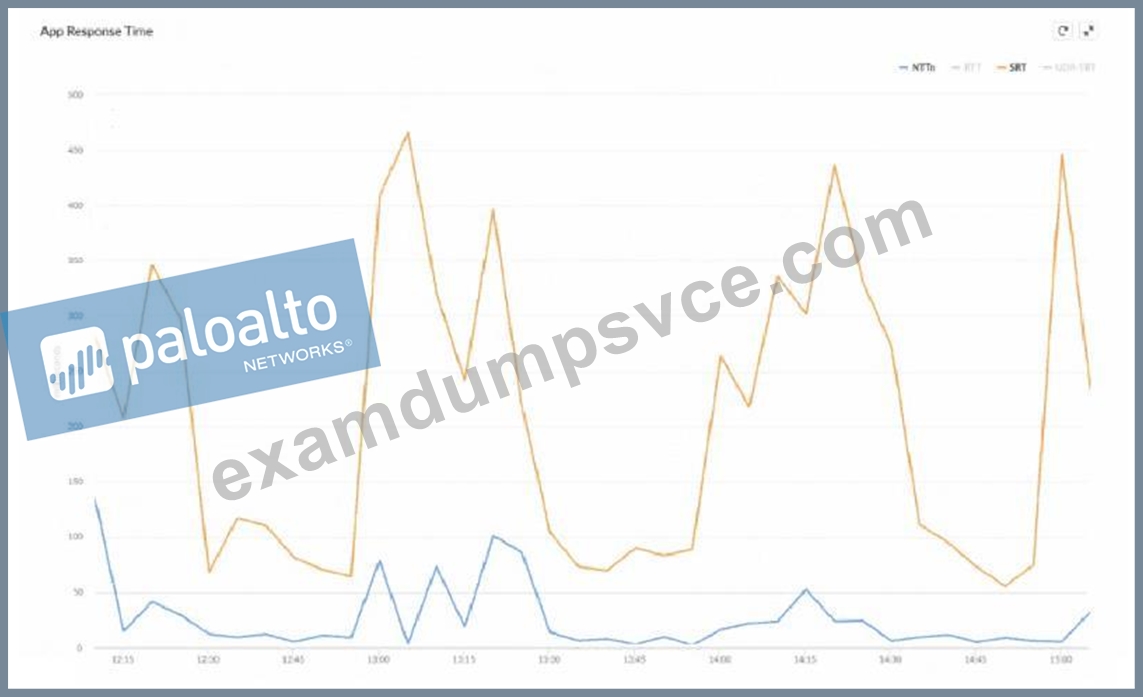
What can be inferred about the performance issue, based on the Network Transfer Time (NTT) and Server Response Time (SRT) image below?
- A. The SRT value increases periodically due to Application Server side issues.
- B. The NTT value increases periodically resulting in higher SRT.
- C. The NTT value drops periodically due to network related issues.
- D. The SRT value drops periodically due to Application Server side issues.
Answer: A
Explanation:
In Prisma SD-WAN, application performance is monitored through distinct metrics that separate network health from application health. The provided graph displays Network Transfer Time (NTT) in blue and Server Response Time (SRT) in orange. NTT measures the round-trip time of packets traversing the WAN fabric, while SRT measures the time elapsed from when the server receives a request to when it sends the first response packet.
Analysis of the telemetry data shows that the NTT (blue line) remains consistently low and stable, generally staying below 100 milliseconds throughout the capture period. This indicates that the SD-WAN path and underlying network circuits are not the source of the latency. Conversely, the SRT (orange line) exhibits significant and erratic spikes, reaching as high as 450 to 475 milliseconds. These spikes occur while the network latency (NTT) remains flat.
Because the latency increases are isolated to the SRT metric, the root cause is confirmed to be on the Application Server side. This pattern typically suggests that the server is struggling with resource exhaustion, high CPU utilization, or database query delays during peak processing times. For a real-time application, these SRT spikes translate directly to jitter and "lag" for the end-user. By distinguishing between these two metrics, Prisma SD-WAN allows network administrators to prove that the network is performing within SLA and shift the troubleshooting focus to the application or server management teams, significantly reducing mean time to innocence (MTTI).
NEW QUESTION # 22
1000 branches are to be deployed on Prisma SD-WAN with the following constraints:
* Devices will be shipped in batches directly to the site
* Configuration Management Database (CMDB) has all the necessary details for a site deployment
* Field tech will be responsible for rack, stack, and cabling of the IONs at each site
* Field tech will need to spend minimum amount of time at each branch site to reduce the cost
* The NOC operates in shifts and is responsible for remote cutover support Which method will achieve the mass deployment in shortest possible time?
- A. Connect the device to the ISP modem or use cellular, use device shell to pre-create the configuration for a site, assign the device to the template when device is online, and connect the LAN switch to the ION.
- B. Connect the device to the ISP modem or use cellular, use Prisma SD-WAN Software Development Kit (SDK) using API method for site deployment once the device is online, connect the LAN switch to the ION.
- C. Use site templates and device shells to pre-create the configuration using CSV bulk upload, connect the device to the ISP modem or using cellular, assign the device to the template when device is online, and connect the LAN switch to the ION.
- D. Connect the ION to the LAN switch to bring it online, configure the device using the legacy network, connect the ISP modem or cellular, and cutover the site once the ION is configured.
Answer: C
Explanation:
For a massive rollout involving 1,000 branch sites, Prisma SD-WAN (formerly CloudGenix) provides a specialized workflow known as Bulk Site Configuration. This method is designed to minimize manual intervention and maximize deployment velocity by leveraging Site Templates and Device Shells.
In this scenario, the primary architectural advantage of Option C is the use of Pre-Staging. By exporting an empty SD-WAN device CSV from the Prisma SD-WAN Controller and populating it with data from the corporate CMDB, administrators can perform a bulk upload to create hundreds or thousands of sites and device shells simultaneously in the management portal. A "Device Shell" acts as a placeholder for a physical ION device that has not yet connected to the cloud. It contains all the site-specific configuration-such as interface roles, circuit labels, and IP addressing-waiting for a serial number to be associated with it.
When the field technician performs the physical "rack and stack," they simply connect the ION device to the internet (via ISP modem or cellular). Through Zero Touch Provisioning (ZTP), the device automatically
"phones home" to the Prisma SD-WAN Cloud Controller using its Manufacturer Installed Certificate (MIC).
Because the configuration was pre-created via the CSV bulk upload, the controller recognizes the device (once assigned to its shell) and immediately pushes the complete configuration. This eliminates the need for the field tech to access a console port or perform local configuration, reducing their on-site time to the bare minimum. While APIs (Option D) can be used for automation, the built-in CSV template workflow is the standard, documented "best practice" for rapidly translating CMDB data into a functioning SD-WAN fabric at this scale.
NEW QUESTION # 23
Site templates are to be used for the large-scale deployment of 100 Prisma SD-WAN branch sites across different regions.
Which two statements align with the capabilities and best practices for Prisma SD-WAN site templates? (Choose two.)
- A. Site templates offer the capability to pre-stage device configurations by creating a device shell.
- B. The use of Jinja conditional statements within a site template is not supported, thereby limiting dynamic customization options.
- C. Once a site has been deployed using a template, its configuration can be updated or modified by applying an updated version of the template.
- D. Mandatory variables for any site template include the site name, ION software version, and at least one ION serial number /device name pair.
Answer: A,D
Explanation:
Comprehensive and Detailed Explanation
Site Templates (often referred to as Site Configuration Templates) are a critical tool for the Zero Touch Provisioning (ZTP) of large-scale deployments in Prisma SD-WAN.
1. Device Pre-staging (Statement C):
One of the primary capabilities of Site Templates is the creation of Device Shells. A device shell is a configuration container that exists in the controller before the physical hardware is installed or connected. By using a template, an administrator can pre-provision the entire configuration (interfaces, routing, subnets) for the "Site" and "Element" (Device). When the physical ION device is later connected to the internet and claimed (associated with the shell via its Serial Number), it immediately inherits this pre-staged configuration, enabling a true "plug-and-play" deployment.
2. Mandatory Variables (Statement B):
To successfully instantiate a functional site from a generic template, specific unique identifiers are required in the variable data set (typically a CSV file).
Site Name: Identifies the location in the portal.
ION Software Version: Ensures the device boots to the specific validated code version required for the deployment, preventing inconsistencies.
ION Serial Number / Device Name: Required to bind the logical configuration (Shell) to the physical hardware. Even if the serial is added later during the claim process, the structure of the template and the deployment workflow mandates these variables to ensure the device can be uniquely identified and managed within the fabric.
Note on Option D: While it is technically possible to re-deploy a template, the Best Practice for "Day 2" operations (updating or modifying configuration after deployment) is to use Prisma SD-WAN Stacks (Network Stacks, Security Stacks, etc.). Stacks allow for granular, policy-based updates across multiple sites without the destructive or rigid nature of re-applying a full site initialization template. Therefore, D is not the aligned best practice.
NEW QUESTION # 24
A network engineer is able to ping and traceroute from SD-WAN branch IP 192.168.1.123 to servers in primary data center - DC1, but is unable to ping or traceroute to a server 10.2.2.22 in the newly configured secondary data center, DC2.
The DC2 ION device is advertising the branch IP subnet 192.168.1.0/24 to the DC2 core via eBGP Core Peer. The DC2 data center site has site prefix 10.2.2.0/23 configured.
Which configuration will resolve the issue in this scenario?
- A. The default 0.0.0.0/0 static route to the DC2 ION pointing to the DC2 next hop.
- B. Reconfigure eBGP Core Peer as Edge Peer type.
- C. Remove site prefix 10.2.2.0/23 from DC2 site configuration.
- D. Reconfigure eBGP Core Peer to iBGP Core Peer.
Answer: A
Explanation:
Comprehensive and Detailed Explanation at least 150 to 250 words each from Palo Alto Networks SD-WAN Engineer documents:
In a Prisma SD-WAN deployment, the routing of traffic between branches and Data Centers (DCs) relies on the proper synchronization between the AppFabric (the overlay) and the local routing protocols (the underlay/LAN side). In this scenario, the branch can successfully reach DC1, indicating the branch ION is correctly participating in the fabric. However, traffic to DC2 (10.2.2.22) is failing.
The DC2 site has the site prefix 10.2.2.0/23 configured. In Prisma SD-WAN, defining a site prefix informs the Controller that this specific subnet "belongs" to that site, causing the Controller to advertise reachability for this prefix to all other ION devices in the fabric. Consequently, when the branch ION (192.168.1.123) attempts to reach 10.2.2.22, it correctly identifies DC2 as the destination and encapsulates the traffic toward the DC2 ION.
The bottleneck occurs once the packet arrives at the DC2 ION. While the ION is advertising the branch subnet (192.168.1.0/24) to the DC Core (ensuring the return path), the ION itself must know how to forward the incoming traffic from the branch to the internal DC network. If the DC2 ION does not have a specific route in its local routing table for the 10.2.2.0/23 subnet pointing to the DC Core's internal interface, the packet will be dropped.
According to Palo Alto Networks best practices for Data Center ION deployment, a static default route (0.0.0.0/0) should be configured on the ION device pointing toward the DC Core's next-hop IP address. This ensures that any traffic received from the AppFabric destined for internal DC resources-which are not directly connected to the ION-is successfully handed off to the core switching fabric for final delivery. Adding this default route (Option A) resolves the reachability issue by providing the "last-hop" routing instruction within the DC.
NEW QUESTION # 25
Which component of the Prisma SD-WAN solution is responsible for the deep application identification (App- ID) and the generation of flow metrics (Network Transfer Time, Server Response Time) at the branch?
- A. The ION Device Data Plane
- B. The Prisma SD-WAN Controller
- C. The API Gateway
- D. The CloudBlade container
Answer: A
Explanation:
Comprehensive and Detailed Explanation
The ION Device Data Plane (the software running locally on the hardware appliance at the branch) is the component responsible for the heavy lifting of traffic analysis.
* Edge Processing: Prisma SD-WAN uses an "Application-Defined" architecture. The ION device performs Deep Packet Inspection (DPI) on the first few packets of a flow to identify the application (e.
g., distinguishing "Skype Video" from "Skype Chat").
* Metric Calculation: The ION device timestamping engine calculates the performance metrics (RTT, NTT, SRT) in real-time as packets pass through its interfaces. It aggregates this metadata.
* Role of Controller (B): The Controller collects and visualizes this data (Analytics), but it does not generate it. The Controller does not sit in the data path of the user traffic. If the ION relied on the controller for App-ID, latency would be unacceptably high. Therefore, all detection and metric generation happens locally on the ION Device.
NEW QUESTION # 26
In a Data Center deployment, what is the key functional difference between configuring a BGP neighbor as a
"Core Peer" versus an "Edge Peer"?
- A. A Core Peer is used for connecting to the internet, while an Edge Peer connects to the MPLS provider.
- B. A Core Peer automatically redistributes learned routes into the SD-WAN fabric, whereas an Edge Peer does not.
- C. A Core Peer is used for LAN-side routing to learn DC prefixes, while an Edge Peer is used for WAN- side routing to the Service Provider.
- D. A Core Peer supports eBGP only, while an Edge Peer supports iBGP only.
Answer: C
Explanation:
Comprehensive and Detailed Explanation
In the Prisma SD-WAN Data Center (DC) model, the terminology for BGP peers defines their role in the topology and how the system generates route maps.
* Core Peer: This peer type is designated for the LAN-side connection (facing the DC Core Switch or internal Routers). Its primary purpose is to learn the subnets/prefixes hosted in the data center so the ION can advertise them to the remote branches. The system automatically creates route maps to facilitate this redistribution into the fabric.
* Edge Peer: This peer type is designated for the WAN-side connection (facing the Edge Router or MPLS PE). Its primary purpose is to provide reachability to the underlay network.
* Distinction: Selecting the correct type affects the default Route Maps and Prefix Lists generated by the controller. Configuring a Core Peer correctly ensures that the DC's internal subnets are properly learned and propagated to the overlay, whereas an Edge Peer configuration focuses on WAN next-hop reachability.
NEW QUESTION # 27
Which troubleshooting action should be taken when resources at one branch site can reach the internet but cannot be reached from the data center (DC)?
- A. Create static route with DC ION as a next hop.
- B. Ensure the LAN branch prefixes are set to "global."
- C. Admin up the Prisma SD-WAN DC endpoints.
- D. Set the site in a control mode.
Answer: B
Explanation:
In the Prisma SD-WAN architecture, reachability between sites is managed by the Control Plane, which automatically advertises prefixes across the secure fabric based on their scope. If a branch site has successful Direct Internet Access (DIA) but is invisible to the Data Center (DC), it indicates that while the local ION is online, its internal network information has not been propagated to the rest of the SD-WAN fabric.
The most common cause for this behavior is that the LAN interfaces or static routes at the branch are configured with a Local scope rather than a Global scope. When a prefix is set to "Local," the ION device treats that network as reachable only within that specific site; it will not advertise that prefix to the Controller for distribution to other ION devices, such as those at the Data Center. By ensuring the LAN branch prefixes are set to "global" (Option B), the administrator instructs the ION device to share these routes with the global fabric.
Once the prefix is marked as global, the Prisma SD-WAN Controller identifies it as a reachable destination and updates the routing tables of all peer ION devices in the same domain, including the DC gateways. This allows the Data Center to build a valid path to the branch resources over the secure VPN tunnels. Options like creating static routes (Option A) or changing site modes (Option C) do not address the fundamental requirement of prefix advertisement within the software-defined fabric, which relies on correctly defined metadata like route scope.
NEW QUESTION # 28
......
Palo Alto Networks SD-WAN-Engineer Exam Syllabus Topics:
| Topic | Details |
|---|---|
| Topic 1 |
|
| Topic 2 |
|
| Topic 3 |
|
| Topic 4 |
|
| Topic 5 |
|
Valid SD-WAN-Engineer Test Answers & Palo Alto Networks SD-WAN-Engineer Exam PDF: https://braindump2go.examdumpsvce.com/SD-WAN-Engineer-valid-exam-dumps.html
