

Authentic L5M5 Dumps With 100% Passing Rate Practice Tests Dumps
CIPS L5M5 Real Exam Questions Guaranteed Updated Dump from ExamDumpsVCE
NEW QUESTION # 29
Which of the following form the 'Triple Bottom Line'? Select THREE
- A. People
- B. Product
- C. Placement
- D. Planet
- E. Profit
Answer: A,D,E
Explanation:
Comprehensive and Detailed Explanation From Exact Extract of Documents:
The concept of the Triple Bottom Line (TBL), also referred to as the "3Ps," is a framework that assesses organisational success through People, Planet, and Profit. These dimensions highlight the balance between social equity (people), environmental stewardship (planet), and economic performance (profit). According to the CIPS L5M5 study guide (p.3), procurement and supply professionals are expected to incorporate sustainability into decision-making processes, ensuring that business practices do not only create economic value but also deliver positive social and environmental impacts. "Product" and "Placement" are not part of the TBL model, as they are marketing-related concepts, not sustainability measures. This principle ensures procurement strategies align with corporate responsibility and long-term sustainable growth.
Reference: Managing Ethical Procurement and Supply (L5M5) Study Guide, p.3
NEW QUESTION # 30
Which of the following is a requirement for an Environmental Management System (EMS) according to ISO 14001?
- A. Periodic reviews conducted by external auditors
- B. Setting recycling targets
- C. A sustainability policy statement
- D. An environmental policy statement
Answer: D
Explanation:
Choice B - Under ISO 14001: Environmental Management System (EMS), an organization is required to establish, implement, and maintain an environmental policy statement that reflects its commitment to environmental protection, regulatory compliance, and continuous improvement.
Incorrect answer:
Choice A - While sustainability is important, ISO 14001 specifically requires an environmental policy statement, not a sustainability policy. Sustainability encompasses a broader scope, including social and economic factors, whereas ISO 14001 focuses primarily on environmental aspects.
Choice C - ISO 14001 does not mandate specific recycling targets. Instead, it requires organizations to identify their environmental aspects and impacts, set environmental objectives, and develop action plans. Recycling may be one of the objectives, but it is not a mandatory requirement.
Choice D- While ISO 14001 requires periodic reviews (such as internal audits and management reviews), external audits are not mandatory unless the organization seeks ISO 14001 certification. Certification audits are conducted by third-party auditors, but internal audits and management reviews are the primary monitoring mechanisms required by the standard.
Reference:
LO-3.2; Page 284-285; Role of industry standards and frameworks used by organizations in securing ESG considerations and ethical standards
NEW QUESTION # 31
Which of the following technologies is increasingly being adopted in supply chain management to enhance transparency, traceability, and prevent counterfeit products?
- A. Supply Chain Operations Reference (SCOR)
- B. Blockchain
- C. Value Stream Mapping
- D. Value chain mapping
Answer: B
Explanation:
Option B- Blockchain technology aids supply chain mapping by providing tranparency over transactions and data exchanges across the supply chain. Blockchain enables every transaction or activity across the supply chain to be securely recorded thus reducing instances of counterfeit products and increasing transparency in supply chain. Thus B is the correct choice.
Incorrect answer:
Option A- Value Chain Mapping focuses on analyzing activities within a business to identify value-adding processes.
Option C- Value Stream Mapping is a lean tool for visualizing and improving workflow.
Option D- Supply Chain Operations Reference (SCOR) is a model for managing and improving supply chain performance.
Reference:
LO-2.1; Page 149; Mapping supply chains to achieve supply chain transparency
NEW QUESTION # 32
XYZ Corp is seeking industry certification and has hired an external firm to assess its compliance with regulatory requirements and industry standards. The firm will provide an unbiased evaluation and recommend improvements. What type of audit is XYZ Corp conducting?
- A. Internal audit
- B. Compliance audit
- C. Third-party audit
- D. Financial audit
Answer: C
Explanation:
Choice B- While the audit focuses on compliance (option C), the key detail in the scenario is that the audit is being conducted by an external firm. This makes it a third-party audit. A compliance audit (option C) could be conducted either internally or externally, depending on the organization's approach.
Incorrect answer:
Choice A- Internal audits are conducted by the organization's own employees or an internal audit team to assess compliance, risks, and processes. Since XYZ Corp hired an external firm, this is not an internal audit.
Choice C- Although the audit involves assessing compliance with regulatory and industry standards, the key point in the scenario is the use of an external firm. This makes it a third-party audit. A compliance audit can be conducted internally, externally, or by a third party. Incorrect (in this context) Choice D- A financial audit focuses on verifying the accuracy of an organization's financial statements and records. The scenario does not mention financial data but instead focuses on regulatory and industry compliance. Therefore, this is not a financial audit.
Reference:
LO-2.3; Page 207-208; Sourcing third parties for auditing services
NEW QUESTION # 33
The development of a documented process to assess the environmental performance of suppliers prior to appointment, would be covered by which part of an ISO 14001:2015 environmental management system?
- A. Support
- B. Context of the organization
- C. Operation
- D. Performance evaluation
Answer: C
Explanation:
Choice B- This is the correct answer. The "Operation" clause of ISO 14001:2015 includes the need for an organization to establish processes for managing external impacts, such as assessing the environmental performance of suppliers and considering their sustainability efforts before appointing them.
Incorrect answer:
Choice A- This part of the ISO 14001:2015 focuses on monitoring, measuring, analyzing, and evaluating the environmental performance of the organization. It is more about assessing the internal processes rather than supplier assessment.
Choice C- This part focuses on understanding the external and internal factors that influence the organization's environmental management system, but not directly on supplier assessment processes.
Choice D- This section covers the resources, competence, awareness, communication, and documented information needed to support the environmental management system, but does not directly address the supplier evaluation process.
Reference:
LO-3.2; Page 284; Role of industry standards and frameworks used by organizations in securing ESG considerations and ethical standards
NEW QUESTION # 34
Which of the following is a disadvantage of the ISO14001 standard?
- A. It is different across industries
- B. Organisations are mandated to have an Environmental Policy
- C. Environmental targets are not set by ISO
- D. All companies use this for greenwashing
Answer: C
Explanation:
Comprehensive and Detailed Explanation From Exact Extract of Documents:
ISO14001 is an international standard for environmental management systems. According to the L5M5 study guide (p.277), one disadvantage is that ISO does not set environmental performance targets itself; instead, it requires organisations to define their own targets. This means some organisations may set very easy or minimal goals, limiting actual environmental improvement. Option A is incorrect as ISO14001 applies consistently across industries. Option C is a requirement, not a disadvantage. Option D is an overgeneralisation-while some firms misuse it for "greenwashing," many genuinely use it to improve sustainability.
Reference: Managing Ethical Procurement and Supply (L5M5) Study Guide, p.277
NEW QUESTION # 35
Scenario:
Apor is an online retailer of clothing and shoes. It sells four different fashion product lines:
Product 1: Apor has achieved competitive advantage on this product line by producing clothing cheaply. This has been achieved through investment in advanced manufacturing technology, which allows items to be made more cheaply than competitors.
Product 2: Apor is marketing to a younger customer segment for this product and has developed unique features that appeal to teenagers in particular.
Product 3: This product is a specialist type of shoe only purchased by professional dancers. Apor's strategy is to appeal to this small and specific customer segment, and it achieves advantage through low cost of manufacture. However, demand has been affected recently due to import duty and tax changes.
Product 4: The marketing slogan for this product is "Greener Clothing for the Planet". Although slightly more expensive than other ranges, Apor achieves advantage through the product's eco-friendly features, appealing to a smaller, specific segment.
Task:
For each product, match the correct Macro Environment Driver and the correct Source of Competitive Advantage.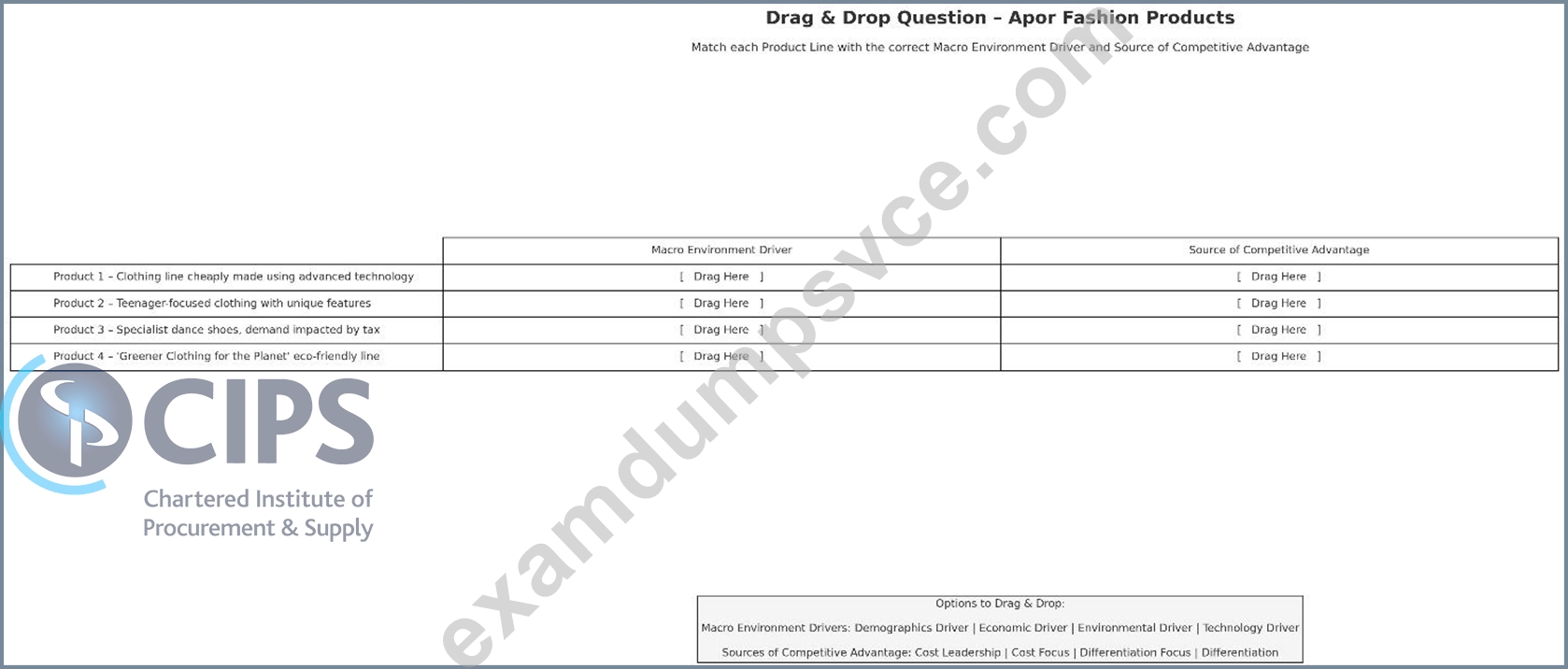
Answer:
Explanation: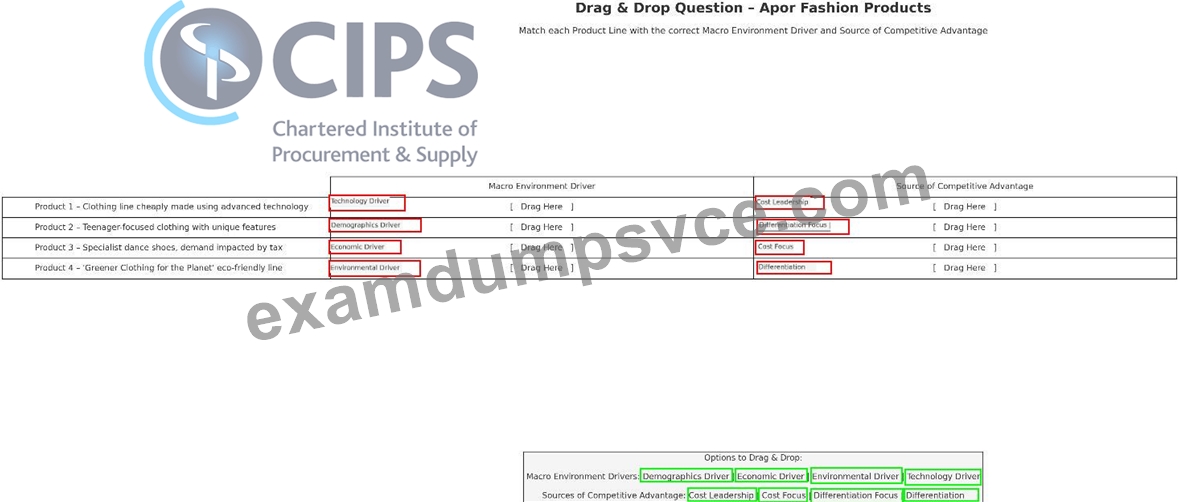
NEW QUESTION # 36
Which of the following are tools that a company can use to improve ethics and sustainability across the supply chain? Select THREE
- A. On-Site Audits
- B. Supplier Preferencing
- C. Supply Chain Mapping
- D. Benchmarking
- E. Cost Analysis
Answer: A,C,D
Explanation:
Comprehensive and Detailed Explanation From Exact Extract of Documents:
The L5M5 study guide highlights several tools procurement can use to embed ethics and sustainability into supply chains. These include benchmarking (A), which compares practices against best-in-class organisations; supply chain mapping (C), which provides visibility of all tiers of suppliers to identify risks; and on-site audits (D), which verify supplier compliance with ethical standards directly. Supplier preferencing (B) is a portfolio analysis tool used to understand suppliers' perspectives, not specifically an ethical improvement tool. Cost analysis (E) is primarily financial and does not ensure ethical compliance. Procurement professionals must apply tools like mapping and audits to identify risks such as forced labour, environmental harm, or corruption.
Reference: Managing Ethical Procurement and Supply (L5M5) Study Guide, section on supplier evaluation and sustainability tools
NEW QUESTION # 37
Seinfeld County Council has entered into a contract with a horticultural services provider. The contract contains a Community Benefit Clause. What is another term for this?
- A. Payment terms
- B. Reward for performance
- C. KPIs
- D. Social value
Answer: D
Explanation:
Comprehensive and Detailed Explanation From Exact Extract of Documents:
A Community Benefit Clause is also known as a Social Value Clause. The L5M5 study guide (p.126) explains that these clauses integrate economic, social, or environmental benefits into public sector contracts. For example, requiring the use of eco-friendly equipment or prioritising local employment. The Social Value Act 2012 formalised this requirement in UK public procurement. Procurement professionals must ensure such clauses are meaningful and enforceable to create real community benefits, not just tick-box exercises.
Reference: Managing Ethical Procurement and Supply (L5M5) Study Guide, p.126
NEW QUESTION # 38
A multinational retail company faces cybersecurity incidents, including unauthorized access to customer payment data and phishing attacks. To strengthen information security, the board seeks a globally recognized framework. The IT team must recommend the most suitable ISO standard for managing these risks systematically. Which ISO standard should the company adopt?
- A. ISO 9001
- B. ISO 45001
- C. ISO 20400
- D. ISO 27001
Answer: D
Explanation:
Choice A - ISO 9001 focuses on quality management and ensuring consistent product or service delivery. While it is valuable for improving operational processes, it does not specifically address information security risks or cybersecurity threats.
Choice B - ISO 27001 is the globally recognized standard for Information Security Management Systems (ISMS). It helps organizations systematically manage and improve their cybersecurity practices, protect customer data, and mitigate risks such as unauthorized access and phishing attacks..
Choice C - This standard focuses on sustainable procurement, ensuring ethical and environmental considerations in supply chain management. It is not relevant to cybersecurity.
Choice D- This standard addresses, occupational health and safety (OH&S), helping organizations improve workplace safety and reduce risks of injuries but does not cover information security.
Reference:
LO-3.3; Page 314; Importance of updating internal and governance standards
NEW QUESTION # 39
Contracts contain different types of clauses. What is the name given to a clause that, if breached, allows damages but not termination of a contract?
- A. Representation
- B. Warranty
- C. Condition
- D. Innominate term
Answer: B
Explanation:
Comprehensive and Detailed Explanation From Exact Extract of Documents:
The L5M5 study guide (p.190) explains that a warranty is a contractual term where breach allows the injured party to claim damages, but the contract continues. By contrast, conditions are fundamental terms-breach may allow termination and damages. Representations are statements made in negotiation, not binding terms, and innominate terms may be treated as conditions or warranties depending on the breach. Understanding the difference is crucial for procurement professionals when drafting and managing contracts, as it affects remedies and supplier relationships.
Reference: Managing Ethical Procurement and Supply (L5M5) Study Guide, p.190
NEW QUESTION # 40
The World Fair Trade Organization (WFTO) aims to help large global businesses expand into new markets, offering better products and fairer prices for consumers. Is this statement accurate?
- A. No, the WFTO focuses on supporting smaller and disadvantaged producers
- B. Yes, the WFTO establishes global rules to safeguard consumers
- C. Yes, the WFTO provides financial aid to international companies
- D. No, the WFTO primarily focuses on diminishing the influence of multinational corporations
Answer: A
Explanation:
Choice C- This is correct. The WFTO's mission is to support small and disadvantaged producers, ensuring fair wages, ethical trade practices, and market access.
Incorrect answer:
Choice A- This is incorrect. The WFTO does not focus on diminishing multinational corporations but works to empower disadvantaged producers.
Choice B- The WFTO does not establish global regulations but promotes fair trade practices and ethical business standards for producers and consumers, therefore this is wrong.
Choice D- This is incorrect. The WFTO's mission does not involve providing financial aid to businesses; it focuses on promoting fair trade principles.
Reference:
LO-3.3; Page 294-295; The World Fair Trade Organization (WFTO) and its principles
NEW QUESTION # 41
Santino is a procurement manager at ABC Ltd. He manages a contract with a supplier. The relationship is characterised by both companies seeking advantages at the expense of the other. What type of relationship does Santino have with his supplier?
- A. Adversarial
- B. Partnership
- C. Transactional
- D. Closer tactical
Answer: A
Explanation:
Comprehensive and Detailed Explanation From Exact Extract of Documents:
The correct answer is Adversarial. The relationship spectrum described in the L5M5 study guide (p.151) outlines different approaches to supplier relationships: transactional, adversarial, tactical, and partnership. An adversarial relationship exists where both parties compete rather than collaborate, often trying to maximise their own benefit at the expense of the other. This type of relationship is common in short-term, price-driven procurement arrangements but is not conducive to long-term collaboration or ethical supply chain practices. Partnership relationships (A) involve cooperation and shared goals, transactional (B) are short-term and arms-length but neutral, and closer tactical (C) involve selective collaboration. Procurement professionals are encouraged to move away from adversarial relationships to more cooperative models where possible.
Reference: Managing Ethical Procurement and Supply (L5M5) Study Guide, p.151
NEW QUESTION # 42
A manufacturing company experienced frequent breakdowns of a critical machine due to improper maintenance. To resolve this, management is investigating the root cause and implementing measures to prevent future occurrences. What type of plan is the management prioritizing?
- A. Root Cause
- B. Risk mitigation plan
- C. Corrective Action Plan
- D. Preventative Action Plan
Answer: D
Explanation:
Choice B- This is the correct answer because the focus is on implementing measures to prevent future breakdowns and ensure the issue does not recur.
Incorrect answer:
Choice A- This would apply if the management's focus was on fixing the immediate issue (e.g., repairing the broken machine). Since the emphasis is on prevention, this is incorrect.
Choice C- While identifying the root cause is a part of the process, the plan described involves taking preventive action beyond just identifying the cause.
Choice D- This is incorrect because risk mitigation focuses on reducing potential risks, often before they occur. In this case, the issue has already occurred, and the goal is prevention, not general risk management.
Reference:
LO-2.4; Page 229-230; Creating corrective action plans and supplier development programmes
NEW QUESTION # 43
Abed, the CEO of a manufacturing firm, plans to introduce an ESG policy. During a board meeting, concerns were raised about potential employee resistance to the initiative. What could be the most likely cause of this resistance?
- A. ESG policies require change which the employees are afraid of
- B. A good ESG strategy promotes innovation
- C. ESG policies require extra resources in both time and money
- D. Negative publicity
Answer: A
Explanation:
Choice D- ESG policies require change and many employees are worried by change. Thus D is the correct answer!
Incorrect answer:
Choice A- ESG agendas increases business reputation and does not negatively publicize.
Choice B- Requiring extra resources is a matter of the management and does not concern the employees.
Choice C- Promoting innovation is a positive effect of ESG policies and leads to more engaged employees.
Reference:
LO-1.1; Page 7; Analyze the application of ethical and ESG (Environmental, Social and Governance) factors in supple chains
NEW QUESTION # 44
A company seeks a fair-trade certification that covers its entire business operations instead of just individual products. Which organization offers certification for the entire organization rather than a single product?
- A. Fair Trade Federation
- B. Fair for Life
- C. Fair Trade USA
- D. Fairtrade International
Answer: A
Explanation:
Choice D- Fair Trade Federation is the correct answer! It is a membership-based organization that evaluates and certifies entire businesses that are committed to fair trade principles across all their operations, not just specific products.
Choice A - Fair Trade USA - Certifies individual products, not entire businesses. It allows companies to label specific items as "Fair Trade Certified" rather than certifying the company as a whole.
Choice B - Fair for Life - While it offers certification for supply chains and business practices, it primarily focuses on product certification rather than certifying an entire organization.
Choice C - Fairtrade International - Like Fair Trade USA, it certifies specific products, particularly commodities like coffee, cocoa, and bananas, rather than the entire business.
Reference:
LO-3.3; Page 300-301; Fairtrade international (FI), global fair trade organizations and their implications for procurement and supply
NEW QUESTION # 45
In the power dominance model, which factor is most likely to strengthen the buyers' power relative to suppliers?
- A. High switching costs for buyers
- B. Low price sensitivity among buyers
- C. A small number of suppliers for a large number of buyers
- D. High availability of substitute products
Answer: D
Explanation:
Choice D is the correct answer. When numerous substitute products are available, buyers can easily switch suppliers if dissatisfied, increasing their bargaining power in negotiations.
Incorrect answer:
Choice A- This typically increases supplier power, as a limited number of suppliers can dictate terms to a larger pool of buyers.
Choice B- This would decrease the power of buyers, as they would be less likely to change suppliers due to the costs involved.
Choice C- If buyers are not sensitive to price, they are less likely to negotiate strongly or switch suppliers based on cost, which decreases their bargaining power.
Reference:
LO-1.4; Page 127-128; Responsible use of power relationships
NEW QUESTION # 46
A leading coffee retailer has launched an initiative to purchase raw materials, such as coffee beans, directly from farmers instead of through intermediaries like exporters. By adopting a partnership approach and investing in the local community, what is this practice called?
- A. Trade Initiative
- B. Fair Trade
- C. Direct Trade
- D. World Trade
Answer: C
Explanation:
Choice C - The above practice is known as Direct Trade, where the buyer (in this case, the coffee retailer) works directly with the producers (farmers) without intermediaries such as exporters or traders. Direct Trade focuses on building strong relationships, ensuring fairer pricing for farmers, and often includes investments in the local community.
Incorrect answer:
Choice A - World Trade is a broad term that refers to the global exchange of goods and services and does not describe the specific practice of eliminating intermediaries.
Choice B - Fair Trade, while similar in its focus on ethical sourcing, operates under specific certification standards and often involves a governing body overseeing the supply chain.
Choice D- Trade Initiative is a general term and not a recognized practice like Direct Trade or Fair Trade.
Reference:
LO-3.3; Page 309; Fairtrade standards that affect the workplace and producers and their implications for procurement and supply
NEW QUESTION # 47
Which of the following could be considered a competitive advantage for a company?
- A. Return on investment
- B. High profit margin
- C. Reduced lead times
- D. Brand reputation
Answer: C
Explanation:
Comprehensive and Detailed Explanation From Exact Extract of Documents:
A competitive advantage is something that makes one organisation more attractive than its competitors. The L5M5 study guide (p.62) highlights reduced lead times as a clear competitive advantage because customers value speed, reliability, and efficiency in delivery. While high profit margins (B) and ROI (C) are outcomes of strong performance, they do not necessarily attract customers. Brand reputation (D) is important but is considered a broader intangible asset rather than a direct competitive advantage in procurement. Reduced lead times demonstrate operational excellence, helping procurement gain a strategic edge in the marketplace.
Reference: Managing Ethical Procurement and Supply (L5M5) Study Guide, p.62
NEW QUESTION # 48
An electronics manufacturing company aims to transition to a circular economy model by minimizing waste and maximizing resource efficiency. Which strategies would best support this shift?
- A. Implementing a one-time recycling program for old devices
- B. Offering discounts on new products but not providing any take-back or recycling options for old devices
- C. Focusing solely on increasing production to meet rising consumer demand
- D. Designing products for easy disassembly and refurbishment, allowing for longer product life and reuse of components
Answer: D
Explanation:
Choice A- While a recycling program is a step in the right direction, it is a reactive approach. A circular economy emphasizes proactive strategies such as designing products for longevity and reusability, rather than just recycling at the end of a product's life.
option promotes sustainable practices by encouraging product longevity and resource recovery, making it the most aligned with circular economy principles. This approach minimizes waste by ensuring that products can be refurbished or repaired rather than discarded. It encourages a culture of reuse, which is fundamental to the circular economy model.
Choice C- This approach is contrary to the principles of a circular economy, which seeks to minimize resource extraction and waste. Increasing production often leads to more waste and environmental impact, rather than promoting sustainability and resource efficiency.
Choice D- While discounts can encourage sales, without a system to handle old devices, this option does not contribute to sustainability. It fails to address the issue of waste management and does not promote reuse or recycling, which are essential components of a circular economy.
Reference:
LO-1.1; Page 14; The role of environmental considerations in securing ethical and sustainable procurement and supply arrangements
NEW QUESTION # 49
Westecs Inc., a leading consumer products manufacturer, has made significant investments in sustainable practices across its supply chains and in promotional advertising. Which of the following is the most likely benefit of this investment?
- A. Unsatisfied shareholders
- B. Increased number of competitors
- C. Improved brand image
- D. Reduced indirect costs
Answer: C
Explanation:
Choice B- Investing in sustainable practices and promoting them effectively can enhance Westecs Inc.'s brand image. Consumers increasingly prefer brands that demonstrate a commitment to sustainability, which can lead to increased customer loyalty and market differentiation.
Incorrect answer:
Choice A- There is an increased spending in indirect costs such as ESG initiatives which is one of the risk of behaving sustainably thus is not a reward.
Choice C- This option is incorrect. Shareholders are typically more satisfied when a company invests in sustainability, as it often aligns with long-term profitability and risk management. However, if the investments are poorly managed or do not lead to expected returns, there could be dissatisfaction, but that is not a likely immediate reward.
Choice D- This option is incorrect. While investing in sustainability may attract new competitors to the market, it is not a direct reward of the investment. Instead, companies might find themselves in a more competitive landscape due to rising consumer demand for sustainable products, but this is not an immediate reward.
Reference:
LO-1.1; Page 28; The risks and rewards of adopting ESG considerations in securing ethical and sustainable procurement and supply arrangements
NEW QUESTION # 50
A discrimination claim has been filed against ASDA Stores Ltd, a leading UK retailer. The claimant alleges discrimination based on skin color and religion, violating the Equality Act 2010. If the claim is successful, what is the maximum compensation award?
- A. No limit
- B. 90 days' pay per employee
- C. £10,000 only
- D. £20,000 per worker
Answer: A
Explanation:
Choice D- For a breach of Equality Act 2010, there is no limit on the award of compensation in a discrimination claim. Thus is the correct answer.
Incorrect answer:
Choice A - 90 days' pay per employee is an award relating to dismissal on grounds of redundancy not discrimination.
Choice B - The average award for unfair dismissal is around £10,000 only not discrimination.
Choice C -The maximum penalty that employers had to pay for non-compliance with national living wage law is £20,000 per worker, which is not concerned with discrimination.
Reference:
LO-1.3; Page 40; Role of EDI in securing ethical and sustainable procurement and supply arrangements
NEW QUESTION # 51
Which of the following are benefits of sustainable business practices? Select TWO
- A. Increased productivity and reduced waste
- B. Increased spending
- C. Weakened performance
- D. Competitive advantage
Answer: A,D
Explanation:
Comprehensive and Detailed Explanation From Exact Extract of Documents:
The L5M5 study guide (p.7) highlights key benefits of sustainability, including increased productivity, reduced waste (A), and gaining competitive advantage (B) in the marketplace. Sustainable practices often improve efficiency, reduce resource consumption, and build stronger reputations, which attract customers and investors. Options C and D are incorrect, as weakened performance and higher spending are not benefits; instead, sustainability enhances resilience and long-term cost savings. Procurement professionals must position sustainability not as a cost burden but as a driver of efficiency, innovation, and brand strength.
Reference: Managing Ethical Procurement and Supply (L5M5) Study Guide, p.7
NEW QUESTION # 52
......
CIPS L5M5 Exam Syllabus Topics:
| Topic | Details |
|---|---|
| Topic 1 |
|
| Topic 2 |
|
| Topic 3 |
|
Verified Pass L5M5 Exam in First Attempt Guaranteed: https://braindump2go.examdumpsvce.com/L5M5-valid-exam-dumps.html
