

Latest Appian ACD301 Dumps for success in Actual Exam Sep-2025]
Realistic ACD301 100% Pass Guaranteed Download Exam Q&A
Appian ACD301 Exam Syllabus Topics:
| Topic | Details |
|---|---|
| Topic 1 |
|
| Topic 2 |
|
| Topic 3 |
|
| Topic 4 |
|
| Topic 5 |
|
NEW QUESTION # 13
You are required to configure a connection so that Jira can inform Appian when specific tickets change (using a webhook). Which three required steps will allow you to connect both systems?
- A. Create a new API Key and associate a service account.
- B. Configure the connection in Jira specifying the URL and credentials.
- C. Create an integration object from Appian to Jira to periodically check the ticket status.
- D. Give the service account system administrator privileges.
- E. Create a Web API object and set up the correct security.
Answer: A,B,E
Explanation:
Comprehensive and Detailed In-Depth Explanation:Configuring a webhook connection from Jira to Appian requires setting up a mechanism for Jira to push ticket change notifications to Appian in real-time.
This involves creating an endpoint in Appian to receive the webhook and configuring Jira to send the data.
Appian's Integration Best Practices and Web API documentation provide the framework for this process.
* Option A (Create a Web API object and set up the correct security):This is a required step. In Appian, a Web API object serves as the endpoint to receive incoming webhook requests from Jira. You must define the API structure (e.g., HTTP method, input parameters) and configure security (e.g., basic authentication, API key, or OAuth) to validate incoming requests. Appian recommends using a service account with appropriate permissions to ensure secure access, aligning with the need for a controlled webhook receiver.
* Option B (Configure the connection in Jira specifying the URL and credentials):This is essential.
In Jira, you need to set up a webhook by providing the Appian Web API's URL (e.g., https://<appian- site>/suite/webapi/<web-api-name>) and the credentials or authentication method (e.g., API key or basic auth) that match the security setup in Appian. This ensures Jira can successfully send ticket change events to Appian.
* Option C (Create a new API Key and associate a service account):This is necessary for secure authentication. Appian recommends using an API key tied to a service account for webhook integrations. The service account should have permissions to process the incoming data (e.g., write to a process or data store) but not excessive privileges. This step complements the Web API security setup and Jira configuration.
* Option D (Give the service account system administrator privileges):This is unnecessary and insecure. System administrator privileges grant broad access, which is overkill for a webhook integration. Appian's security best practices advocate for least-privilege principles, limiting the service account to the specific objects or actions needed (e.g., executing the Web API).
* Option E (Create an integration object from Appian to Jira to periodically check the ticket status):This is incorrect for a webhook scenario. Webhooks are push-based, where Jira notifies Appian of changes. Creating an integration object for periodic polling (pull-based) is a different approach and not required for the stated requirement of Jira informing Appian via webhook.
These three steps (A, B, C) establish a secure, functional webhook connection without introducing unnecessary complexity or security risks.
References:Appian Documentation - Web API Configuration, Appian Integration Best Practices - Webhooks, Appian Lead Developer Training - External System Integration.
The three required steps that will allow you to connect both systems are:
* A. Create a Web API object and set up the correct security. This will allow you to define an endpoint in Appian that can receive requests from Jira via webhook. You will also need to configure the security settings for the Web API object, such as authentication method, allowed origins, and access control.
* B. Configure the connection in Jira specifying the URL and credentials. This will allow you to set up a webhook in Jira that can send requests to Appian when specific tickets change. You will need to specify the URL of the Web API object in Appian, as well as any credentials required for authentication.
* C. Create a new API Key and associate a service account. This will allow you to generate a unique token that can be used for authentication between Jira and Appian. You will also need to create a service account in Appian that has permissions to access or update data related to Jira tickets.
The other options are incorrect for the following reasons:
* D. Give the service account system administrator privileges. This is not required and could pose a security risk, as giving system administrator privileges to a service account could allow it to perform actions that are not related to Jira tickets, such as modifying system settings or accessing sensitive data.
* E. Create an integration object from Appian to Jira to periodically check the ticket status. This is not required and could cause unnecessary overhead, as creating an integration object from Appian to Jira would involve polling Jira for ticket status changes, which could consume more resources than using webhook notifications. Verified References: Appian Documentation, section "Web API" and "API Keys".
NEW QUESTION # 14
What are two advantages of having High Availability (HA) for Appian Cloud applications?
- A. An Appian Cloud HA instance is composed of multiple active nodes running in different availability zones in different regions.
- B. In the event of a system failure, your Appian instance will be restored and available to your users in less than 15 minutes, having lost no more than the last 1 minute worth of data. This is an advantage of having HA, as it guarantees a high level of service availability and reliability for your Appian instance. If one of the nodes fails or becomes unavailable, the other node will take over and continue to serve requests without any noticeable downtime or data loss for your users.
- C. In the event of a system failure, your Appian instance will be restored and available to your users in less than 15 minutes, having lost no more than the last 1 minute worth of data.
- D. A typical Appian Cloud HA instance is composed of two active nodes.
- E. Data and transactions are continuously replicated across the active nodes to achieve redundancy and avoid single points of failure.
Answer: C,E
Explanation:
The other options are incorrect for the following reasons:
A : An Appian Cloud HA instance is composed of multiple active nodes running in different availability zones in different regions. This is not an advantage of having HA, but rather a description of how HA works in Appian Cloud. An Appian Cloud HA instance consists of two active nodes running in different availability zones within the same region, not different regions.
C : A typical Appian Cloud HA instance is composed of two active nodes. This is not an advantage of having HA, but rather a description of how HA works in Appian Cloud. A typical Appian Cloud HA instance consists of two active nodes running in different availability zones within the same region, but this does not necessarily provide any benefit over having one active node. Verified Reference: Appian Documentation, section "High Availability".
Explanation:
Comprehensive and Detailed In-Depth Explanation:
High Availability (HA) in Appian Cloud is designed to ensure that applications remain operational and data integrity is maintained even in the face of hardware failures, network issues, or other disruptions. Appian's Cloud Architecture and HA documentation outline the benefits, focusing on redundancy, minimal downtime, and data protection. The question asks for two advantages, and the options must align with these core principles.
Option B (Data and transactions are continuously replicated across the active nodes to achieve redundancy and avoid single points of failure):
This is a key advantage of HA. Appian Cloud HA instances use multiple active nodes to replicate data and transactions in real-time across the cluster. This redundancy ensures that if one node fails, others can take over without data loss, eliminating single points of failure. This is a fundamental feature of Appian's HA setup, leveraging distributed architecture to enhance reliability, as detailed in the Appian Cloud High Availability Guide.
Option D (In the event of a system failure, your Appian instance will be restored and available to your users in less than 15 minutes, having lost no more than the last 1 minute worth of data):
This is another significant advantage. Appian Cloud HA is engineered to provide rapid recovery and minimal data loss. The Service Level Agreement (SLA) and HA documentation specify that in the case of a failure, the system failover is designed to complete within a short timeframe (typically under 15 minutes), with data loss limited to the last minute due to synchronous replication. This ensures business continuity and meets stringent uptime and data integrity requirements.
Option A (An Appian Cloud HA instance is composed of multiple active nodes running in different availability zones in different regions):
This is a description of the HA architecture rather than an advantage. While running nodes across different availability zones and regions enhances fault tolerance, the benefit is the resulting redundancy and availability, which are captured in Options B and D. This option is more about implementation than a direct user or operational advantage.
Option C (A typical Appian Cloud HA instance is composed of two active nodes):
This is a factual statement about the architecture but not an advantage. The number of nodes (typically two or more, depending on configuration) is a design detail, not a benefit. The advantage lies in what this setup enables (e.g., redundancy and quick recovery), as covered by B and D.
The two advantages-continuous replication for redundancy (B) and fast recovery with minimal data loss (D)-reflect the primary value propositions of Appian Cloud HA, ensuring both operational resilience and data integrity for users.
Reference:
The two advantages of having High Availability (HA) for Appian Cloud applications are:
B : Data and transactions are continuously replicated across the active nodes to achieve redundancy and avoid single points of failure. This is an advantage of having HA, as it ensures that there is always a backup copy of data and transactions in case one of the nodes fails or becomes unavailable. This also improves data integrity and consistency across the nodes, as any changes made to one node are automatically propagated to the other node.
NEW QUESTION # 15
You need to connect Appian with LinkedIn to retrieve personal information about the users in your application. This information is considered private, and users should allow Appian to retrieve their information. Which authentication method would you recommend to fulfill this request?
- A. API Key Authentication
- B. Basic Authentication with user's login information
- C. Basic Authentication with dedicated account's login information
- D. OAuth 2.0: Authorization Code Grant
Answer: D
NEW QUESTION # 16
You are planning a strategy around data volume testing for an Appian application that queries and writes to a MySQL database. You have administrator access to the Appian application and to the database. What are two key considerations when designing a data volume testing strategy?
- A. Testing with the correct amount of data should be in the definition of done as part of each sprint.
- B. The amount of data that needs to be populated should be determined by the project sponsor and the stakeholders based on their estimation.
- C. Data from previous tests needs to remain in the testing environment prior to loading prepopulated data.
- D. Data model changes must wait until towards the end of the project.
- E. Large datasets must be loaded via Appian processes.
Answer: A,B
Explanation:
Comprehensive and Detailed In-Depth Explanation:Data volume testing ensures an Appian application performs efficiently under realistic data loads, especially when interacting with external databases like MySQL. As an Appian Lead Developer with administrative access, the focus is on scalability, performance, and iterative validation. The two key considerations are:
* Option C (The amount of data that needs to be populated should be determined by the project sponsor and the stakeholders based on their estimation):Determining the appropriate data volume is critical to simulate real-world usage. Appian's Performance Testing Best Practices recommend collaborating with stakeholders (e.g., project sponsors, business analysts) to define expected data sizes based on production scenarios. This ensures the test reflects actual requirements-like peak transaction volumes or record counts-rather than arbitrary guesses. For example, if the application will handle 1 million records in production, stakeholders must specify this to guide test data preparation.
* Option D (Testing with the correct amount of data should be in the definition of done as part of each sprint):Appian's Agile Development Guide emphasizes incorporating performance testing (including data volume) into the Definition of Done (DoD) for each sprint. This ensures that features are validated under realistic conditions iteratively, preventing late-stage performance issues. With admin access, you can query/write to MySQL and assess query performance or write latency with the specified data volume, aligning with Appian's recommendation to "test early and often."
* Option A (Data from previous tests needs to remain in the testing environment prior to loading prepopulated data):This is impractical and risky. Retaining old test data can skew results, introduce inconsistencies, or violate data integrity (e.g., duplicate keys in MySQL). Best practices advocate for a clean, controlled environment with fresh, prepopulated data per test cycle.
* Option B (Large datasets must be loaded via Appian processes):While Appian processes can load data, this is not a requirement. With database admin access, you can use SQL scripts ortools like MySQL Workbench for faster, more efficient data population, bypassing Appian process overhead.
Appian documentation notes this as a preferred method for large datasets.
* Option E (Data model changes must wait until towards the end of the project):Delaying data model changes contradicts Agile principles and Appian's iterative design approach. Changes should occur as needed throughout development to adapt to testing insights, not be deferred.
References:Appian Lead Developer Training - Performance Testing Best Practices, Appian Documentation - Data Management and Testing Strategies.
NEW QUESTION # 17
An existing integration is implemented in Appian. Its role is to send data for the main case and its related objects in a complex JSON to a REST API, to insert new information into an existing application. This integration was working well for a while. However, the customer highlighted one specific scenario where the integration failed in Production, and the API responded with a 500 Internal Error code. The project is in Post- Production Maintenance, and the customer needs your assistance. Which three steps should you take to troubleshoot the issue?
- A. Send the same payload to the test API to ensure the issue is not related to the API environment.
- B. Ensure there were no network issues when the integration was sent.
- C. Obtain the JSON sent to the API and validate that there is no difference between the expected JSON format and the sent one.
- D. Analyze the behavior of subsequent calls to the Production API to ensure there is no global issue, and ask the customer to analyze the API logs to understand the nature of the issue.
- E. Send a test case to the Production API to ensure the service is still up and running.
Answer: A,C,D
Explanation:
Comprehensive and Detailed In-Depth Explanation:As an Appian Lead Developer in a Post-Production Maintenance phase, troubleshooting a failed integration (HTTP 500 Internal Server Error) requires a systematic approach to isolate the root cause-whether it's Appian-side, API-side, or environmental. A 500 error typically indicates an issue on the server (API) side, but the developer must confirm Appian's contribution and collaborate with the customer. The goal is to select three steps that efficiently diagnose the specific scenario while adhering to Appian's best practices. Let's evaluate each option:
* A. Send the same payload to the test API to ensure the issue is not related to the API environment:This is a critical step. Replicating the failure by sending the exact payload (from the failed Production call) to a test API environment helps determine if the issue is environment-specific (e.g., Production-only configuration) or inherent to the payload/API logic. Appian's Integration troubleshooting guidelines recommend testing in a non-Production environment first to isolate variables. If the test API succeeds, the Production environment or API state is implicated; if it fails, the payload or API logic is suspect.
This step leverages Appian's Integration object logging (e.g., request/response capture) and is a standard diagnostic practice.
* B. Send a test case to the Production API to ensure the service is still up and running:While verifying Production API availability is useful, sending an arbitrary test case risks further Production disruption during maintenance and may not replicate the specific scenario. A generic test might succeed (e.g., with simpler data), masking the issue tied to the complex JSON. Appian's Post-Production guidelines discourage unnecessary Production interactions unless replicating the exact failure is controlled and justified. This step is less precise than analyzing existing behavior (C) and is not among the top three priorities.
* C. Analyze the behavior of subsequent calls to the Production API to ensure there is no global issue, and ask the customer to analyze the API logs to understand the nature of the issue:This is essential.
Reviewing subsequent Production calls (via Appian's Integration logs or monitoring tools) checks if the
500 error is isolated or systemic (e.g., API outage). Since Appiancan't access API server logs, collaborating with the customer to review their logs is critical for a 500 error, which often stems from server-side exceptions (e.g., unhandled data). Appian Lead Developer training emphasizes partnership with API owners and using Appian's Process History or Application Monitoring to correlate failures- making this a key troubleshooting step.
* D. Obtain the JSON sent to the API and validate that there is no difference between the expected JSON format and the sent one:This is a foundational step. The complex JSON payload is central to the integration, and a 500 error could result from malformed data (e.g., missing fields, invalid types) that the API can't process. In Appian, you can retrieve the sent JSON from the Integration object's execution logs (if enabled) or Process Instance details. Comparing it against the API's documented schema (e.g., via Postman or API specs) ensures Appian's output aligns with expectations. Appian's documentation stresses validating payloads as a first-line check for integration failures, especially in specific scenarios.
* E. Ensure there were no network issues when the integration was sent:While network issues (e.g., timeouts, DNS failures) can cause integration errors, a 500 Internal Server Error indicates the request reached the API and triggered a server-side failure-not a network issue (which typically yields 503 or timeout errors). Appian's Connected System logs can confirm HTTP status codes, and network checks (e.g., via IT teams) are secondary unless connectivity is suspected. This step is less relevant to the 500 error and lower priority than A, C, and D.
Conclusion: The three best steps are A (test API with same payload), C (analyze subsequent calls and customer logs), and D (validate JSON payload). These steps systematically isolate the issue-testing Appian' s output (D), ruling out environment-specific problems (A), and leveraging customer insights into the API failure (C). This aligns with Appian's Post-Production Maintenance strategies: replicate safely, analyze logs, and validate data.
References:
* Appian Documentation: "Troubleshooting Integrations" (Integration Object Logging and Debugging).
* Appian Lead Developer Certification: Integration Module (Post-Production Troubleshooting).
* Appian Best Practices: "Handling REST API Errors in Appian" (500 Error Diagnostics).
NEW QUESTION # 18
For each scenario outlined, match the best tool to use to meet expectations. Each tool will be used once Note: To change your responses, you may deselected your response by clicking the blank space at the top of the selection list.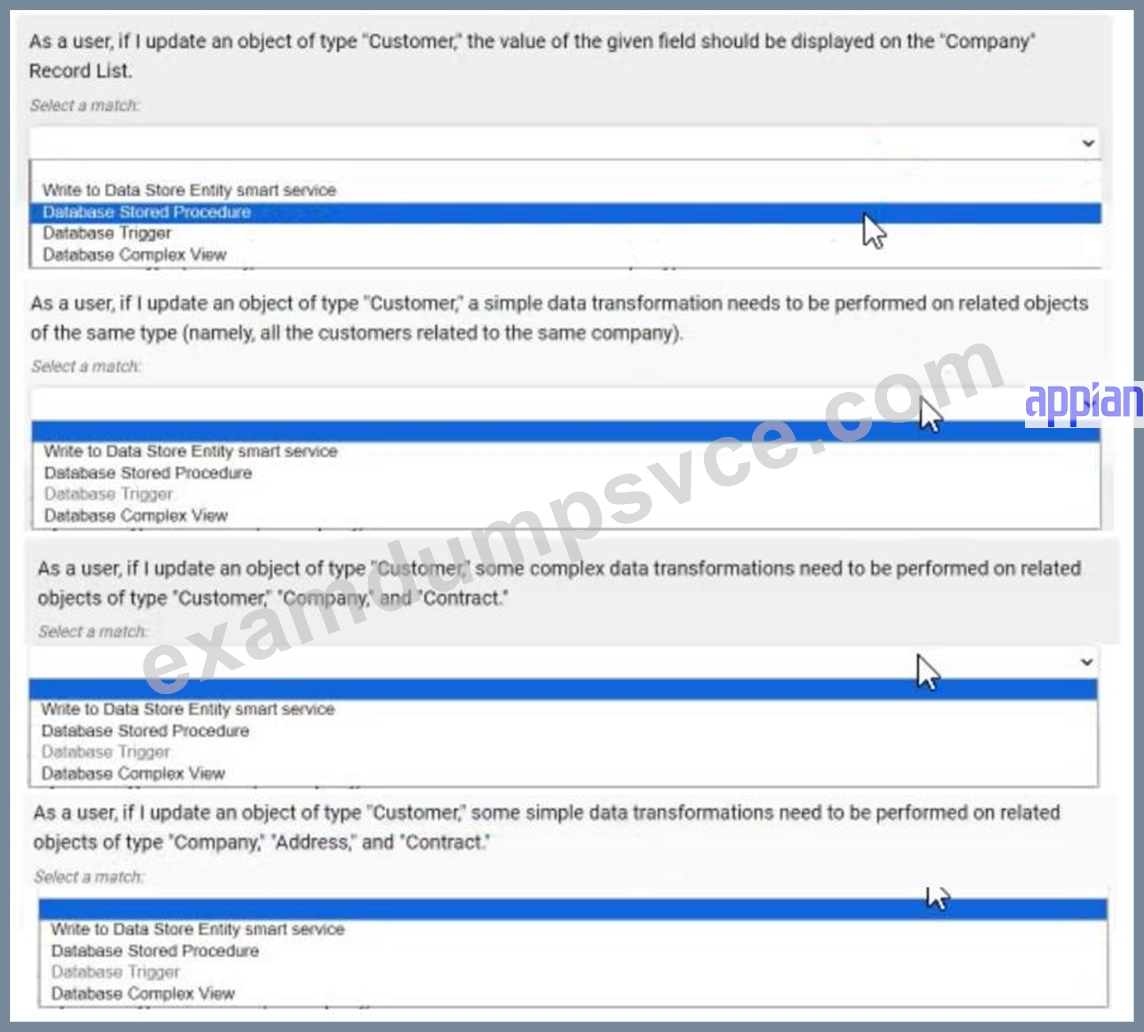
Answer:
Explanation: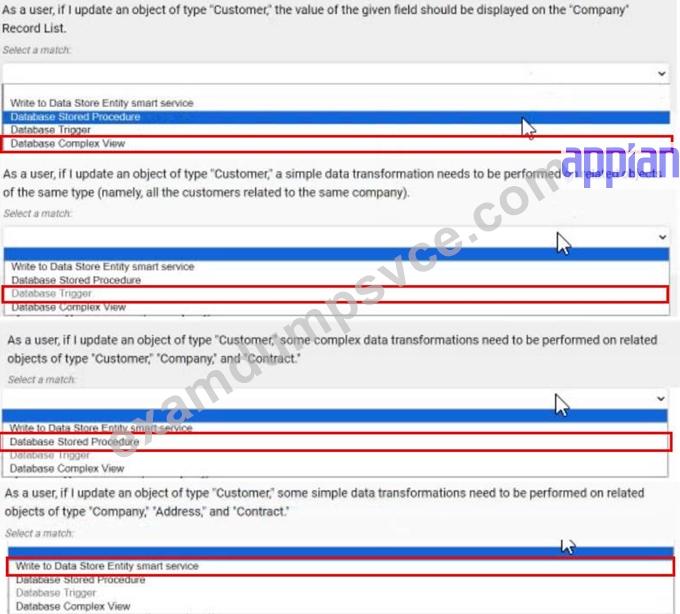
NEW QUESTION # 19
You need to export data using an out-of-the-box Appian smart service. Which two formats are available (or data generation?
- A. XML
- B. CSV
- C. JSDN
- D. Excel
Answer: B,D
Explanation:
The two formats that are available for data generation using an out-of-the-box Appian smart service are:
A . CSV. This is a comma-separated values format that can be used to export data in a tabular form, such as records, reports, or grids. CSV files can be easily opened and manipulated by spreadsheet applications such as Excel or Google Sheets.
C . Excel. This is a format that can be used to export data in a spreadsheet form, with multiple worksheets, formatting, formulas, charts, and other features. Excel files can be opened by Excel or other compatible applications.
The other options are incorrect for the following reasons:
B . XML. This is a format that can be used to export data in a hierarchical form, using tags and attributes to define the structure and content of the data. XML files can be opened by text editors or XML parsers, but they are not supported by the out-of-the-box Appian smart service for data generation.
D . JSON. This is a format that can be used to export data in a structured form, using objects and arrays to represent the data. JSON files can be opened by text editors or JSON parsers, but they are not supported by the out-of-the-box Appian smart service for data generation. Verified Reference: Appian Documentation, section "Write to Data Store Entity" and "Write to Multiple Data Store Entities".
NEW QUESTION # 20
You are tasked to build a large-scale acquisition application for a prominent customer. The acquisition process tracks the time it takes to fulfill a purchase request with an award.
The customer has structured the contract so that there are multiple application development teams.
How should you design for multiple processes and forms, while minimizing repeated code?
- A. Create a Center of Excellence (CoE).
- B. Create a common objects application.
- C. Create a Scrum of Scrums sprint meeting for the team leads.
- D. Create duplicate processes and forms as needed.
Answer: B
Explanation:
Comprehensive and Detailed In-Depth Explanation:As an Appian Lead Developer, designing a large-scale acquisition application with multiple development teams requires a strategy to manage processes, forms, and code reuse effectively. The goal is to minimize repeated code (e.g., duplicate interfaces, process models) while ensuring scalability and maintainability across teams. Let's evaluate each option:
* A. Create a Center of Excellence (CoE):A Center of Excellence is an organizational structure or team focused on standardizing practices, training, and governance across projects. While beneficial for long- term consistency, it doesn't directly address the technical design of minimizing repeated code for processes and forms. It's a strategic initiative, not a design solution, and doesn't solve the immediate need for code reuse. Appian's documentation mentions CoEs for governance but not as a primary design approach, making this less relevant here.
* B. Create a common objects application:This is the best recommendation. In Appian, a "common objects application" (or shared application) is used to store reusable components like expression rules, interfaces, process models, constants, and data types (e.g., CDTs). For a large-scale acquisition application with multiple teams, centralizing shared objects (e.g., rule!CommonForm, pm!
CommonProcess) ensures consistency, reduces duplication, and simplifies maintenance. Teams can reference these objects in their applications, adhering to Appian's design best practices for scalability.
This approach minimizes repeated code while allowing team-specific customizations, aligning with Lead Developer standards for large projects.
* C. Create a Scrum of Scrums sprint meeting for the team leads:A Scrum of Scrums meeting is a coordination mechanism for Agile teams, focusing on aligning sprint goals and resolving cross-team dependencies. While useful for collaboration, it doesn't address the technical design of minimizing repeated code-it's a process, not a solution for codereuse. Appian's Agile methodologies support such meetings, but they don't directly reduce duplication in processes and forms, making this less applicable.
* D. Create duplicate processes and forms as needed:Duplicating processes and forms (e.g., copying interface!PurchaseForm for each team) leads to redundancy, increased maintenance effort, and potential inconsistencies (e.g., divergent logic). This contradicts the goal of minimizing repeated code and violates Appian's design principles for reusability and efficiency. Appian's documentation strongly discourages duplication, favoring shared objects instead, making this the least effective option.
Conclusion: Creating a common objects application (B) is the recommended design. It centralizes reusable processes, forms, and other components, minimizing code duplication across teams while ensuring consistency and scalability for the large-scale acquisition application. This leverages Appian's application architecture for shared resources, aligning with Lead Developer best practices for multi-team projects.
References:
* Appian Documentation: "Designing Large-Scale Applications" (Common Application for Reusable Objects).
* Appian Lead Developer Certification: Application Design Module (Minimizing Code Duplication).
* Appian Best Practices: "Managing Multi-Team Development" (Shared Objects Strategy).
To build a large scale acquisition application for a prominent customer, you should design for multiple processes and forms, while minimizing repeated code. One way to do this is to create a common objects application, which is a shared application that contains reusable components, such as rules, constants, interfaces, integrations, or data types, that can be used by multiple applications. This way, you can avoid duplication and inconsistency of code, and make it easier to maintain and update your applications. You can also use the common objects application to define common standards and best practices for your application development teams, such as naming conventions, coding styles, or documentation guidelines. Verified References: [Appian Best Practices], [Appian Design Guidance]
NEW QUESTION # 21
You are required to create an integration from your Appian Cloud instance to an application hosted within a customer's self-managed environment.
The customer's IT team has provided you with a REST API endpoint to test with: https://internal.network/api/api/ping.
Which recommendation should you make to progress this integration?
- A. Set up a VPN tunnel.
- B. Expose the API as a SOAP-based web service.
- C. Deploy the API/service into Appian Cloud.
- D. Add Appian Cloud's IP address ranges to the customer network's allowed IP listing.
Answer: A
Explanation:
Comprehensive and Detailed In-Depth Explanation:
As an Appian Lead Developer, integrating an Appian Cloud instance with a customer's self-managed (on-premises) environment requires addressing network connectivity, security, and Appian's cloud architecture constraints. The provided endpoint (https://internal.network/api/api/ping) is a REST API on an internal network, inaccessible directly from Appian Cloud due to firewall restrictions and lack of public exposure. Let's evaluate each option:
A . Expose the API as a SOAP-based web service:
Converting the REST API to SOAP isn't a practical recommendation. The customer has provided a REST endpoint, and Appian fully supports REST integrations via Connected Systems and Integration objects. Changing the API to SOAP adds unnecessary complexity, development effort, and risks for the customer, with no benefit to Appian's integration capabilities. Appian's documentation emphasizes using the API's native format (REST here), making this irrelevant.
B . Deploy the API/service into Appian Cloud:
Deploying the customer's API into Appian Cloud is infeasible. Appian Cloud is a managed PaaS environment, not designed to host customer applications or APIs. The API resides in the customer's self-managed environment, and moving it would require significant architectural changes, violating security and operational boundaries. Appian's integration strategy focuses on connecting to external systems, not hosting them, ruling this out.
C . Add Appian Cloud's IP address ranges to the customer network's allowed IP listing:
This approach involves whitelisting Appian Cloud's IP ranges (available in Appian documentation) in the customer's firewall to allow direct HTTP/HTTPS requests. However, Appian Cloud's IPs are dynamic and shared across tenants, making this unreliable for long-term integrations-changes in IP ranges could break connectivity. Appian's best practices discourage relying on IP whitelisting for cloud-to-on-premises integrations due to this limitation, favoring secure tunnels instead.
D . Set up a VPN tunnel:
This is the correct recommendation. A Virtual Private Network (VPN) tunnel establishes a secure, encrypted connection between Appian Cloud and the customer's self-managed network, allowing Appian to access the internal REST API (https://internal.network/api/api/ping). Appian supports VPNs for cloud-to-on-premises integrations, and this approach ensures reliability, security, and compliance with network policies. The customer's IT team can configure the VPN, and Appian's documentation recommends this for such scenarios, especially when dealing with internal endpoints.
Conclusion: Setting up a VPN tunnel (D) is the best recommendation. It enables secure, reliable connectivity from Appian Cloud to the customer's internal API, aligning with Appian's integration best practices for cloud-to-on-premises scenarios.
Reference:
Appian Documentation: "Integrating Appian Cloud with On-Premises Systems" (VPN and Network Configuration).
Appian Lead Developer Certification: Integration Module (Cloud-to-On-Premises Connectivity).
Appian Best Practices: "Securing Integrations with Legacy Systems" (VPN Recommendations).
NEW QUESTION # 22
You need to generate a PDF document with specific formatting. Which approach would you recommend?
- A. Use the PDF from XSL-FO Transformation smart service to generate the content with the specific format.
- B. Use the Word Doc from Template smart service in a process model to add the specific format.
- C. Create an embedded interface with the necessary content and ask the user to use the browser "Print" functionality to save it as a PDF.
- D. There is no way to fulfill the requirement using Appian. Suggest sending the content as a plain email instead.
Answer: A
Explanation:
Comprehensive and Detailed In-Depth Explanation:
As an Appian Lead Developer, generating a PDF with specific formatting is a common requirement, and Appian provides several tools to achieve this. The question emphasizes "specific formatting," which implies precise control over layout, styling, and content structure. Let's evaluate each option based on Appian's official documentation and capabilities:
A . Create an embedded interface with the necessary content and ask the user to use the browser "Print" functionality to save it as a PDF:
This approach involves designing an interface (e.g., using SAIL components) and relying on the browser's native print-to-PDF feature. While this is feasible for simple content, it lacks precision for "specific formatting." Browser rendering varies across devices and browsers, and print styles (e.g., CSS) are limited in Appian's control. Appian Lead Developer best practices discourage relying on client-side functionality for critical document generation due to inconsistency and lack of automation. This is not a recommended solution for a production-grade requirement.
B . Use the PDF from XSL-FO Transformation smart service to generate the content with the specific format:
This is the correct choice. The "PDF from XSL-FO Transformation" smart service (available in Appian's process modeling toolkit) allows developers to generate PDFs programmatically with precise formatting using XSL-FO (Extensible Stylesheet Language Formatting Objects). XSL-FO provides fine-grained control over layout, fonts, margins, and styling-ideal for "specific formatting" requirements. In a process model, you can pass XML data and an XSL-FO stylesheet to this smart service, producing a downloadable PDF. Appian's documentation highlights this as the preferred method for complex PDF generation, making it a robust, scalable, and Appian-native solution.
C . Use the Word Doc from Template smart service in a process model to add the specific format:
This option uses the "Word Doc from Template" smart service to generate a Microsoft Word document from a template (e.g., a .docx file with placeholders). While it supports formatting defined in the template and can be converted to PDF post-generation (e.g., via a manual step or external tool), it's not a direct PDF solution. Appian doesn't natively convert Word to PDF within the platform, requiring additional steps outside the process model. For "specific formatting" in a PDF, this is less efficient and less precise than the XSL-FO approach, as Word templates are better suited for editable documents rather than final PDFs.
D . There is no way to fulfill the requirement using Appian. Suggest sending the content as a plain email instead:
This is incorrect. Appian provides multiple tools for document generation, including PDFs, as evidenced by options B and C. Suggesting a plain email fails to meet the requirement of generating a formatted PDF and contradicts Appian's capabilities. Appian Lead Developer training emphasizes leveraging platform features to meet business needs, ruling out this option entirely.
Conclusion: The PDF from XSL-FO Transformation smart service (B) is the recommended approach. It provides direct PDF generation with specific formatting control within Appian's process model, aligning with best practices for document automation and precision. This method is scalable, repeatable, and fully supported by Appian's architecture.
Reference:
Appian Documentation: "PDF from XSL-FO Transformation Smart Service" (Process Modeling > Smart Services).
Appian Lead Developer Certification: Document Generation Module (PDF Generation Techniques).
Appian Best Practices: "Generating Documents in Appian" (XSL-FO vs. Template-Based Approaches).
NEW QUESTION # 23
You are running an inspection as part of the first deployment process from TEST to PROD. You receive a notice that one of your objects will not deploy because it is dependent on an object from an application owned by a separate team.
What should be your next step?
- A. Halt the production deployment and contact the other team for guidance on promoting the object to PROD.
- B. Check the dependencies of the necessary object. Deploy to PROD if there are few dependencies and it is low risk.
- C. Push a functionally viable package to PROD without the dependencies, and plan the rest of the deployment accordingly with the other team's constraints.
- D. Create your own object with the same code base, replace the dependent object in the application, and deploy to PROD.
Answer: A
Explanation:
Comprehensive and Detailed In-Depth Explanation:As an Appian Lead Developer, managing a deployment from TEST to PROD requires careful handling of dependencies, especially when objects from another team's application are involved. The scenario describes a dependency issue during deployment, signaling a need for collaboration and governance. Let's evaluate each option:
* A. Create your own object with the same code base, replace the dependent object in the application, and deploy to PROD:This approach involves duplicating the object, which introduces redundancy, maintenance risks, and potential version control issues. It violates Appian's governance principles, as objects should be owned and managed by their respective teams to ensure consistency and avoid conflicts. Appian's deployment best practices discourage duplicating objects unless absolutely necessary, making this an unsustainable and risky solution.
* B. Halt the production deployment and contact the other team for guidance on promoting the object to PROD:This is the correct step. When an object from another application (owned by a separate team) is a dependency, Appian's deployment process requires coordination to ensure both applications' objects are deployed in sync. Halting the deployment prevents partial deployments that could break functionality, and contacting the other team aligns with Appian's collaboration and governance guidelines. The other team can provide the necessary object version, adjust their deployment timeline, or resolve the dependency, ensuring a stable PROD environment.
* C. Check the dependencies of the necessary object. Deploy to PROD if there are few dependencies and it is low risk:This approach risks deploying an incomplete or unstable application if the dependency isn' t fully resolved. Even with "few dependencies" and "low risk," deploying without the other team's object could lead to runtime errors or broken functionality in PROD. Appian's documentation emphasizes thorough dependency management during deployment, requiring all objects (including those from other applications) to be promoted together, making this risky and not recommended.
* D. Push a functionally viable package to PROD without the dependencies, and plan the rest of the deployment accordingly with the other team's constraints:Deploying without dependencies creates an incomplete solution, potentially leaving the application non-functional or unstable in PROD. Appian's deployment process ensures all dependencies are included to maintain application integrity, and partial deployments are discouraged unless explicitly planned (e.g., phased rollouts). This option delays resolution and increases risk, contradicting Appian's best practices for Production stability.
Conclusion: Halting the production deployment and contacting the other team for guidance (B) is the next step. It ensures proper collaboration, aligns with Appian's governance model, and prevents deployment errors, providing a safe and effective resolution.
References:
* Appian Documentation: "Deployment Best Practices" (Managing Dependencies Across Applications).
* Appian Lead Developer Certification: Application Management Module (Cross-Team Collaboration).
* Appian Best Practices: "Handling Production Deployments" (Dependency Resolution).
NEW QUESTION # 24
An existing integration is implemented in Appian. Its role is to send data for the main case and its related objects in a complex JSON to a REST API, to insert new information into an existing application. This integration was working well for a while. However, the customer highlighted one specific scenario where the integration failed in Production, and the API responded with a 500 Internal Error code. The project is in Post-Production Maintenance, and the customer needs your assistance. Which three steps should you take to troubleshoot the issue?
- A. Send the same payload to the test API to ensure the issue is not related to the API environment.
- B. Ensure there were no network issues when the integration was sent.
- C. Obtain the JSON sent to the API and validate that there is no difference between the expected JSON format and the sent one.
- D. Analyze the behavior of subsequent calls to the Production API to ensure there is no global issue, and ask the customer to analyze the API logs to understand the nature of the issue.
- E. Send a test case to the Production API to ensure the service is still up and running.
Answer: A,C,D
Explanation:
Comprehensive and Detailed In-Depth Explanation:
As an Appian Lead Developer in a Post-Production Maintenance phase, troubleshooting a failed integration (HTTP 500 Internal Server Error) requires a systematic approach to isolate the root cause-whether it's Appian-side, API-side, or environmental. A 500 error typically indicates an issue on the server (API) side, but the developer must confirm Appian's contribution and collaborate with the customer. The goal is to select three steps that efficiently diagnose the specific scenario while adhering to Appian's best practices. Let's evaluate each option:
A . Send the same payload to the test API to ensure the issue is not related to the API environment:
This is a critical step. Replicating the failure by sending the exact payload (from the failed Production call) to a test API environment helps determine if the issue is environment-specific (e.g., Production-only configuration) or inherent to the payload/API logic. Appian's Integration troubleshooting guidelines recommend testing in a non-Production environment first to isolate variables. If the test API succeeds, the Production environment or API state is implicated; if it fails, the payload or API logic is suspect. This step leverages Appian's Integration object logging (e.g., request/response capture) and is a standard diagnostic practice.
B . Send a test case to the Production API to ensure the service is still up and running:
While verifying Production API availability is useful, sending an arbitrary test case risks further Production disruption during maintenance and may not replicate the specific scenario. A generic test might succeed (e.g., with simpler data), masking the issue tied to the complex JSON. Appian's Post-Production guidelines discourage unnecessary Production interactions unless replicating the exact failure is controlled and justified. This step is less precise than analyzing existing behavior (C) and is not among the top three priorities.
C . Analyze the behavior of subsequent calls to the Production API to ensure there is no global issue, and ask the customer to analyze the API logs to understand the nature of the issue:
This is essential. Reviewing subsequent Production calls (via Appian's Integration logs or monitoring tools) checks if the 500 error is isolated or systemic (e.g., API outage). Since Appian can't access API server logs, collaborating with the customer to review their logs is critical for a 500 error, which often stems from server-side exceptions (e.g., unhandled data). Appian Lead Developer training emphasizes partnership with API owners and using Appian's Process History or Application Monitoring to correlate failures-making this a key troubleshooting step.
D . Obtain the JSON sent to the API and validate that there is no difference between the expected JSON format and the sent one:
This is a foundational step. The complex JSON payload is central to the integration, and a 500 error could result from malformed data (e.g., missing fields, invalid types) that the API can't process. In Appian, you can retrieve the sent JSON from the Integration object's execution logs (if enabled) or Process Instance details. Comparing it against the API's documented schema (e.g., via Postman or API specs) ensures Appian's output aligns with expectations. Appian's documentation stresses validating payloads as a first-line check for integration failures, especially in specific scenarios.
E . Ensure there were no network issues when the integration was sent:
While network issues (e.g., timeouts, DNS failures) can cause integration errors, a 500 Internal Server Error indicates the request reached the API and triggered a server-side failure-not a network issue (which typically yields 503 or timeout errors). Appian's Connected System logs can confirm HTTP status codes, and network checks (e.g., via IT teams) are secondary unless connectivity is suspected. This step is less relevant to the 500 error and lower priority than A, C, and D.
Conclusion: The three best steps are A (test API with same payload), C (analyze subsequent calls and customer logs), and D (validate JSON payload). These steps systematically isolate the issue-testing Appian's output (D), ruling out environment-specific problems (A), and leveraging customer insights into the API failure (C). This aligns with Appian's Post-Production Maintenance strategies: replicate safely, analyze logs, and validate data.
Reference:
Appian Documentation: "Troubleshooting Integrations" (Integration Object Logging and Debugging).
Appian Lead Developer Certification: Integration Module (Post-Production Troubleshooting).
Appian Best Practices: "Handling REST API Errors in Appian" (500 Error Diagnostics).
NEW QUESTION # 25
You are asked to design a case management system for a client. In addition to storing some basic metadata about a case, one of the client's requirements is the ability for users to update a case. The client would like any user in their organization of 500 people to be able to make these updates. The users are all based in the company's headquarters, and there will be frequent cases where users are attempting to edit the same case. The client wants to ensure no information is lost when these edits occur and does not want the solution to burden their process administrators with any additional effort. Which data locking approach should you recommend?
- A. Design a process report and query to determine who opened the edit form first.
- B. Add an @Version annotation to the case CDT to manage the locking.
- C. Use the database to implement low-level pessimistic locking.
- D. Allow edits without locking the case CDI.
Answer: B
Explanation:
Comprehensive and Detailed In-Depth Explanation:
The requirement involves a case management system where 500 users may simultaneously edit the same case, with a need to prevent data loss and minimize administrative overhead. Appian's data management and concurrency control strategies are critical here, especially when integrating with an underlying database.
Option C (Add an @Version annotation to the case CDT to manage the locking):
This is the recommended approach. In Appian, the @Version annotation on a Custom Data Type (CDT) enables optimistic locking, a lightweight concurrency control mechanism. When a user updates a case, Appian checks the version number of the CDT instance. If another user has modified it in the meantime, the update fails, prompting the user to refresh and reapply changes. This prevents data loss without requiring manual intervention by process administrators. Appian's Data Design Guide recommends @Version for scenarios with high concurrency (e.g., 500 users) and frequent edits, as it leverages the database's native versioning (e.g., in MySQL or PostgreSQL) and integrates seamlessly with Appian's process models. This aligns with the client's no-burden requirement.
Option A (Allow edits without locking the case CDI):
This is risky. Without locking, simultaneous edits could overwrite each other, leading to data loss-a direct violation of the client's requirement. Appian does not recommend this for collaborative environments.
Option B (Use the database to implement low-level pessimistic locking):
Pessimistic locking (e.g., using SELECT ... FOR UPDATE in MySQL) locks the record during the edit process, preventing other users from modifying it until the lock is released. While effective, it can lead to deadlocks or performance bottlenecks with 500 users, especially if edits are frequent. Additionally, managing this at the database level requires custom SQL and increases administrative effort (e.g., monitoring locks), which the client wants to avoid. Appian prefers higher-level solutions like @Version over low-level database locking.
Option D (Design a process report and query to determine who opened the edit form first):
This is impractical and inefficient. Building a custom report and query to track form opens adds complexity and administrative overhead. It doesn't inherently prevent data loss and relies on manual resolution, conflicting with the client's requirements.
The @Version annotation provides a robust, Appian-native solution that balances concurrency, data integrity, and ease of maintenance, making it the best fit.
NEW QUESTION # 26
You need to generate a PDF document with specific formatting. Which approach would you recommend?
- A. Use the PDF from XSL-FO Transformation smart service to generate the content with the specific format.
- B. Use the Word Doc from Template smart service in a process model to add the specific format.
- C. Create an embedded interface with the necessary content and ask the user to use the browser "Print" functionality to save it as a PDF.
- D. There is no way to fulfill the requirement using Appian. Suggest sending the content as a plain email instead.
Answer: A
Explanation:
Comprehensive and Detailed In-Depth Explanation:As an Appian Lead Developer, generating a PDF with specific formatting is a common requirement, and Appian provides several tools to achieve this. The question emphasizes "specific formatting," which implies precise control over layout, styling, and content structure.
Let's evaluate each option based on Appian's official documentation and capabilities:
* A. Create an embedded interface with the necessary content and ask the user to use the browser "Print" functionality to save it as a PDF:This approach involves designing an interface (e.g., using SAIL components) and relying on the browser's native print-to-PDF feature. While this is feasible for simple content, it lacks precision for "specific formatting." Browser rendering varies across devices and browsers, and print styles (e.g., CSS) are limited in Appian's control. Appian Lead Developer best practices discouragerelying on client-side functionality for critical document generation due to inconsistency and lack of automation. This is not a recommended solution for a production-grade requirement.
* B. Use the PDF from XSL-FO Transformation smart service to generate the content with the specific format:This is the correct choice. The "PDF from XSL-FO Transformation" smart service (available in Appian's process modeling toolkit) allows developers to generate PDFs programmatically with precise formatting using XSL-FO (Extensible Stylesheet Language Formatting Objects). XSL-FO provides fine- grained control over layout, fonts, margins, and styling-ideal for "specific formatting" requirements.
In a process model, you can pass XML data and an XSL-FO stylesheet to this smart service, producing a downloadable PDF. Appian's documentation highlights this as the preferred method for complex PDF generation, making it a robust, scalable, and Appian-native solution.
* C. Use the Word Doc from Template smart service in a process model to add the specific format:This option uses the "Word Doc from Template" smart service to generate a Microsoft Word document from a template (e.g., a .docx file with placeholders). While it supports formatting defined in the template and can be converted to PDF post-generation (e.g., via a manual step or external tool), it's not a direct PDF solution. Appian doesn't natively convert Word to PDF within the platform, requiring additional steps outside the process model. For "specific formatting" in a PDF, this is less efficient and less precise than the XSL-FO approach, as Word templates are better suited for editable documents rather than final PDFs.
* D. There is no way to fulfill the requirement using Appian. Suggest sending the content as a plain email instead:This is incorrect. Appian provides multiple tools for document generation, including PDFs, as evidenced by options B and C. Suggesting a plain email fails to meet the requirement of generating a formatted PDF and contradicts Appian's capabilities. Appian Lead Developer training emphasizes leveraging platform features to meet business needs, ruling out this option entirely.
Conclusion: The PDF from XSL-FO Transformation smart service (B) is the recommended approach. It provides direct PDF generation with specific formatting control within Appian's process model, aligning with best practices for document automation and precision. This method is scalable, repeatable, and fully supported by Appian's architecture.
References:
* Appian Documentation: "PDF from XSL-FO Transformation Smart Service" (Process Modeling > Smart Services).
* Appian Lead Developer Certification: Document Generation Module (PDF Generation Techniques).
* Appian Best Practices: "Generating Documents in Appian" (XSL-FO vs. Template-Based Approaches).
NEW QUESTION # 27
You are the lead developer for an Appian project, in a backlog refinement meeting. You are presented with the following user story:
"As a restaurant customer, I need to be able to place my food order online to avoid waiting in line for takeout." Which two functional acceptance criteria would you consider 'good'?
- A. The user cannot submit the form without filling out all required fields.
- B. The system must handle up to 500 unique orders per day.
- C. The user will click Save, and the order information will be saved in the ORDER table and have audit history.
- D. The user will receive an email notification when their order is completed.
Answer: A,C
Explanation:
Comprehensive and Detailed In-Depth Explanation:As an Appian Lead Developer, defining "good" functional acceptance criteria for a user story requires ensuring they are specific, testable, and directly tied to the user's need (placing an online food order to avoid waiting in line). Good criteria focus on functionality, usability, and reliability, aligning with Appian's Agile and design best practices. Let's evaluate each option:
* A. The user will click Save, and the order information will be saved in the ORDER table and have audit history:This is a "good" criterion. It directly validates the core functionality of the user story-placing an order online. Saving order data in the ORDER table (likely via a process model or Data Store Entity) ensures persistence, and audit history (e.g., using Appian's audit logs or database triggers) tracks changes, supporting traceability and compliance. This is specific, testable (e.g., verify data in the table and logs), and essential for the user's goal, aligning with Appian's data management and user experience guidelines.
* B. The user will receive an email notification when their order is completed:While useful, this is a
"nice-to-have" enhancement, not a core requirement of the user story. The story focuses on placing an order online to avoid waiting, not on completion notifications. Email notifications add value but aren't essential for validating the primary functionality. Appian's user story best practices prioritize criteria tied to the main user need, making this secondary and not "good" in this context.
* C. The system must handle up to 500 unique orders per day:This is a non-functional requirement (performance/scalability), not a functional acceptance criterion. It describes system capacity, not specific user behavior or functionality. While important for design, it's not directly testable for the user story's outcome (placing an order) and isn't tied to the user's experience. Appian's Agile methodologies separate functional and non-functional requirements, making this less relevant as a
"good" criterion here.
* D. The user cannot submit the form without filling out all required fields:This is a "good" criterion. It ensures data integrity and usability by preventing incomplete orders, directly supporting the user's ability to place a valid online order. In Appian, this can be implemented using form validation (e.g., required attributes in SAIL interfaces or process model validations), making it specific, testable (e.g., verify form submission fails with missing fields), and critical for a reliable user experience. This aligns with Appian's UI design and user story validation standards.
Conclusion: The two "good" functional acceptance criteria are A (order saved with audit history) and D (required fields enforced). These directly validate the user story's functionality (placing a valid order online), are testable, and ensure a reliable, user-friendly experience-aligning with Appian's Agile and design best practices for user stories.
References:
* Appian Documentation: "Writing Effective User Stories and Acceptance Criteria" (Functional Requirements).
* Appian Lead Developer Certification: Agile Development Module (Acceptance Criteria Best Practices).
* Appian Best Practices: "Designing User Interfaces in Appian" (Form Validation and Data Persistence).
NEW QUESTION # 28
You are reviewing the Engine Performance Logs in Production for a single application that has been live for six months. This application experiences concurrent user activity and has a fairly sustained load during business hours. The client has reported performance issues with the application during business hours.
During your investigation, you notice a high Work Queue - Java Work Queue Size value in the logs. You also notice unattended process activities, including timer events and sending notification emails, are taking far longer to execute than normal.
The client increased the number of CPU cores prior to the application going live.
What is the next recommendation?
- A. Optimize slow-performing user interfaces.
- B. Add more application servers.
- C. Add execution and analytics shards
- D. Add more engine replicas.
Answer: D
Explanation:
As an Appian Lead Developer, analyzing Engine Performance Logs to address performance issues in a Production application requires understanding Appian's architecture and the specific metrics described. The scenario indicates a high "Work Queue - Java Work Queue Size," which reflects a backlog of tasks in the Java Work Queue (managed by Appian engines), and delays in unattended process activities (e.g., timer events, email notifications). These symptoms suggest the Appian engines are overloaded, despite the client increasing CPU cores. Let's evaluate each option:
* A. Add more engine replicas:This is the correct recommendation. In Appian, engine replicas (part of the Appian Engine cluster) handle process execution, including unattended tasks like timers and notifications. A high Java Work Queue Size indicates the engines are overwhelmed by concurrent activity during business hours, causing delays. Adding more engine replicas distributes the workload, reducing queue size and improving performance for both user-driven and unattended tasks. Appian's documentation recommends scaling engine replicas to handle sustained loads, especially in Production with high concurrency. SinceCPU cores were already increased (likely on application servers), the bottleneck is likely the engine capacity, not the servers.
* B. Optimize slow-performing user interfaces:While optimizing user interfaces (e.g., SAIL forms, reports) can improve user experience, the scenario highlights delays in unattended activities (timers, emails), not UI performance. The Java Work Queue Size issue points to engine-level processing, not UI rendering, so this doesn't address the root cause. Appian's performance tuning guidelines prioritize engine scaling for queue-related issues, making this a secondary concern.
* C. Add more application servers:Application servers handle web traffic (e.g., SAIL interfaces, API calls), not process execution or unattended tasks managed by engines. Increasing application servers would help with UI concurrency but wouldn't reduce the Java Work Queue Size or speed up timer
/email processing, as these are engine responsibilities. Since the client already increased CPU cores (likely on application servers), this is redundant and unrelated to the issue.
* D. Add execution and analytics shards:Execution shards (for process data) and analytics shards (for reporting) are part of Appian's data fabric for scalability, but they don't directly address engine workload or Java Work Queue Size. Shards optimize data storage and query performance, not real-time process execution. The logs indicate an engine bottleneck, not a data storage issue, so this isn't relevant.
Appian's documentation confirms shards are for long-term scaling, not immediate performance fixes.
Conclusion: Adding more engine replicas (A) is the next recommendation. It directly resolves the high Java Work Queue Size and delays in unattended tasks, aligning with Appian's architecture for handling concurrent loads in Production. This requires collaboration with system administrators to configure additional replicas in the Appian cluster.
References:
* Appian Documentation: "Engine Performance Monitoring" (Java Work Queue and Scaling Replicas).
* Appian Lead Developer Certification: Performance Optimization Module (Engine Scaling Strategies).
* Appian Best Practices: "Managing Production Performance" (Work Queue Analysis).
NEW QUESTION # 29
......
Accurate ACD301 Answers 365 Days Free Updates: https://braindump2go.examdumpsvce.com/ACD301-valid-exam-dumps.html
